Sun-Kundalini and Earth-Kundalini
Arundale describes Kundalini flowing between solar and terrestrial poles. Read his image of the Rod of Power and his tentative comparison with the Caduceus.
In this article
Understanding the concept
Sun-Kundalini and Earth-Kundalini are the two poles of the spiritual Fire in George S. Arundale’s Theosophical account. The human being is where a descending solar current and an ascending earthly current are supposed to meet. Arundale pictures their relation as a Rod of Power. [9][10]
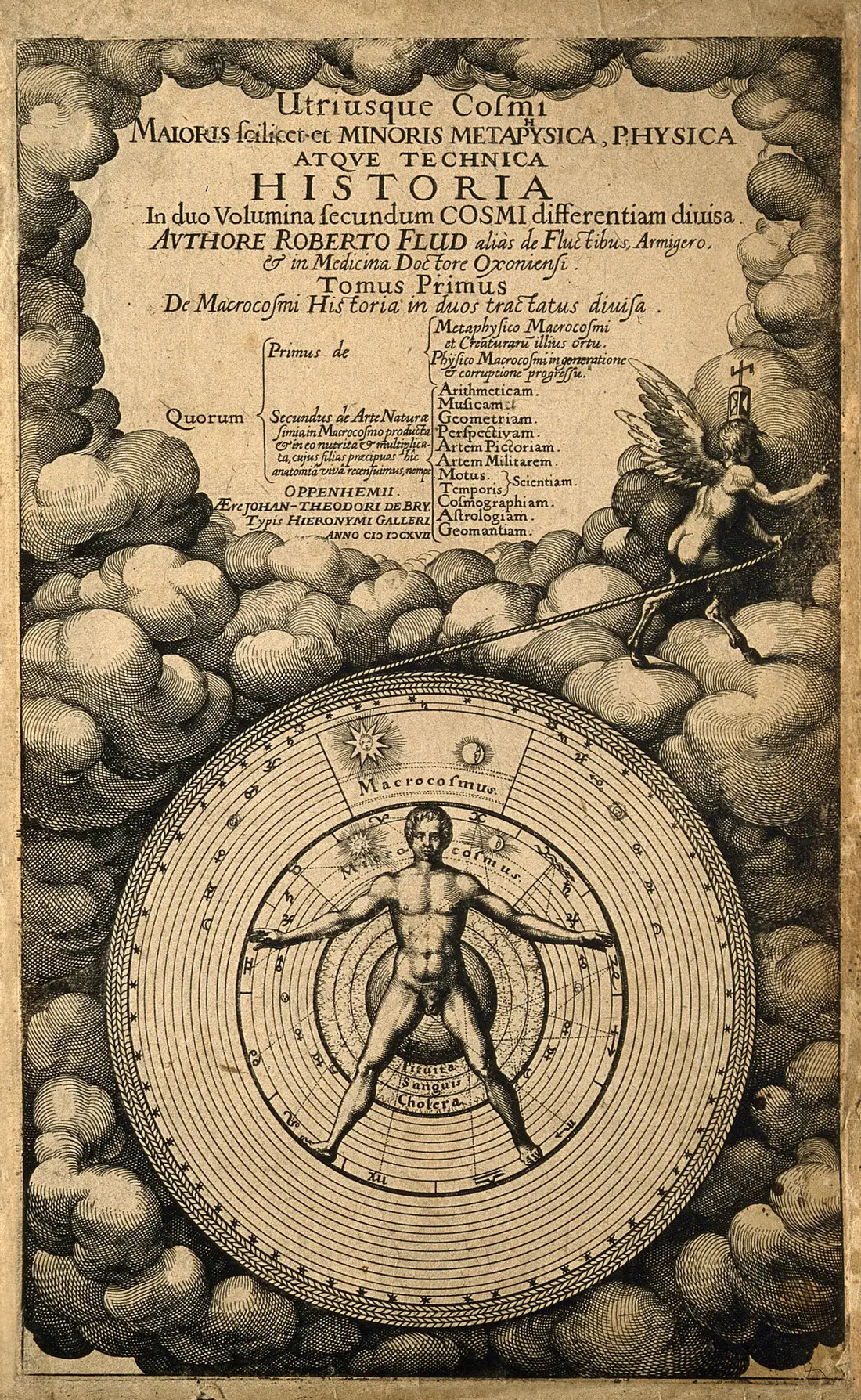
Theodor de Bry’s engraving for Robert Fludd, 1617, shows a human figure within the larger world. The print illustrates an older image of the person as a microcosm.
Wellcome Collection, 2989i. From Robert Fludd’s macrocosm and microcosm history; the collection attributes the engraving to T. de Bry. Public Domain Mark. Resized and converted to WebP without crop or recolouring. · Image source ↗ · Public Domain
Arundale’s two currents
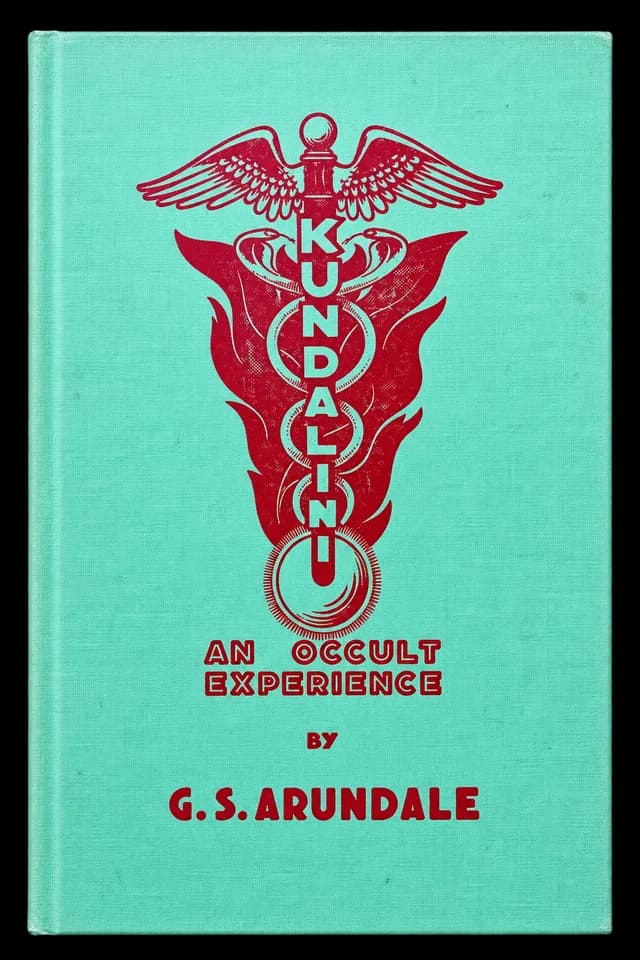
Kundalini: An Occult Experience by George S. Arundale
George S. Arundale’s music chapter pairs a cosmic Fire from the Sun with an individual Fire from the Earth. He pictures the Sun singing and the Earth answering. Individual people take part in the exchange. [13][14]
The Rod of Power and the Caduceus
Chapter 6 calls the Sun positive and the Earth negative, giving both an essential part in the polarity. The Rod of Power is a symbol of the two poles and a proposed focus for their force. Arundale places the meeting at the spinal base. He compares it to the confluence of the Yamuna and the Ganges, which proceed together after the meeting. [9][10]
Arundale also compares the Rod with the Caduceus, relating the latter’s central line and intertwining paths to Suṣumṇā, Iḍā and Piṅgalā. He considers a possible distinction between release and fulfilment and leaves the relationship unresolved. He likewise leaves open whether any centre has a chiefly solar or terrestrial role. [10][11]
The Library scan includes the passage from the music chapter and has a gap at chapter 6. The chapter 6 passages are cited to PDF leaves 21–24 of Benjamin Adamah’s 2009 transcription. [8][9][10][11]
See references (4)
- Kundalini: An Occult Experience, chapter 6, PDF leaf 21 of Benjamin Adamah’s 2009 digital transcription
- Kundalini: An Occult Experience, chapter 6, PDF leaf 22 of Benjamin Adamah’s 2009 digital transcription
- Kundalini: An Occult Experience, chapter 6, PDF leaf 23 of Benjamin Adamah’s 2009 digital transcription
- Kundalini: An Occult Experience, chapter 6, PDF leaf 24 of Benjamin Adamah’s 2009 digital transcription
Swedenborg’s spiritual sun
Heaven and Its Wonders and Hell by Emanuel Swedenborg
In Heaven and Its Wonders and Hell, Emanuel Swedenborg describes the Lord appearing as a spiritual sun. The appearance varies according to how divine love is received. He expressly distinguishes the spiritual sun from the one that lights the natural world. [1][2][3][4][5][6][7]
See references (7)
- Heaven and Its Wonders and Hell, printed p. 85, Reader page 92
- Heaven and Its Wonders and Hell, printed p. 86, Reader page 93
- Heaven and Its Wonders and Hell, printed p. 88, Reader page 95
- Heaven and Its Wonders and Hell, printed p. 89, Reader page 96
- Heaven and Its Wonders and Hell, printed p. 90, Reader page 97
- Heaven and Its Wonders and Hell, printed p. 91, Reader page 98
- Heaven and Its Wonders and Hell, printed p. 92, Reader page 99
Two meanings of a spiritual sun
Arundale’s solar pole works in relation to the Earth and to the person in whom their currents are said to meet. Swedenborg’s spiritual sun gives form to the presence of divine love and the angels’ reception of it. [1][2][3][4][5][6][7][13][9]
The Caduceus remains a comparison within Arundale’s account. The Rod represents a cosmic polarity, while the Caduceus raises questions for him about the related channels and the direction of their work. [10][11]
See references (11)
- Heaven and Its Wonders and Hell, printed p. 85, Reader page 92
- Heaven and Its Wonders and Hell, printed p. 86, Reader page 93
- Heaven and Its Wonders and Hell, printed p. 88, Reader page 95
- Heaven and Its Wonders and Hell, printed p. 89, Reader page 96
- Heaven and Its Wonders and Hell, printed p. 90, Reader page 97
- Heaven and Its Wonders and Hell, printed p. 91, Reader page 98
- Heaven and Its Wonders and Hell, printed p. 92, Reader page 99
- Kundalini: An Occult Experience, chapter 6, PDF leaf 22 of Benjamin Adamah’s 2009 digital transcription
- Kundalini: An Occult Experience, chapter 6, PDF leaf 23 of Benjamin Adamah’s 2009 digital transcription
- Kundalini: An Occult Experience, chapter 6, PDF leaf 24 of Benjamin Adamah’s 2009 digital transcription
- Kundalini: An Occult Experience, printed p. 97, Reader page 99
Read further in the library

Heaven and Its Wonders and Hell
Reading note
Separately attributed primary Library account, cited on exact verified Reader leaves.
Kundalini: An Occult Experience
Reading note
The separately titled account draws on exact passages in the consulted Library edition.
Sources
See references (14)
- Heaven and Its Wonders and Hell, printed p. 85, Reader page 92Emanuel Swedenborg, Heaven and Its Wonders and Hell, translated by J. C. Ager. The American Swedenborg Printing and Publishing Society, New York, 1916. Original Latin work first published in 1758.Read this page in Heaven and Its Wonders and Hell ↗Return to text ↑
- Heaven and Its Wonders and Hell, printed p. 86, Reader page 93Emanuel Swedenborg, Heaven and Its Wonders and Hell, translated by J. C. Ager. The American Swedenborg Printing and Publishing Society, New York, 1916. Original Latin work first published in 1758.Read this page in Heaven and Its Wonders and Hell ↗Return to text ↑
- Heaven and Its Wonders and Hell, printed p. 88, Reader page 95Emanuel Swedenborg, Heaven and Its Wonders and Hell, translated by J. C. Ager. The American Swedenborg Printing and Publishing Society, New York, 1916. Original Latin work first published in 1758.Read this page in Heaven and Its Wonders and Hell ↗Return to text ↑
- Heaven and Its Wonders and Hell, printed p. 89, Reader page 96Emanuel Swedenborg, Heaven and Its Wonders and Hell, translated by J. C. Ager. The American Swedenborg Printing and Publishing Society, New York, 1916. Original Latin work first published in 1758.Read this page in Heaven and Its Wonders and Hell ↗Return to text ↑
- Heaven and Its Wonders and Hell, printed p. 90, Reader page 97Emanuel Swedenborg, Heaven and Its Wonders and Hell, translated by J. C. Ager. The American Swedenborg Printing and Publishing Society, New York, 1916. Original Latin work first published in 1758.Read this page in Heaven and Its Wonders and Hell ↗Return to text ↑
- Heaven and Its Wonders and Hell, printed p. 91, Reader page 98Emanuel Swedenborg, Heaven and Its Wonders and Hell, translated by J. C. Ager. The American Swedenborg Printing and Publishing Society, New York, 1916. Original Latin work first published in 1758.Read this page in Heaven and Its Wonders and Hell ↗Return to text ↑
- Heaven and Its Wonders and Hell, printed p. 92, Reader page 99Emanuel Swedenborg, Heaven and Its Wonders and Hell, translated by J. C. Ager. The American Swedenborg Printing and Publishing Society, New York, 1916. Original Latin work first published in 1758.Read this page in Heaven and Its Wonders and Hell ↗Return to text ↑
- Kundalini: An Occult Experience, chapter 6, PDF leaf 21 of Benjamin Adamah’s 2009 digital transcription ↗George S. Arundale’s chapter 6 consulted in Benjamin Adamah’s 2009 digital transcription. Exact PDF leaf, not a printed 1938 page or a Library Reader PageRef. This chapter body is absent from the retained Library source scan.Return to text ↑
- Kundalini: An Occult Experience, chapter 6, PDF leaf 22 of Benjamin Adamah’s 2009 digital transcription ↗George S. Arundale’s chapter 6 consulted in Benjamin Adamah’s 2009 digital transcription. Exact PDF leaf, not a printed 1938 page or a Library Reader PageRef. This chapter body is absent from the retained Library source scan.Return to text ↑
- Kundalini: An Occult Experience, chapter 6, PDF leaf 23 of Benjamin Adamah’s 2009 digital transcription ↗George S. Arundale’s chapter 6 consulted in Benjamin Adamah’s 2009 digital transcription. Exact PDF leaf, not a printed 1938 page or a Library Reader PageRef. This chapter body is absent from the retained Library source scan.Return to text ↑
- Kundalini: An Occult Experience, chapter 6, PDF leaf 24 of Benjamin Adamah’s 2009 digital transcription ↗George S. Arundale’s chapter 6 consulted in Benjamin Adamah’s 2009 digital transcription. Exact PDF leaf, not a printed 1938 page or a Library Reader PageRef. This chapter body is absent from the retained Library source scan.Return to text ↑
- Robert Fludd, macrocosm and microcosm title-page engraving, 1617; Wellcome Collection 2989i ↗Wellcome Collection, 2989i. From Robert Fludd’s macrocosm and microcosm history; the collection attributes the engraving to T. de Bry. Current primary collection record designates Public Domain Mark.
- Kundalini: An Occult Experience, printed p. 97, Reader page 99George S. Arundale, Kundalini: An Occult Experience, The Theosophical Publishing House, Adyar, Madras, India, 1938. Consulted Library edition IMJ-0227-E001.Read this page in Kundalini: An Occult Experience ↗Return to text ↑
- Kundalini: An Occult Experience, printed p. 98, Reader page 100George S. Arundale, Kundalini: An Occult Experience, The Theosophical Publishing House, Adyar, Madras, India, 1938. Consulted Library edition IMJ-0227-E001.Read this page in Kundalini: An Occult Experience ↗Return to text ↑