Stone, plant and animal contemplation
In Steiner’s exercise, stone, animal and plant prompt three kinds of attention. Read why he uses a crystal and what he means by spiritual colour.
In this article
Understanding the concept
Stone, plant and animal contemplation compares the responses evoked by three kinds of natural form. Rudolf Steiner puts the exercise in esoteric enlightenment, the stage of training in which he says the student first perceives spiritual light and colour. [1][2][3][4]
Knowledge of the Higher Worlds by Rudolf Steiner
Rudolf Steiner begins with a stone and an animal. Both have form, and he takes the animal’s ability to move of its own accord as a sign of instinct or desire. He invites the student to think and feel the difference between the forces he believes shape the two. A clear crystal can serve as the stone. A footnote makes clear that the exercise is a comparison rather than a search for visions in the crystal. [1][2]
He introduces a plant after the student has attended to the feelings produced by stone and animal. The response to the plant falls between the other two in Steiner’s account. He describes spiritual blue or blue-red for stone, red or red-yellow for animal, and green tending toward light pink for plant. He gives these as broad ranges with many possible variations. [2][3][5]
Steiner expects the student to retain a keen eye for physical reality and become more receptive to nature’s beauty and to the lives of other beings. He counts a loss of sympathy or powers of observation as a problem in the practice. [6]
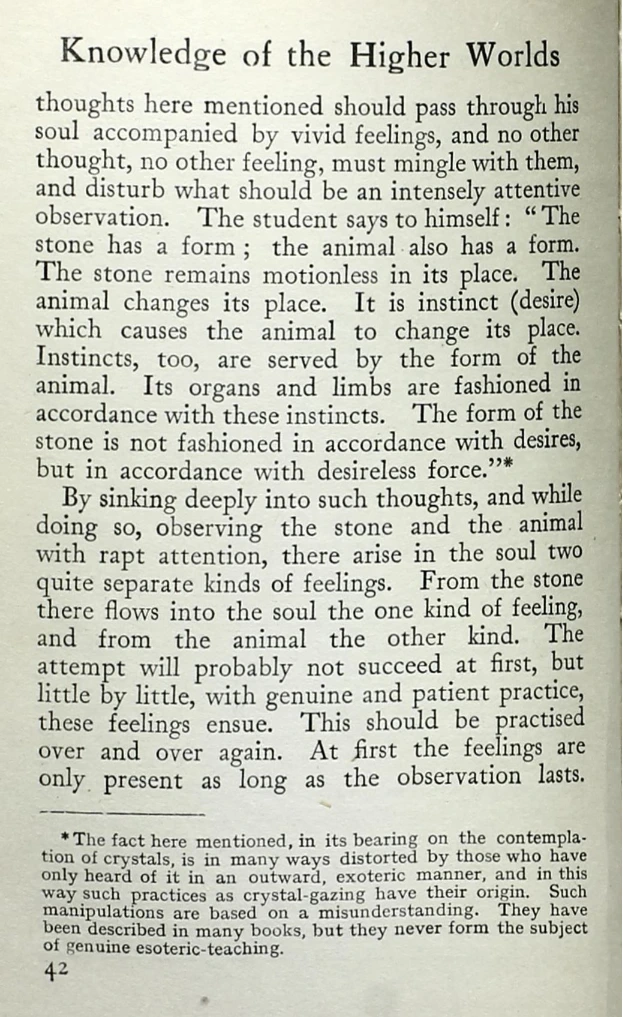
The stone and animal comparison includes a note explaining why the exercise differs from crystal-gazing. Knowledge of the Higher Worlds, printed p. 42, Library reader p. 46.
Rudolf Steiner, G. Metaxa translation, edited by Harry Collison. Historical public-domain source facsimile from the exact checksum-verified Library edition. Repository date 1932; the inspected title page is undated. · Image source ↗ · Public Domain
See references (5)
- Knowledge of the Higher Worlds and Its Attainment, Reader page 45
- Knowledge of the Higher Worlds and Its Attainment, Reader page 46
- Knowledge of the Higher Worlds and Its Attainment, Reader page 47
- Knowledge of the Higher Worlds and Its Attainment, Reader page 48
- Knowledge of the Higher Worlds and Its Attainment, Reader page 49
Three kinds of form or one possible future
Steiner’s seed meditation also begins with an object kept in view. There the question is how a future plant can be present as a possibility. In this exercise he asks the student to compare the kinds of feeling already evoked by a stone, a plant and an animal. [2][3][5][7][8][9]
See references (6)
- Knowledge of the Higher Worlds and Its Attainment, Reader page 46
- Knowledge of the Higher Worlds and Its Attainment, Reader page 47
- Knowledge of the Higher Worlds and Its Attainment, Reader page 48
- Knowledge of the Higher Worlds and Its Attainment, Reader page 53
- Knowledge of the Higher Worlds and Its Attainment, Reader page 54
- Knowledge of the Higher Worlds and Its Attainment, Reader page 59
Read further in the library

Knowledge of the Higher Worlds and Its Attainment
Reading note
The separately titled account draws on exact passages in the consulted Library edition.
Sources
See references (9)
- Knowledge of the Higher Worlds and Its Attainment, Reader page 45Rudolf Steiner, Knowledge of the Higher Worlds and Its Attainment, authorized English translation by G. Metaxa, edited by Harry Collison, Anthroposophic Press, New York City. Exact Library edition IMJ-0513-E001. No publication year is visible on the inspected title page; the repository assigns 1932. Claims of supersensible perception remain attributed to Steiner.Read this page in Knowledge of the Higher Worlds and Its Attainment ↗Return to text ↑
- Knowledge of the Higher Worlds and Its Attainment, Reader page 46Rudolf Steiner, Knowledge of the Higher Worlds and Its Attainment, authorized English translation by G. Metaxa, edited by Harry Collison, Anthroposophic Press, New York City. Exact Library edition IMJ-0513-E001. No publication year is visible on the inspected title page; the repository assigns 1932. Claims of supersensible perception remain attributed to Steiner.Read this page in Knowledge of the Higher Worlds and Its Attainment ↗Return to text ↑
- Knowledge of the Higher Worlds and Its Attainment, Reader page 47Rudolf Steiner, Knowledge of the Higher Worlds and Its Attainment, authorized English translation by G. Metaxa, edited by Harry Collison, Anthroposophic Press, New York City. Exact Library edition IMJ-0513-E001. No publication year is visible on the inspected title page; the repository assigns 1932. Claims of supersensible perception remain attributed to Steiner.Read this page in Knowledge of the Higher Worlds and Its Attainment ↗Return to text ↑
- Knowledge of the Higher Worlds and Its Attainment, Reader page 32Rudolf Steiner, Knowledge of the Higher Worlds and Its Attainment, authorized English translation by G. Metaxa, edited by Harry Collison, Anthroposophic Press, New York City. Exact Library edition IMJ-0513-E001. No publication year is visible on the inspected title page; the repository assigns 1932. Claims of supersensible perception remain attributed to Steiner.Read this page in Knowledge of the Higher Worlds and Its Attainment ↗Return to text ↑
- Knowledge of the Higher Worlds and Its Attainment, Reader page 48Rudolf Steiner, Knowledge of the Higher Worlds and Its Attainment, authorized English translation by G. Metaxa, edited by Harry Collison, Anthroposophic Press, New York City. Exact Library edition IMJ-0513-E001. No publication year is visible on the inspected title page; the repository assigns 1932. Claims of supersensible perception remain attributed to Steiner.Read this page in Knowledge of the Higher Worlds and Its Attainment ↗Return to text ↑
- Knowledge of the Higher Worlds and Its Attainment, Reader page 49Rudolf Steiner, Knowledge of the Higher Worlds and Its Attainment, authorized English translation by G. Metaxa, edited by Harry Collison, Anthroposophic Press, New York City. Exact Library edition IMJ-0513-E001. No publication year is visible on the inspected title page; the repository assigns 1932. Claims of supersensible perception remain attributed to Steiner.Read this page in Knowledge of the Higher Worlds and Its Attainment ↗Return to text ↑
- Knowledge of the Higher Worlds and Its Attainment, Reader page 53Rudolf Steiner, Knowledge of the Higher Worlds and Its Attainment, authorized English translation by G. Metaxa, edited by Harry Collison, Anthroposophic Press, New York City. Exact Library edition IMJ-0513-E001. No publication year is visible on the inspected title page; the repository assigns 1932. Claims of supersensible perception remain attributed to Steiner.Read this page in Knowledge of the Higher Worlds and Its Attainment ↗Return to text ↑
- Knowledge of the Higher Worlds and Its Attainment, Reader page 54Rudolf Steiner, Knowledge of the Higher Worlds and Its Attainment, authorized English translation by G. Metaxa, edited by Harry Collison, Anthroposophic Press, New York City. Exact Library edition IMJ-0513-E001. No publication year is visible on the inspected title page; the repository assigns 1932. Claims of supersensible perception remain attributed to Steiner.Read this page in Knowledge of the Higher Worlds and Its Attainment ↗Return to text ↑
- Knowledge of the Higher Worlds and Its Attainment, Reader page 59Rudolf Steiner, Knowledge of the Higher Worlds and Its Attainment, authorized English translation by G. Metaxa, edited by Harry Collison, Anthroposophic Press, New York City. Exact Library edition IMJ-0513-E001. No publication year is visible on the inspected title page; the repository assigns 1932. Claims of supersensible perception remain attributed to Steiner.Read this page in Knowledge of the Higher Worlds and Its Attainment ↗Return to text ↑