Seed meditation
Steiner’s seed meditation asks what a living seed can become. Read his exercise and compare the banyan-seed lesson in the Chandogya Upanishad.
In this article
Understanding the concept
Seed meditation uses the difference between a living seed and a convincing imitation as an object of contemplation. They may look alike, but only one can become a plant. Rudolf Steiner starts from this difference to ask how an unseen possibility can become an object of attention. [2][3][4]
Steiner’s seed exercise
Knowledge of the Higher Worlds by Rudolf Steiner
Rudolf Steiner asks the student to look at an actual seed, observing its shape and colour before imagining the plant it could become with soil and light. An artificial copy might pass for the real thing to the eye. A footnote acknowledges that a microscope could distinguish them, then returns to his interest in what the student can bring to mind through the comparison. [2][3]
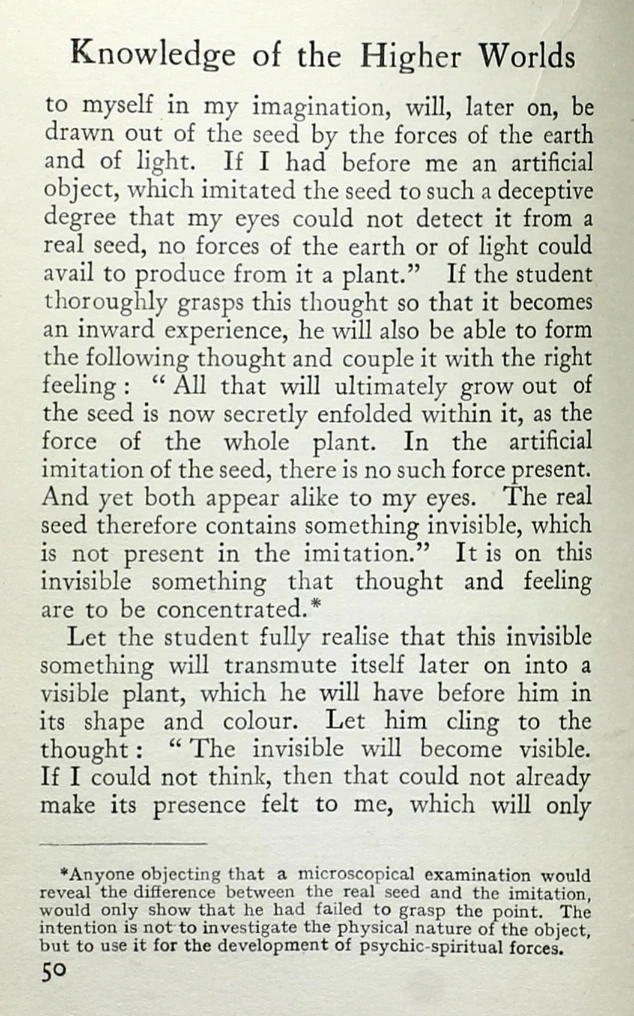
Steiner compares a real seed with an artificial one. Knowledge of the Higher Worlds, printed p. 50, Library reader p. 54.
Rudolf Steiner, G. Metaxa translation, edited by Harry Collison. Historical public-domain source facsimile from the exact checksum-verified Library edition. Repository date 1932; the inspected title page is undated. · Image source ↗ · Public Domain
The colours of seed and plant
In inner tranquillity, the thought is supposed to become a distinct feeling. Steiner describes a flame-like impression with a lilac centre and a bluish edge. He compares the experience to the feeling evoked by a physical colour. [4]
The next exercise starts with a full-grown plant that will wither and leave seeds. Steiner gives the ensuing impression a greenish-blue centre and a yellowish-red edge. He asks the student to keep using a real object and to exercise ordinary judgement throughout. He regards a picture produced by imagination alone as easy to mistake for what he calls a supersensible perception. [5][6][7][4][8]
See references (5)
- Knowledge of the Higher Worlds and Its Attainment, Reader page 55
- Knowledge of the Higher Worlds and Its Attainment, Reader page 57
- Knowledge of the Higher Worlds and Its Attainment, Reader page 56
- Knowledge of the Higher Worlds and Its Attainment, Reader page 58
- Knowledge of the Higher Worlds and Its Attainment, Reader page 59
The banyan seed
The Chandogya Upanishad: the banyan seed
In Chandogya Upanishad VI.12, Uddalaka asks his son Svetaketu to break open a banyan fruit and then one of its tiny seeds. The son sees nothing inside. In F. Max Müller’s translation, his father uses the tree’s unseen essence to teach about the Self and tells him, “thou, O Svetaketu, art it.” [1]
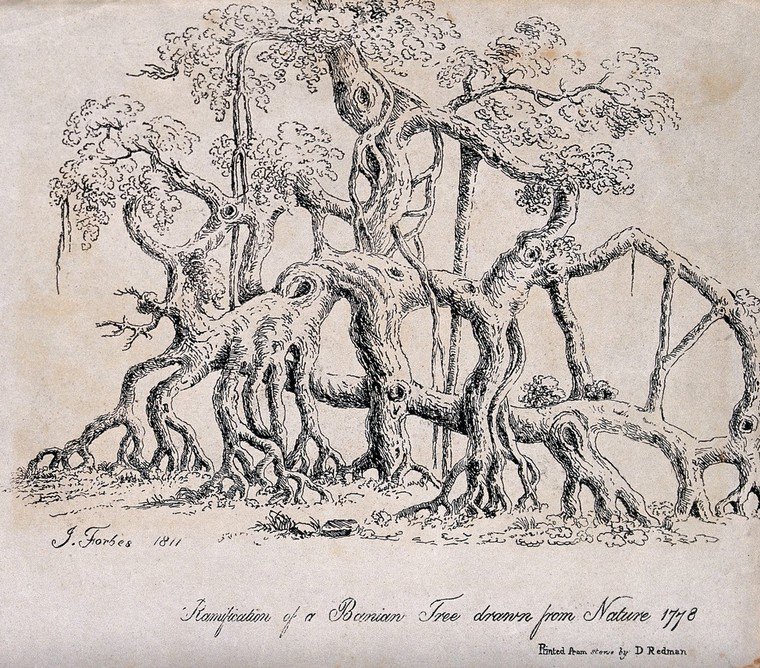
A mature banyan with spreading aerial roots, drawn by James Forbes in 1778 and reproduced in W. Stoker’s 1811 lithograph. The Upanishadic dialogue starts with one of the tree’s tiny seeds.
Wellcome Collection, 20052i, image V0043038. W. Stoker after James Forbes; printed by D. Redman, 1811. Public Domain Mark; resized and converted to JPEG. · Image source ↗ · Public Domain
What the seed helps explain
The Upanishad uses the seed to teach a father’s lesson about the Self. Steiner uses the visible seed to give a student something concrete from which to develop an inward exercise. The resemblance is strongest at the start: an ordinary object prompts a question about something the observer cannot yet see. [1][3][4][6]
Read further in the library
Knowledge of the Higher Worlds and Its Attainment
Reading note
The separately titled account draws on exact passages in the consulted Library edition.
Sources
See references (9)
- Chandogya Upanishad VI.12, F. Max Müller translation, printed p. 104 ↗Chandogya Upanishad VI.12.1–3, in F. Max Müller’s The Upanishads, Part I, Sacred Books of the East I (1879), printed p. 104. Consulted transcription tied to the scanned page. Printed page is not a Lumitheca Reader leaf.Return to text ↑
- Knowledge of the Higher Worlds and Its Attainment, Reader page 53Rudolf Steiner, Knowledge of the Higher Worlds and Its Attainment, authorized English translation by G. Metaxa, edited by Harry Collison, Anthroposophic Press, New York City. Exact Library edition IMJ-0513-E001. No publication year is visible on the inspected title page; the repository assigns 1932. Claims of supersensible perception remain attributed to Steiner.Read this page in Knowledge of the Higher Worlds and Its Attainment ↗Return to text ↑
- Knowledge of the Higher Worlds and Its Attainment, Reader page 54Rudolf Steiner, Knowledge of the Higher Worlds and Its Attainment, authorized English translation by G. Metaxa, edited by Harry Collison, Anthroposophic Press, New York City. Exact Library edition IMJ-0513-E001. No publication year is visible on the inspected title page; the repository assigns 1932. Claims of supersensible perception remain attributed to Steiner.Read this page in Knowledge of the Higher Worlds and Its Attainment ↗Return to text ↑
- Knowledge of the Higher Worlds and Its Attainment, Reader page 55Rudolf Steiner, Knowledge of the Higher Worlds and Its Attainment, authorized English translation by G. Metaxa, edited by Harry Collison, Anthroposophic Press, New York City. Exact Library edition IMJ-0513-E001. No publication year is visible on the inspected title page; the repository assigns 1932. Claims of supersensible perception remain attributed to Steiner.Read this page in Knowledge of the Higher Worlds and Its Attainment ↗Return to text ↑
- Knowledge of the Higher Worlds and Its Attainment, Reader page 57Rudolf Steiner, Knowledge of the Higher Worlds and Its Attainment, authorized English translation by G. Metaxa, edited by Harry Collison, Anthroposophic Press, New York City. Exact Library edition IMJ-0513-E001. No publication year is visible on the inspected title page; the repository assigns 1932. Claims of supersensible perception remain attributed to Steiner.Read this page in Knowledge of the Higher Worlds and Its Attainment ↗Return to text ↑
- Knowledge of the Higher Worlds and Its Attainment, Reader page 56Rudolf Steiner, Knowledge of the Higher Worlds and Its Attainment, authorized English translation by G. Metaxa, edited by Harry Collison, Anthroposophic Press, New York City. Exact Library edition IMJ-0513-E001. No publication year is visible on the inspected title page; the repository assigns 1932. Claims of supersensible perception remain attributed to Steiner.Read this page in Knowledge of the Higher Worlds and Its Attainment ↗Return to text ↑
- Knowledge of the Higher Worlds and Its Attainment, Reader page 58Rudolf Steiner, Knowledge of the Higher Worlds and Its Attainment, authorized English translation by G. Metaxa, edited by Harry Collison, Anthroposophic Press, New York City. Exact Library edition IMJ-0513-E001. No publication year is visible on the inspected title page; the repository assigns 1932. Claims of supersensible perception remain attributed to Steiner.Read this page in Knowledge of the Higher Worlds and Its Attainment ↗Return to text ↑
- Knowledge of the Higher Worlds and Its Attainment, Reader page 59Rudolf Steiner, Knowledge of the Higher Worlds and Its Attainment, authorized English translation by G. Metaxa, edited by Harry Collison, Anthroposophic Press, New York City. Exact Library edition IMJ-0513-E001. No publication year is visible on the inspected title page; the repository assigns 1932. Claims of supersensible perception remain attributed to Steiner.Read this page in Knowledge of the Higher Worlds and Its Attainment ↗Return to text ↑
- Banyan tree (Ficus benghalensis L.) with many trunks, 1811, after a drawing of 1778 ↗Wellcome Collection, 20052i, image V0043038. W. Stoker after James Forbes; printed by D. Redman, 1811. Public Domain Mark; resized and converted to JPEG.