Inner tranquillity
Inner tranquillity is the steadiness to see experience in perspective. Compare Steiner’s quiet daily review with Vivekananda’s ideal of composure during work.
In this article
Understanding the concept
Inner tranquillity is the steadiness that lets a person examine an experience after its first emotional force has passed. In Rudolf Steiner’s training, a brief daily review is meant to help the student distinguish what matters from what merely feels urgent. [3][4][5][6]
Knowledge of the Higher Worlds by Rudolf Steiner
Rudolf Steiner asks the student to set aside a short part of the day and review past joys, sorrows and actions as if they belonged to someone else. He compares that change of vantage point to climbing a hill and finally seeing the shape of the country one has spent the day walking through. He suggests starting with past misfortunes, where distance is already possible. [3][4][5]
Five minutes is his example for someone with little spare time. He measures progress through changes in ordinary life: an insult has less power to throw the student off course, or a delay becomes a chance to observe what is around them. [4][7][8][9]
Steiner calls the further aim the awakening of a higher being within the student. The quiet interval is supposed to strengthen the student’s ability to meet ordinary duties. [6][9][7][10]
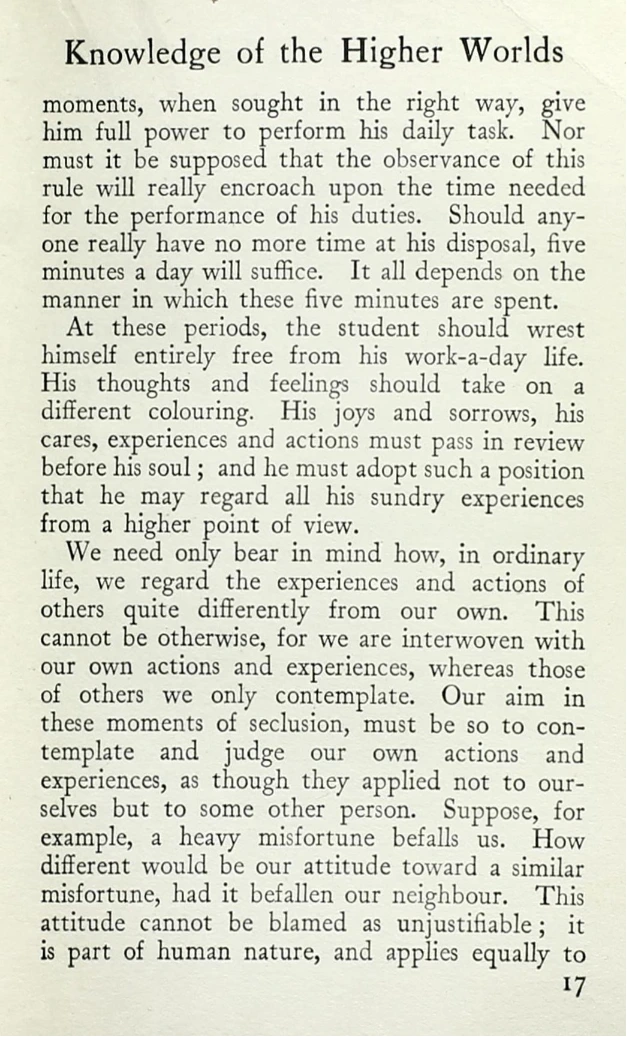
The student is asked to look back on a personal experience as an observer. Knowledge of the Higher Worlds, printed p. 17, Library reader p. 21.
Rudolf Steiner, G. Metaxa translation, edited by Harry Collison. Historical public-domain source facsimile from the exact checksum-verified Library edition. Repository date 1932; the inspected title page is undated. · Image source ↗ · Public Domain
See references (8)
- Knowledge of the Higher Worlds and Its Attainment, Reader page 20
- Knowledge of the Higher Worlds and Its Attainment, Reader page 21
- Knowledge of the Higher Worlds and Its Attainment, Reader page 22
- Knowledge of the Higher Worlds and Its Attainment, Reader page 23
- Knowledge of the Higher Worlds and Its Attainment, Reader page 26
- Knowledge of the Higher Worlds and Its Attainment, Reader page 24
- Knowledge of the Higher Worlds and Its Attainment, Reader page 25
- Knowledge of the Higher Worlds and Its Attainment, Reader page 27
Karma-Yoga by Swami Vivekananda
Swami Vivekananda pictures someone walking through a crowded city with the stillness of a person alone in a desert or cave. He makes that composure part of his ideal of work. The city matters to the image because the person carries the stillness into activity. [1][2]
See references (2)
Stillness during work and after it
Vivekananda places calm in the middle of action. Steiner begins after the event, when a person has the distance to see it in perspective. For Steiner, the value of the exercise becomes apparent when someone returns to work with more room to choose a response. [1][2][4][6]
Steiner also moves from reviewing a particular life to meditation on matters that reach beyond it. In his account, looking back on the events of a day offers a starting point for that further work. [5][10][11][12]
See references (8)
- Karma-Yoga, Reader page 14
- Karma-Yoga, Reader page 15
- Knowledge of the Higher Worlds and Its Attainment, Reader page 21
- Knowledge of the Higher Worlds and Its Attainment, Reader page 22
- Knowledge of the Higher Worlds and Its Attainment, Reader page 23
- Knowledge of the Higher Worlds and Its Attainment, Reader page 27
- Knowledge of the Higher Worlds and Its Attainment, Reader page 28
- Knowledge of the Higher Worlds and Its Attainment, Reader page 29
Read further in the library

Karma Yoga
Reading note
Separately attributed primary Library account, cited on exact verified Reader leaves.

Knowledge of the Higher Worlds and Its Attainment
Reading note
The separately titled account draws on exact passages in the consulted Library edition.
Sources
See references (12)
- Karma-Yoga, Reader page 14Swami Vivekananda, Karma-Yoga, in Karma-Yoga & Bhakti-Yoga, English second printing, Ramakrishna-Vivekananda Center of New York, Inc., 1939. Exact Library edition IMJ-0097-E002. Only the Karma-Yoga part is used in this crawl; the old Work slug mentioning Hindi does not identify this edition’s language.Read this page in Karma Yoga ↗Return to text ↑
- Karma-Yoga, Reader page 15Swami Vivekananda, Karma-Yoga, in Karma-Yoga & Bhakti-Yoga, English second printing, Ramakrishna-Vivekananda Center of New York, Inc., 1939. Exact Library edition IMJ-0097-E002. Only the Karma-Yoga part is used in this crawl; the old Work slug mentioning Hindi does not identify this edition’s language.Read this page in Karma Yoga ↗Return to text ↑
- Knowledge of the Higher Worlds and Its Attainment, Reader page 20Rudolf Steiner, Knowledge of the Higher Worlds and Its Attainment, authorized English translation by G. Metaxa, edited by Harry Collison, Anthroposophic Press, New York City. Exact Library edition IMJ-0513-E001. No publication year is visible on the inspected title page; the repository assigns 1932. Claims of supersensible perception remain attributed to Steiner.Read this page in Knowledge of the Higher Worlds and Its Attainment ↗Return to text ↑
- Knowledge of the Higher Worlds and Its Attainment, Reader page 21Rudolf Steiner, Knowledge of the Higher Worlds and Its Attainment, authorized English translation by G. Metaxa, edited by Harry Collison, Anthroposophic Press, New York City. Exact Library edition IMJ-0513-E001. No publication year is visible on the inspected title page; the repository assigns 1932. Claims of supersensible perception remain attributed to Steiner.Read this page in Knowledge of the Higher Worlds and Its Attainment ↗Return to text ↑
- Knowledge of the Higher Worlds and Its Attainment, Reader page 22Rudolf Steiner, Knowledge of the Higher Worlds and Its Attainment, authorized English translation by G. Metaxa, edited by Harry Collison, Anthroposophic Press, New York City. Exact Library edition IMJ-0513-E001. No publication year is visible on the inspected title page; the repository assigns 1932. Claims of supersensible perception remain attributed to Steiner.Read this page in Knowledge of the Higher Worlds and Its Attainment ↗Return to text ↑
- Knowledge of the Higher Worlds and Its Attainment, Reader page 23Rudolf Steiner, Knowledge of the Higher Worlds and Its Attainment, authorized English translation by G. Metaxa, edited by Harry Collison, Anthroposophic Press, New York City. Exact Library edition IMJ-0513-E001. No publication year is visible on the inspected title page; the repository assigns 1932. Claims of supersensible perception remain attributed to Steiner.Read this page in Knowledge of the Higher Worlds and Its Attainment ↗Return to text ↑
- Knowledge of the Higher Worlds and Its Attainment, Reader page 26Rudolf Steiner, Knowledge of the Higher Worlds and Its Attainment, authorized English translation by G. Metaxa, edited by Harry Collison, Anthroposophic Press, New York City. Exact Library edition IMJ-0513-E001. No publication year is visible on the inspected title page; the repository assigns 1932. Claims of supersensible perception remain attributed to Steiner.Read this page in Knowledge of the Higher Worlds and Its Attainment ↗Return to text ↑
- Knowledge of the Higher Worlds and Its Attainment, Reader page 24Rudolf Steiner, Knowledge of the Higher Worlds and Its Attainment, authorized English translation by G. Metaxa, edited by Harry Collison, Anthroposophic Press, New York City. Exact Library edition IMJ-0513-E001. No publication year is visible on the inspected title page; the repository assigns 1932. Claims of supersensible perception remain attributed to Steiner.Read this page in Knowledge of the Higher Worlds and Its Attainment ↗Return to text ↑
- Knowledge of the Higher Worlds and Its Attainment, Reader page 25Rudolf Steiner, Knowledge of the Higher Worlds and Its Attainment, authorized English translation by G. Metaxa, edited by Harry Collison, Anthroposophic Press, New York City. Exact Library edition IMJ-0513-E001. No publication year is visible on the inspected title page; the repository assigns 1932. Claims of supersensible perception remain attributed to Steiner.Read this page in Knowledge of the Higher Worlds and Its Attainment ↗Return to text ↑
- Knowledge of the Higher Worlds and Its Attainment, Reader page 27Rudolf Steiner, Knowledge of the Higher Worlds and Its Attainment, authorized English translation by G. Metaxa, edited by Harry Collison, Anthroposophic Press, New York City. Exact Library edition IMJ-0513-E001. No publication year is visible on the inspected title page; the repository assigns 1932. Claims of supersensible perception remain attributed to Steiner.Read this page in Knowledge of the Higher Worlds and Its Attainment ↗Return to text ↑
- Knowledge of the Higher Worlds and Its Attainment, Reader page 28Rudolf Steiner, Knowledge of the Higher Worlds and Its Attainment, authorized English translation by G. Metaxa, edited by Harry Collison, Anthroposophic Press, New York City. Exact Library edition IMJ-0513-E001. No publication year is visible on the inspected title page; the repository assigns 1932. Claims of supersensible perception remain attributed to Steiner.Read this page in Knowledge of the Higher Worlds and Its Attainment ↗Return to text ↑
- Knowledge of the Higher Worlds and Its Attainment, Reader page 29Rudolf Steiner, Knowledge of the Higher Worlds and Its Attainment, authorized English translation by G. Metaxa, edited by Harry Collison, Anthroposophic Press, New York City. Exact Library edition IMJ-0513-E001. No publication year is visible on the inspected title page; the repository assigns 1932. Claims of supersensible perception remain attributed to Steiner.Read this page in Knowledge of the Higher Worlds and Its Attainment ↗Return to text ↑