Spiritual touch
Spiritual touch is the ability to feel contact attributed to a spiritual body. Compare A. M. Griffen’s reported encounter with Swedenborg’s account of sensation.
In this article
Understanding spiritual touch
Spiritual touch is the capacity to feel contact attributed to a spiritual body. In afterlife writing it can explain why an embrace feels substantial to someone whose body is said to have changed. [1][2]
A. M. Griffen describes contact that depends on what he touches. His hands are said to pass through the bedclothes but to feel his deceased father. The contrast matters to his explanation of how the sense works. [1]
The Encyclopaedia of Death and Life, Volume I, compiled by J. R. Francis
J. R. Francis reprints A. M. Griffen’s recollection of retiring for the night, becoming unable to move and then being unaware for a time. Griffen says he embraced his deceased father using arms he understood as spiritual, while his physical arms remained inactive. [3][1]
His spiritual hands pass through his bedclothes as though nothing were there. His father’s spiritual body, in contrast, gives an exceptionally vivid sensation when touched. He interprets that selectivity as a property of spiritual perception. [1]
Griffen takes the sense of contact as a starting point for a wider idea. He calls touch the spirit’s primary intelligent sense and gives sight a related role. He also says his observations are too few to work out a spiritual biology. [2]
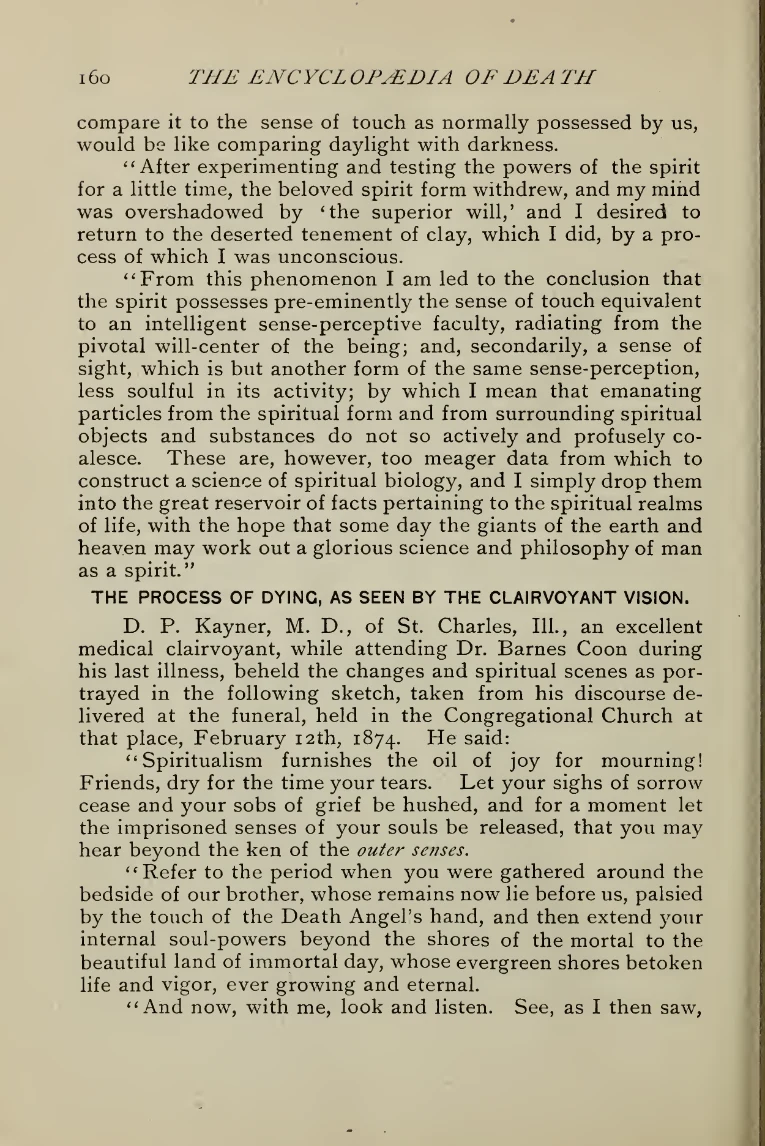
Source facsimile: The Encyclopaedia of Death and Life in the Spirit-World, Volume I (1903), printed p. 160, Reader page 159.
The Encyclopaedia of Death and Life in the Spirit-World, Volume I, fourth edition, 1903. Public-domain historical page extracted from the checksum-verified Library PDF. · Image source ↗ · Public Domain
See references (3)
Heaven and Its Wonders and Hell by Emanuel Swedenborg
Emanuel Swedenborg describes a surviving person as fully human in form and sensation. His argument requires a substantial spiritual subject capable of perceiving, rather than a formless remnant of thought. He distinguishes spiritual senses and their objects from natural perception. [4][5][6][7][8]
See references (5)
- Heaven and Its Wonders and Hell, printed p. 372, Reader page 379
- Heaven and Its Wonders and Hell, printed p. 373, Reader page 380
- Heaven and Its Wonders and Hell, printed p. 374, Reader page 381
- Heaven and Its Wonders and Hell, printed p. 388, Reader page 395
- Heaven and Its Wonders and Hell, printed p. 391, Reader page 398
The embrace and the theory of sensation
Griffen reports an embrace and then asks how a hand could feel a person while passing through cloth. His explanation of the order of the senses is a further step, and he recognises the small number of observations he has to work with. [1][2]
Swedenborg starts from the claim that a surviving person retains a human form and senses. Griffen starts with what felt different in one encounter. Touch serves as part of a larger account of personhood in one case, and as a particular experience to explain in the other. [4][5][6][7][8][1][2]
See references (7)
- The Encyclopaedia of Death and Life in the Spirit-World, Volume I, printed p. 159, Reader page 158
- The Encyclopaedia of Death and Life in the Spirit-World, Volume I, printed p. 160, Reader page 159
- Heaven and Its Wonders and Hell, printed p. 372, Reader page 379
- Heaven and Its Wonders and Hell, printed p. 373, Reader page 380
- Heaven and Its Wonders and Hell, printed p. 374, Reader page 381
- Heaven and Its Wonders and Hell, printed p. 388, Reader page 395
- Heaven and Its Wonders and Hell, printed p. 391, Reader page 398
Read further in the library

The Encyclopaedia of Death and Life in the Spirit-World, Volume I
Reading note
The separately titled account draws on exact passages in the consulted Library edition.

Heaven and Its Wonders and Hell
Reading note
Separately attributed comparison with exact previously researched Library passages.
Sources
See references (8)
- The Encyclopaedia of Death and Life in the Spirit-World, Volume I, printed p. 159, Reader page 158J. R. Francis (compiler), The Encyclopaedia of Death and Life in the Spirit-World, Volume I, fourth edition. The Progressive Thinker Publishing House, Chicago, 1903. Individual authors, communicators and quoted sources identified in each account.Read this page in The Encyclopaedia of Death and Life in the Spirit-World, Volume I ↗Return to text ↑
- The Encyclopaedia of Death and Life in the Spirit-World, Volume I, printed p. 160, Reader page 159J. R. Francis (compiler), The Encyclopaedia of Death and Life in the Spirit-World, Volume I, fourth edition. The Progressive Thinker Publishing House, Chicago, 1903. Individual authors, communicators and quoted sources identified in each account.Read this page in The Encyclopaedia of Death and Life in the Spirit-World, Volume I ↗Return to text ↑
- The Encyclopaedia of Death and Life in the Spirit-World, Volume I, printed p. 158, Reader page 157J. R. Francis (compiler), The Encyclopaedia of Death and Life in the Spirit-World, Volume I, fourth edition. The Progressive Thinker Publishing House, Chicago, 1903. Individual authors, communicators and quoted sources identified in each account.Read this page in The Encyclopaedia of Death and Life in the Spirit-World, Volume I ↗Return to text ↑
- Heaven and Its Wonders and Hell, printed p. 372, Reader page 379Emanuel Swedenborg, Heaven and Its Wonders and Hell, translated by J. C. Ager. The American Swedenborg Printing and Publishing Society, New York, 1916. Original Latin work first published in 1758.Read this page in Heaven and Its Wonders and Hell ↗Return to text ↑
- Heaven and Its Wonders and Hell, printed p. 373, Reader page 380Emanuel Swedenborg, Heaven and Its Wonders and Hell, translated by J. C. Ager. The American Swedenborg Printing and Publishing Society, New York, 1916. Original Latin work first published in 1758.Read this page in Heaven and Its Wonders and Hell ↗Return to text ↑
- Heaven and Its Wonders and Hell, printed p. 374, Reader page 381Emanuel Swedenborg, Heaven and Its Wonders and Hell, translated by J. C. Ager. The American Swedenborg Printing and Publishing Society, New York, 1916. Original Latin work first published in 1758.Read this page in Heaven and Its Wonders and Hell ↗Return to text ↑
- Heaven and Its Wonders and Hell, printed p. 388, Reader page 395Emanuel Swedenborg, Heaven and Its Wonders and Hell, translated by J. C. Ager. The American Swedenborg Printing and Publishing Society, New York, 1916. Original Latin work first published in 1758.Read this page in Heaven and Its Wonders and Hell ↗Return to text ↑
- Heaven and Its Wonders and Hell, printed p. 391, Reader page 398Emanuel Swedenborg, Heaven and Its Wonders and Hell, translated by J. C. Ager. The American Swedenborg Printing and Publishing Society, New York, 1916. Original Latin work first published in 1758.Read this page in Heaven and Its Wonders and Hell ↗Return to text ↑