Spiritual Respiration
Spiritual respiration is inward breathing in Swedenborg’s account of the spirit. Read how he links breath to thought and describes the passage after death.
In this article
Understanding the concept
Spiritual respiration is an inward breathing associated with thought and the continuing life of the spirit. Emanuel Swedenborg pairs it with the heart’s relation to affection. [1][2][3]
The idea has a place in his account of dying. He uses it to explain how thought could continue when breathing and the heartbeat no longer connect a person to the body. [3][4][5]
See references (5)
- Heaven and Its Wonders and Hell, printed p. 380, Reader page 387
- Heaven and Its Wonders and Hell, printed p. 381, Reader page 388
- Heaven and Its Wonders and Hell, printed p. 382, Reader page 389
- Heaven and Its Wonders and Hell, printed p. 383, Reader page 390
- Heaven and Its Wonders and Hell, printed p. 431, Reader page 438
Heaven and Its Wonders and Hell by Emanuel Swedenborg
Emanuel Swedenborg’s Heaven and Its Wonders and Hell places the relation in §§445–449. Bodily breathing and heartbeat form a bond through which spiritual life is expressed in the natural body. Death separates the person from that bodily service, while the spirit continues. [1][2]
In §449, Swedenborg says his bodily senses became nearly unresponsive while his thought remained clear. Breathing almost stopped, in his description, but he perceived an inward breath alongside a slight bodily one. He describes celestial angels sharing their thoughts with him. [3][4]
Swedenborg calls the drawing forth of the spirit resuscitation. The scene is his account of an experience he understood as resembling dying. The term refers to entry into spiritual life. [2][3][4]
Elsewhere he associates heavenly love with freer respiration and a fuller life within heaven. Breathing expresses fitness for a state. The explanation belongs to his relation between affection, thought and experienced surroundings. [5]
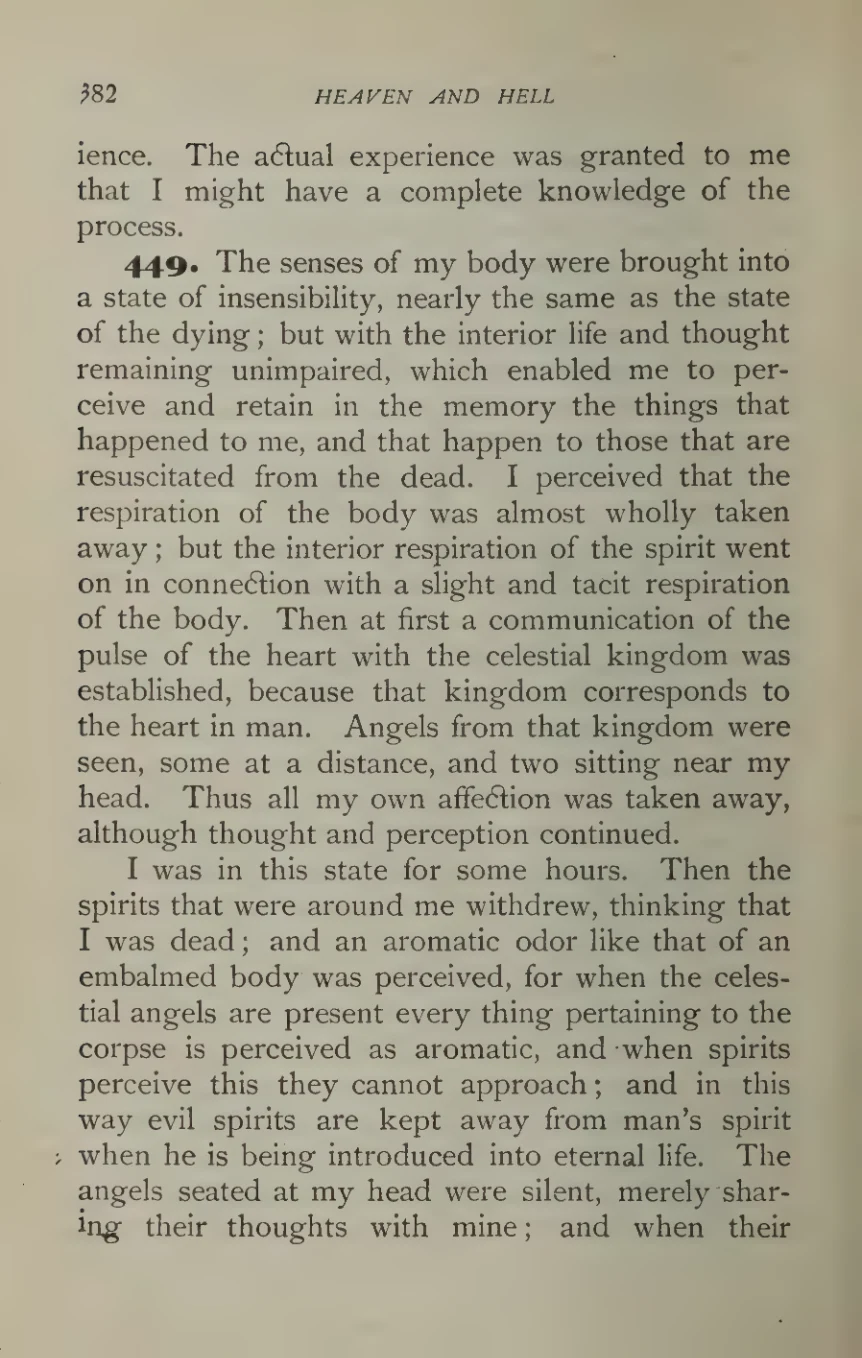
Heaven and Its Wonders and Hell (1916), printed p. 382, Library Reader page 389. Section 449 describes inward breathing alongside a faint bodily breath.
Emanuel Swedenborg, Heaven and Its Wonders and Hell, J. C. Ager translation, New York, 1916. Public-domain historical page from the checksum-verified Library PDF. · Image source ↗ · Public Domain
See references (5)
- Heaven and Its Wonders and Hell, printed p. 380, Reader page 387
- Heaven and Its Wonders and Hell, printed p. 381, Reader page 388
- Heaven and Its Wonders and Hell, printed p. 382, Reader page 389
- Heaven and Its Wonders and Hell, printed p. 383, Reader page 390
- Heaven and Its Wonders and Hell, printed p. 431, Reader page 438
Evolution of Immortality by Rosicruciæ, catalogued as F. B. Dowd
Freeman Benjamin Dowd, writing as Rosicruciæ, interprets divine breath as energy illuminating an inward centre. He also describes the earth’s supposed inhalation and exhalation through magnetic and electrical currents, extending one creative pattern between person and planet. [6][7][8][9]
What breath explains in each book
Swedenborg makes inward breathing the counterpart of thought and gives it a place in his account of passing beyond bodily life. Dowd uses divine breath for energy entering a person and uses breathing again to describe a planet’s inward and outward currents. One asks how personal life continues, and the other puts breathing into a pattern of creation. [1][2][3][6][7][8][9][5]
See references (8)
- Heaven and Its Wonders and Hell, printed p. 380, Reader page 387
- Heaven and Its Wonders and Hell, printed p. 381, Reader page 388
- Heaven and Its Wonders and Hell, printed p. 382, Reader page 389
- Heaven and Its Wonders and Hell, printed p. 431, Reader page 438
- Evolution of Immortality, printed p. 27, Reader page 24
- Evolution of Immortality, printed p. 28, Reader page 25
- Evolution of Immortality, printed p. 30, Reader page 27
- Evolution of Immortality, printed p. 31, Reader page 28
Read further in the library

Heaven and Its Wonders and Hell
Reading note
The separately titled account draws on exact passages in the consulted Library edition.
Evolution of Immortality
Reading note
Separately attributed comparison with exact previously researched Library passages.
Sources
See references (9)
- Heaven and Its Wonders and Hell, printed p. 380, Reader page 387Emanuel Swedenborg, Heaven and Its Wonders and Hell, From Things Heard and Seen, translated by J. C. Ager. American Swedenborg Printing and Publishing Society, New York, 1916. Latin original first published in 1758. Numbered sections and exact pages refer to this consulted edition. Claims of spiritual experience remain attributed.Read this page in Heaven and Its Wonders and Hell ↗Return to text ↑
- Heaven and Its Wonders and Hell, printed p. 381, Reader page 388Emanuel Swedenborg, Heaven and Its Wonders and Hell, From Things Heard and Seen, translated by J. C. Ager. American Swedenborg Printing and Publishing Society, New York, 1916. Latin original first published in 1758. Numbered sections and exact pages refer to this consulted edition. Claims of spiritual experience remain attributed.Read this page in Heaven and Its Wonders and Hell ↗Return to text ↑
- Heaven and Its Wonders and Hell, printed p. 382, Reader page 389Emanuel Swedenborg, Heaven and Its Wonders and Hell, From Things Heard and Seen, translated by J. C. Ager. American Swedenborg Printing and Publishing Society, New York, 1916. Latin original first published in 1758. Numbered sections and exact pages refer to this consulted edition. Claims of spiritual experience remain attributed.Read this page in Heaven and Its Wonders and Hell ↗Return to text ↑
- Heaven and Its Wonders and Hell, printed p. 383, Reader page 390Emanuel Swedenborg, Heaven and Its Wonders and Hell, From Things Heard and Seen, translated by J. C. Ager. American Swedenborg Printing and Publishing Society, New York, 1916. Latin original first published in 1758. Numbered sections and exact pages refer to this consulted edition. Claims of spiritual experience remain attributed.Read this page in Heaven and Its Wonders and Hell ↗Return to text ↑
- Heaven and Its Wonders and Hell, printed p. 431, Reader page 438Emanuel Swedenborg, Heaven and Its Wonders and Hell, From Things Heard and Seen, translated by J. C. Ager. American Swedenborg Printing and Publishing Society, New York, 1916. Latin original first published in 1758. Numbered sections and exact pages refer to this consulted edition. Claims of spiritual experience remain attributed.Read this page in Heaven and Its Wonders and Hell ↗Return to text ↑
- Evolution of Immortality, printed p. 27, Reader page 24Rosicruciæ, catalogued as Freeman Benjamin Dowd, Evolution of Immortality. Eulian Publishing Company, Salem, Mass., copyright 1900; title page undated. The book’s metaphysical and scientific assertions remain attributed. The separately reproduced Higher Thought of Sex address has no speaker named in this edition.Read this page in Evolution of Immortality ↗Return to text ↑
- Evolution of Immortality, printed p. 28, Reader page 25Rosicruciæ, catalogued as Freeman Benjamin Dowd, Evolution of Immortality. Eulian Publishing Company, Salem, Mass., copyright 1900; title page undated. The book’s metaphysical and scientific assertions remain attributed. The separately reproduced Higher Thought of Sex address has no speaker named in this edition.Read this page in Evolution of Immortality ↗Return to text ↑
- Evolution of Immortality, printed p. 30, Reader page 27Rosicruciæ, catalogued as Freeman Benjamin Dowd, Evolution of Immortality. Eulian Publishing Company, Salem, Mass., copyright 1900; title page undated. The book’s metaphysical and scientific assertions remain attributed. The separately reproduced Higher Thought of Sex address has no speaker named in this edition.Read this page in Evolution of Immortality ↗Return to text ↑
- Evolution of Immortality, printed p. 31, Reader page 28Rosicruciæ, catalogued as Freeman Benjamin Dowd, Evolution of Immortality. Eulian Publishing Company, Salem, Mass., copyright 1900; title page undated. The book’s metaphysical and scientific assertions remain attributed. The separately reproduced Higher Thought of Sex address has no speaker named in this edition.Read this page in Evolution of Immortality ↗Return to text ↑