Spiritual Discernment
Spiritual discernment means weighing what deserves trust or attention. Compare how esoteric writers and storytellers test visions, authority and intuition.
In this article
Understanding the concept
Spiritual discernment is the practice of deciding what deserves trust or attention in spiritual life. A vivid experience can raise separate questions about what happened, where it came from and what authority it should have. The books below ask how a person can keep those judgments open to revision. [1][2][3][4][5][6]
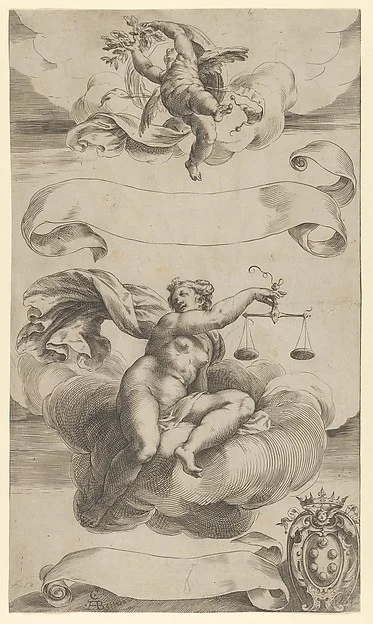
Cherubino Alberti, An Allegory of Truth and Justice, catalogued 1628. The scales provide an earlier artistic image of judgement, shown here as allegorical context.
The Metropolitan Museum of Art. The Elisha Whittelsey Collection, The Elisha Whittelsey Fund, 1951. CC0. Resized and converted to WebP without crop or recolouring. · Image source ↗ · CC0
See references (6)
- Initiation and Its Results, printed p. 31, Reader page 31
- Initiation and Its Results, printed p. 32, Reader page 32
- Initiation and Its Results, printed p. 47, Reader page 46
- Initiation and Its Results, printed p. 48, Reader page 47
- Initiation and Its Results, printed p. 55, Reader page 54
- Initiation and Its Results, printed p. 56, Reader page 55
Discernment in Steiner’s training
Knowledge of the Higher Worlds by Rudolf Steiner
Rudolf Steiner places sound judgement within the trials as well as the later explanation of spiritual organs. He asks for a readiness to abandon an opinion when logical thought demands it and to distinguish reality from superstition or fanciful invention. Receptivity and correction are both required by his account. [16][17]
His newspaper example shows why the origin of an impression matters. A person believes that a death was foreseen the previous day. Steiner proposes an overlooked cause: the person’s eyes had passed over a report of the illness without consciously registering it. The later thought can therefore feel spontaneous while still having an ordinary source. [18][19]
A different problem arises when the student’s own desires appear as external forms. Steiner gives reversed numbers and a wish appearing to move toward its originator as examples of the interpretive adjustment required. He regards self-knowledge as preparation for recognizing those appearances. [20][21][22]
In the sleep chapters, he adds a restraint on system-building. Isolated spiritual experiences should not immediately be assembled into a complete account of the higher worlds. He recommends attending more clearly to what has actually been experienced and waiting for further connections, rather than supplying gaps through invention. [23]
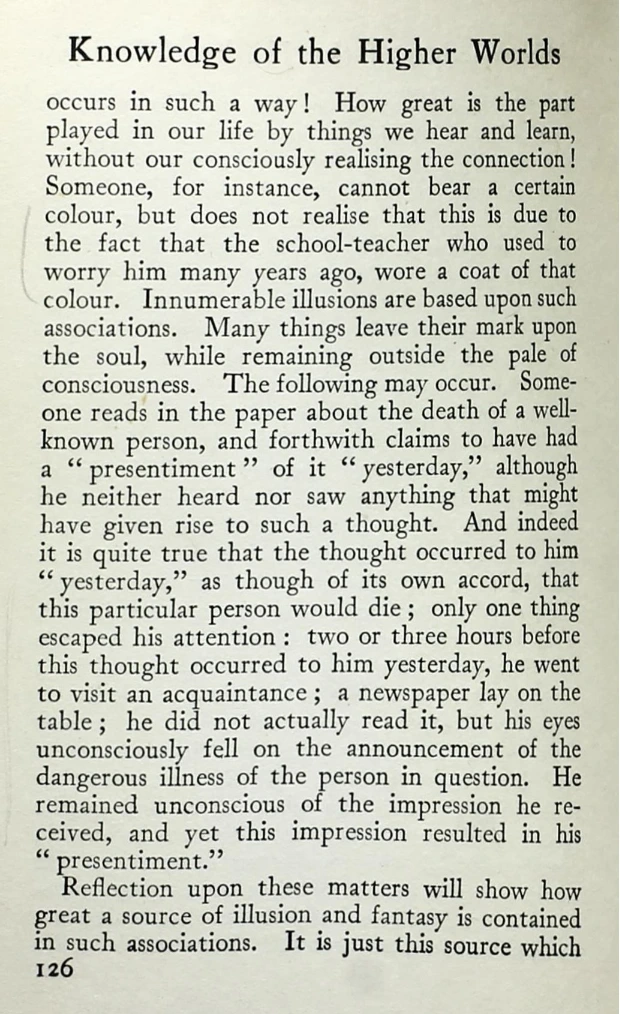
Source facsimile: Knowledge of the Higher Worlds, Reader page 130. The apparent premonition is traced to an unnoticed newspaper announcement of illness.
Rudolf Steiner, G. Metaxa translation, edited by Harry Collison. Historical public-domain source facsimile from the exact checksum-verified Library edition. Repository date 1932; the inspected title page is undated. · Image source ↗ · Public Domain
See references (8)
- Knowledge of the Higher Worlds and Its Attainment, Reader page 77
- Knowledge of the Higher Worlds and Its Attainment, Reader page 78
- Knowledge of the Higher Worlds and Its Attainment, Reader page 129
- Knowledge of the Higher Worlds and Its Attainment, Reader page 130
- Knowledge of the Higher Worlds and Its Attainment, Reader page 149
- Knowledge of the Higher Worlds and Its Attainment, Reader page 150
- Knowledge of the Higher Worlds and Its Attainment, Reader page 151
- Knowledge of the Higher Worlds and Its Attainment, Reader page 176
Initiation and Its Results by Rudolf Steiner
Rudolf Steiner’s Initiation and Its Results names discernment as the first qualification of the probationary path. The student is to distinguish the eternal from the temporal, the true from the false, and truth from mere opinion. The next qualification asks for an appropriate valuation of what has been distinguished. [3][4]
The distinction has to become habitual. Steiner imagines a person repeatedly looking beyond an object’s passing features towards what endures. An intellectual definition of the four qualifications is insufficient in his account; their effect depends on a settled manner of attending and responding. [4][7]
Elsewhere, discernment is tested through possible mistakes. An apparent premonition may come from an unnoticed newspaper report. A seemingly external animal-like figure may express the observer’s own passion. In each case the immediate appearance leaves the origin of the experience unresolved. [1][2][8][5][6]
Openness also belongs to his six cultivated qualities. Steiner asks the student to remain willing to test and rearrange an opinion, instead of rejecting a report solely because it conflicts with existing views. The intended disposition combines receptivity with examination. [9][10]
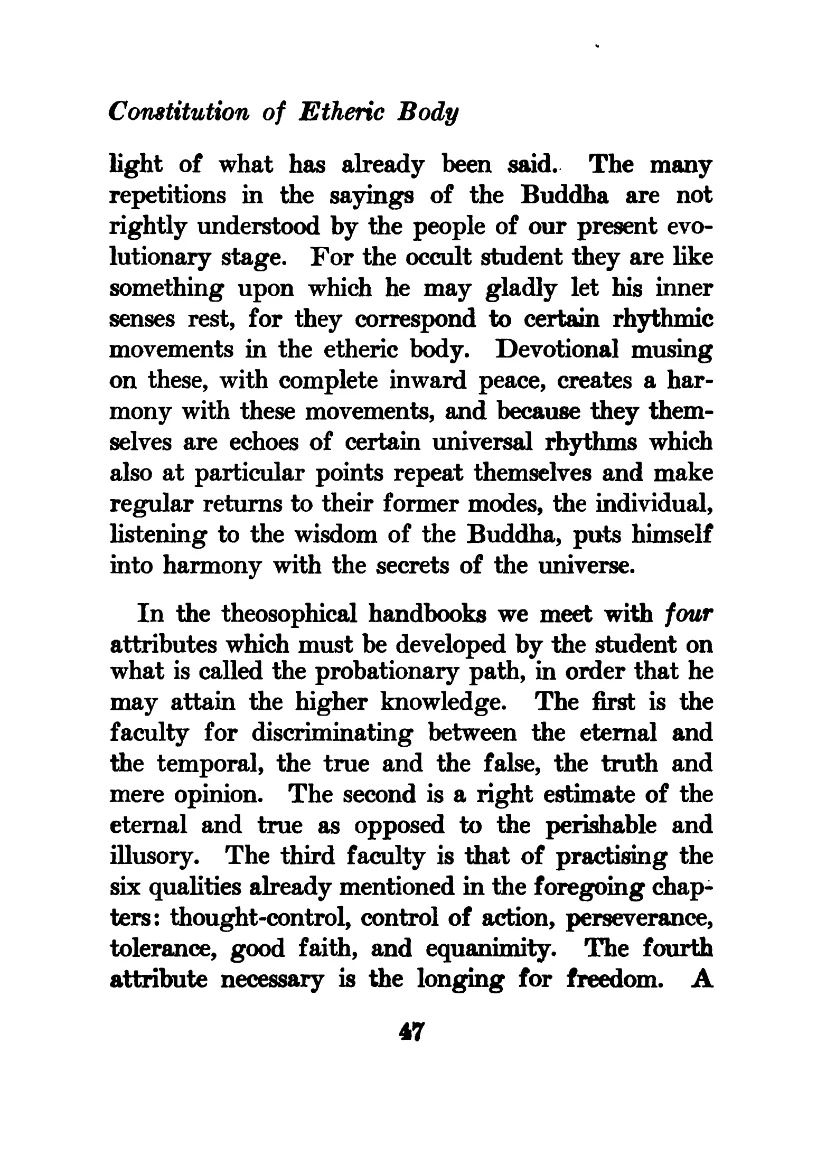
Source facsimile: Initiation and Its Results (1909), printed p. 47, Reader page 46.
Rudolf Steiner, Initiation and Its Results, Clifford Bax translation, First American Edition, 1909. Public-domain historical page from the checksum-verified Library PDF. · Image source ↗ · Public Domain
See references (10)
- Initiation and Its Results, printed p. 31, Reader page 31
- Initiation and Its Results, printed p. 32, Reader page 32
- Initiation and Its Results, printed p. 47, Reader page 46
- Initiation and Its Results, printed p. 48, Reader page 47
- Initiation and Its Results, printed p. 55, Reader page 54
- Initiation and Its Results, printed p. 56, Reader page 55
- Initiation and Its Results, printed p. 49, Reader page 48
- Initiation and Its Results, printed p. 54, Reader page 53
- Initiation and Its Results, printed p. 28, Reader page 28
- Initiation and Its Results, printed p. 29, Reader page 29
Inquiry and intuition
Evolution of Immortality by Rosicruciæ, catalogued as F. B. Dowd
Freeman Benjamin Dowd, publishing as Rosicruciæ in Evolution of Immortality, treats the serpent’s question as a stimulus to developing mind. Desire for knowledge brings investigation and discrimination beyond the enclosed garden, while the chapter also distinguishes directed desire from destructive passion. [11][12][13][14]
Kundalini: An Occult Experience by George S. Arundale
George S. Arundale connects discernment with an enlargement of consciousness. He imagines the reader beginning to distinguish reality from unreality, truth from falsity and what is useful from what is useless. The first glimpse is not yet a stable habit. He expects a more consistent discrimination to develop over time. [24][25]
His account of intuition places a further condition on judgement. An impression should arise from the depths of being and remain free from personal distortion. Arundale gives that inward criterion great weight, while his preface acknowledges the observer’s personal equation. The tension between those passages belongs to the account and should remain visible. [26][27][28]
Discernment is also meant to change conduct. Arundale imagines an increased capacity to understand what a friend needs, but adds that advice should respect discretion and tact. A conviction of insight does not remove the practical responsibility to avoid hindering the person one intends to help. [29]
A later image gives the whole body the role of a gauge of reality. That is Arundale’s description of a claimed transformation of sensitivity, not a procedure for deciding whether a bodily sensation has a supernatural cause. His own examples include different and sometimes opposed sensations. [30][31]
See references (8)
- Kundalini: An Occult Experience, printed p. 5, Reader page 21
- Kundalini: An Occult Experience, Reader page 22
- Kundalini: An Occult Experience, printed p. xv, Reader page 11
- Kundalini: An Occult Experience, printed p. 65, Reader page 67
- Kundalini: An Occult Experience, printed p. 66, Reader page 68
- Kundalini: An Occult Experience, printed p. 67, Reader page 69
- Kundalini: An Occult Experience, printed p. 86, Reader page 88
- Kundalini: An Occult Experience, Reader page 89
Accounts of visions and authority
In Ghostly Japan by Lafcadio Hearn
Lafcadio Hearn’s Story of a Tengu gives discernment an unusual test. A priest rescues a kite from children and is offered a reward by the tengu whose bird-form he has saved. His wish is to see the Buddha’s assembly at Vulture Peak. The tengu promises to reproduce it, on condition that the priest makes no act of worship. [56][57][58][59]
The spectacle is overwhelming: the Buddha’s voice, radiant beings, heavenly flowers and an immense assembly. The priest forgets the warning and bows in devotion. At once the appearance disappears. The tengu subsequently says that the Guardian of the Doctrine has punished the spirits for deceiving a pious person. [60][61][62]
The priest’s sincerity is never the same thing as the spectacle’s authenticity. His devotion is real within the story, but its apparent object is staged. Hearn identifies an earlier Japanese story collection and a related Noh play; he presents a transmitted narrative, not an independently observed case of a counterfeit supernatural event. [56][59][61][62]
The Other World, edited by Frederick George Lee
Frederick George Lee’s The Other World separates accepting that a witness had an experience from deciding what caused it. A reported encounter can be taken seriously while its origin remains open to question. [45][46][47][48]
His discussion of dreams preserves an unresolved problem. After presenting different views of their origin, he says the distinction between angelic and demonic dreams lacks a safe criterion in the account he attributes to Aquinas. The chapter also opens with Jung-Stilling’s warning that some predictions may fail. The caution belongs beside the impressive fulfilment stories. [49][50][51][52]
Chevalier’s testimony gives the difficulty a personal form. A communicator first appears to be a deceased child, but later answers religious challenges in a way the witness takes as evidence of deception. The account records his changing conviction. Its logic also deserves attention: deciding that a communicator is dishonest leaves its subsequent self-description in need of scrutiny, rather than making that answer an independent guarantee. [53][54][45][46][47][48]
Jung-Stilling’s passage near the end of the book draws another boundary. Deliberately seeking intercourse is distinguished from an unsolicited experience received under divine guidance. His advice concerns the person’s intention and response as well as the apparent visitor. It is a religious rule for conduct, with different grounds from a test that could identify an apparition by appearance alone. [55]
See references (11)
- The Other World, Reader page 480
- The Other World, Reader page 481
- The Other World, Reader page 482
- The Other World, Reader page 483
- The Other World, Reader page 215
- The Other World, Reader page 220
- The Other World, Reader page 221
- The Other World, Reader page 222
- The Other World, Reader page 478
- The Other World, Reader page 479
- The Other World, Reader page 523
Light-Bearers of Darkness: Inquire Within
Inquire Within makes the testing of spiritual authority a central problem in Light-Bearers of Darkness. A reproduced pledge requires members to accept messages without investigating how they are received, to disclose doubt only to the masters and to avoid weakening other members’ faith. The passage describes an arrangement that restricts how a disputed claim can be examined. [33][34]
A later reported exchange sharpens the problem. After disturbing experiences and disagreement over messages, the reply attributed to the Christian Father preserves the truth of the teaching while allowing that its channel is faulty. Robert William Felkin is then reported as treating attacks themselves as evidence of the teaching’s importance. Such explanations can absorb an apparent failure without changing the original claim. [35][36]
Does initiation require surrendering judgement? This source says that the training it criticises does so, but its reproduced documents do not all say the same thing. The neophyte obligation rejects passivity to an uninitiated influence. That limited protection differs from the message pledge’s ban on investigating transmission. Each statement has to be read in its own setting, rather than combined into a universal rule for initiation. [37][38][34][39][40]
Inquire Within repeatedly converts similarities between symbols and organizations into a claim of hidden coordination. The book’s antisemitic conspiracy claims lack support from the documents it reproduces. Its own reading of those documents needs the scrutiny it asks readers to apply to occult authorities. [41][42][43][44]
See references (12)
- Light-Bearers of Darkness, Reader page 91
- Light-Bearers of Darkness, printed p. 89, Reader page 92
- Light-Bearers of Darkness, printed p. 138, Reader page 141
- Light-Bearers of Darkness, printed p. 139, Reader page 142
- Light-Bearers of Darkness, printed p. 65, Reader page 68
- Light-Bearers of Darkness, printed p. 66, Reader page 69
- Light-Bearers of Darkness, printed p. 151, Reader page 154
- Light-Bearers of Darkness, printed p. 152, Reader page 155
- Light-Bearers of Darkness, printed p. 3, Reader page 6
- Light-Bearers of Darkness, printed p. 10, Reader page 13
- Light-Bearers of Darkness, printed p. 75, Reader page 78
- Light-Bearers of Darkness, printed p. 117, Reader page 120
What needs discernment?
The newspaper example appears in both Library translations of related GA 10 material. It asks the reader to look for an ordinary cause of an extraordinary impression. A second translation helps explain the example and leaves its evidential status the same. [3][4][5][6][10][1][2][15][16][19][23]
Dowd interprets the serpent as opening a path to inquiry. Steiner asks a student to practise distinguishing the enduring from the passing. Arundale gives expanded judgment a social test in how thoughtfully one responds to someone else. Each shows a different way discernment can matter to conduct. [11][12][13][14][9][10][3][4][16][17][27][29]
Arundale emphasises an intuition free from personal distortion. Steiner checks whether expectation or an overlooked impression has already shaped what the person thinks. Lee’s witnesses ask a related question when they reconsider what kind of communicator they met. [18][19][26][27][28][16][17][50][51][52][45][46][48]
Steiner expects a person to revise even a favoured belief when understanding demands it. Inquire Within focuses on whether a group’s demands for allegiance leave room for such a revision. The question shifts from the individual’s habits to the authority an institution claims. [16][17][37][38][34][35][36]
Hearn’s priest responds sincerely to a spectacle staged by the tengu. Steiner’s apparent premonition can begin with an unnoticed newspaper report. In each, a strong response leaves the experience’s origin open to question. [18][19][59][61][62][56][57]
See references (38)
- Initiation and Its Results, printed p. 31, Reader page 31
- Initiation and Its Results, printed p. 32, Reader page 32
- Initiation and Its Results, printed p. 47, Reader page 46
- Initiation and Its Results, printed p. 48, Reader page 47
- Initiation and Its Results, printed p. 55, Reader page 54
- Initiation and Its Results, printed p. 56, Reader page 55
- Initiation and Its Results, printed p. 28, Reader page 28
- Initiation and Its Results, printed p. 29, Reader page 29
- Evolution of Immortality, printed p. 112, Reader page 110
- Evolution of Immortality, printed p. 113, Reader page 112
- Evolution of Immortality, printed p. 119, Reader page 118
- Evolution of Immortality, printed p. 120, Reader page 119
- Rudolf Steiner Archive: GA 10 publication and translation history
- Knowledge of the Higher Worlds and Its Attainment, Reader page 77
- Knowledge of the Higher Worlds and Its Attainment, Reader page 78
- Knowledge of the Higher Worlds and Its Attainment, Reader page 129
- Knowledge of the Higher Worlds and Its Attainment, Reader page 130
- Knowledge of the Higher Worlds and Its Attainment, Reader page 176
- Kundalini: An Occult Experience, printed p. xv, Reader page 11
- Kundalini: An Occult Experience, printed p. 65, Reader page 67
- Kundalini: An Occult Experience, printed p. 66, Reader page 68
- Kundalini: An Occult Experience, printed p. 67, Reader page 69
- Light-Bearers of Darkness, printed p. 89, Reader page 92
- Light-Bearers of Darkness, printed p. 138, Reader page 141
- Light-Bearers of Darkness, printed p. 139, Reader page 142
- Light-Bearers of Darkness, printed p. 65, Reader page 68
- Light-Bearers of Darkness, printed p. 66, Reader page 69
- The Other World, Reader page 480
- The Other World, Reader page 481
- The Other World, Reader page 483
- The Other World, Reader page 220
- The Other World, Reader page 221
- The Other World, Reader page 222
- In Ghostly Japan, Reader page 204
- In Ghostly Japan, Reader page 205
- In Ghostly Japan, Reader page 207
- In Ghostly Japan, Reader page 209
- In Ghostly Japan, Reader page 210
Read further in the library

Initiation and Its Results
Reading note
The separately titled account draws on exact passages in the consulted Library edition.

Evolution of Immortality
Reading note
Separately attributed comparison with exact previously researched Library passages.

Knowledge of the Higher Worlds and Its Attainment
Reading note
The separately titled account draws on exact passages in the consulted Library edition.

Kundalini: An Occult Experience
Reading note
The separately titled account draws on exact passages in the consulted Library edition.

Light-Bearers of Darkness
Reading note
The separately titled account draws on exact passages in the consulted Library edition.

The Other World
Reading note
The separately titled account draws on exact passages in the consulted Library edition.

In Ghostly Japan
Reading note
The separately titled account draws on exact passages in the consulted Library edition.
Sources
See references (62)
- Initiation and Its Results, printed p. 31, Reader page 31Rudolf Steiner, Initiation and Its Results: A Sequel to The Way of Initiation, translated by Clifford Bax. First American Edition, 1909. Macoy Publishing and Masonic Supply Co., New York; Max Gysi, London. Claims of clairvoyant perception and subtle organs remain attributed. References identify the exact consulted Library edition.Read this page in Initiation and Its Results ↗Return to text ↑
- Initiation and Its Results, printed p. 32, Reader page 32Rudolf Steiner, Initiation and Its Results: A Sequel to The Way of Initiation, translated by Clifford Bax. First American Edition, 1909. Macoy Publishing and Masonic Supply Co., New York; Max Gysi, London. Claims of clairvoyant perception and subtle organs remain attributed. References identify the exact consulted Library edition.Read this page in Initiation and Its Results ↗Return to text ↑
- Initiation and Its Results, printed p. 47, Reader page 46Rudolf Steiner, Initiation and Its Results: A Sequel to The Way of Initiation, translated by Clifford Bax. First American Edition, 1909. Macoy Publishing and Masonic Supply Co., New York; Max Gysi, London. Claims of clairvoyant perception and subtle organs remain attributed. References identify the exact consulted Library edition.Read this page in Initiation and Its Results ↗Return to text ↑
- Initiation and Its Results, printed p. 48, Reader page 47Rudolf Steiner, Initiation and Its Results: A Sequel to The Way of Initiation, translated by Clifford Bax. First American Edition, 1909. Macoy Publishing and Masonic Supply Co., New York; Max Gysi, London. Claims of clairvoyant perception and subtle organs remain attributed. References identify the exact consulted Library edition.Read this page in Initiation and Its Results ↗Return to text ↑
- Initiation and Its Results, printed p. 55, Reader page 54Rudolf Steiner, Initiation and Its Results: A Sequel to The Way of Initiation, translated by Clifford Bax. First American Edition, 1909. Macoy Publishing and Masonic Supply Co., New York; Max Gysi, London. Claims of clairvoyant perception and subtle organs remain attributed. References identify the exact consulted Library edition.Read this page in Initiation and Its Results ↗Return to text ↑
- Initiation and Its Results, printed p. 56, Reader page 55Rudolf Steiner, Initiation and Its Results: A Sequel to The Way of Initiation, translated by Clifford Bax. First American Edition, 1909. Macoy Publishing and Masonic Supply Co., New York; Max Gysi, London. Claims of clairvoyant perception and subtle organs remain attributed. References identify the exact consulted Library edition.Read this page in Initiation and Its Results ↗Return to text ↑
- Initiation and Its Results, printed p. 49, Reader page 48Rudolf Steiner, Initiation and Its Results: A Sequel to The Way of Initiation, translated by Clifford Bax. First American Edition, 1909. Macoy Publishing and Masonic Supply Co., New York; Max Gysi, London. Claims of clairvoyant perception and subtle organs remain attributed. References identify the exact consulted Library edition.Read this page in Initiation and Its Results ↗Return to text ↑
- Initiation and Its Results, printed p. 54, Reader page 53Rudolf Steiner, Initiation and Its Results: A Sequel to The Way of Initiation, translated by Clifford Bax. First American Edition, 1909. Macoy Publishing and Masonic Supply Co., New York; Max Gysi, London. Claims of clairvoyant perception and subtle organs remain attributed. References identify the exact consulted Library edition.Read this page in Initiation and Its Results ↗Return to text ↑
- Initiation and Its Results, printed p. 28, Reader page 28Rudolf Steiner, Initiation and Its Results: A Sequel to The Way of Initiation, translated by Clifford Bax. First American Edition, 1909. Macoy Publishing and Masonic Supply Co., New York; Max Gysi, London. Claims of clairvoyant perception and subtle organs remain attributed. References identify the exact consulted Library edition.Read this page in Initiation and Its Results ↗Return to text ↑
- Initiation and Its Results, printed p. 29, Reader page 29Rudolf Steiner, Initiation and Its Results: A Sequel to The Way of Initiation, translated by Clifford Bax. First American Edition, 1909. Macoy Publishing and Masonic Supply Co., New York; Max Gysi, London. Claims of clairvoyant perception and subtle organs remain attributed. References identify the exact consulted Library edition.Read this page in Initiation and Its Results ↗Return to text ↑
- Evolution of Immortality, printed p. 112, Reader page 110Rosicruciæ, catalogued as Freeman Benjamin Dowd, Evolution of Immortality. Eulian Publishing Company, Salem, Mass., copyright 1900; title page undated. The book’s metaphysical and scientific assertions remain attributed. The separately reproduced Higher Thought of Sex address has no speaker named in this edition.Read this page in Evolution of Immortality ↗Return to text ↑
- Evolution of Immortality, printed p. 113, Reader page 112Rosicruciæ, catalogued as Freeman Benjamin Dowd, Evolution of Immortality. Eulian Publishing Company, Salem, Mass., copyright 1900; title page undated. The book’s metaphysical and scientific assertions remain attributed. The separately reproduced Higher Thought of Sex address has no speaker named in this edition.Read this page in Evolution of Immortality ↗Return to text ↑
- Evolution of Immortality, printed p. 119, Reader page 118Rosicruciæ, catalogued as Freeman Benjamin Dowd, Evolution of Immortality. Eulian Publishing Company, Salem, Mass., copyright 1900; title page undated. The book’s metaphysical and scientific assertions remain attributed. The separately reproduced Higher Thought of Sex address has no speaker named in this edition.Read this page in Evolution of Immortality ↗Return to text ↑
- Evolution of Immortality, printed p. 120, Reader page 119Rosicruciæ, catalogued as Freeman Benjamin Dowd, Evolution of Immortality. Eulian Publishing Company, Salem, Mass., copyright 1900; title page undated. The book’s metaphysical and scientific assertions remain attributed. The separately reproduced Higher Thought of Sex address has no speaker named in this edition.Read this page in Evolution of Immortality ↗Return to text ↑
- Rudolf Steiner Archive: GA 10 publication and translation history ↗Steiner Online Library, Rudolf Steiner Archive, GA 10 bibliography. Used only for publication relationships, not independent confirmation of spiritual claims.Return to text ↑
- Knowledge of the Higher Worlds and Its Attainment, Reader page 77Rudolf Steiner, Knowledge of the Higher Worlds and Its Attainment, authorized English translation by G. Metaxa, edited by Harry Collison, Anthroposophic Press, New York City. Exact Library edition IMJ-0513-E001. No publication year is visible on the inspected title page; the repository assigns 1932. Claims of supersensible perception remain attributed to Steiner.Read this page in Knowledge of the Higher Worlds and Its Attainment ↗Return to text ↑
- Knowledge of the Higher Worlds and Its Attainment, Reader page 78Rudolf Steiner, Knowledge of the Higher Worlds and Its Attainment, authorized English translation by G. Metaxa, edited by Harry Collison, Anthroposophic Press, New York City. Exact Library edition IMJ-0513-E001. No publication year is visible on the inspected title page; the repository assigns 1932. Claims of supersensible perception remain attributed to Steiner.Read this page in Knowledge of the Higher Worlds and Its Attainment ↗Return to text ↑
- Knowledge of the Higher Worlds and Its Attainment, Reader page 129Rudolf Steiner, Knowledge of the Higher Worlds and Its Attainment, authorized English translation by G. Metaxa, edited by Harry Collison, Anthroposophic Press, New York City. Exact Library edition IMJ-0513-E001. No publication year is visible on the inspected title page; the repository assigns 1932. Claims of supersensible perception remain attributed to Steiner.Read this page in Knowledge of the Higher Worlds and Its Attainment ↗Return to text ↑
- Knowledge of the Higher Worlds and Its Attainment, Reader page 130Rudolf Steiner, Knowledge of the Higher Worlds and Its Attainment, authorized English translation by G. Metaxa, edited by Harry Collison, Anthroposophic Press, New York City. Exact Library edition IMJ-0513-E001. No publication year is visible on the inspected title page; the repository assigns 1932. Claims of supersensible perception remain attributed to Steiner.Read this page in Knowledge of the Higher Worlds and Its Attainment ↗Return to text ↑
- Knowledge of the Higher Worlds and Its Attainment, Reader page 149Rudolf Steiner, Knowledge of the Higher Worlds and Its Attainment, authorized English translation by G. Metaxa, edited by Harry Collison, Anthroposophic Press, New York City. Exact Library edition IMJ-0513-E001. No publication year is visible on the inspected title page; the repository assigns 1932. Claims of supersensible perception remain attributed to Steiner.Read this page in Knowledge of the Higher Worlds and Its Attainment ↗Return to text ↑
- Knowledge of the Higher Worlds and Its Attainment, Reader page 150Rudolf Steiner, Knowledge of the Higher Worlds and Its Attainment, authorized English translation by G. Metaxa, edited by Harry Collison, Anthroposophic Press, New York City. Exact Library edition IMJ-0513-E001. No publication year is visible on the inspected title page; the repository assigns 1932. Claims of supersensible perception remain attributed to Steiner.Read this page in Knowledge of the Higher Worlds and Its Attainment ↗Return to text ↑
- Knowledge of the Higher Worlds and Its Attainment, Reader page 151Rudolf Steiner, Knowledge of the Higher Worlds and Its Attainment, authorized English translation by G. Metaxa, edited by Harry Collison, Anthroposophic Press, New York City. Exact Library edition IMJ-0513-E001. No publication year is visible on the inspected title page; the repository assigns 1932. Claims of supersensible perception remain attributed to Steiner.Read this page in Knowledge of the Higher Worlds and Its Attainment ↗Return to text ↑
- Knowledge of the Higher Worlds and Its Attainment, Reader page 176Rudolf Steiner, Knowledge of the Higher Worlds and Its Attainment, authorized English translation by G. Metaxa, edited by Harry Collison, Anthroposophic Press, New York City. Exact Library edition IMJ-0513-E001. No publication year is visible on the inspected title page; the repository assigns 1932. Claims of supersensible perception remain attributed to Steiner.Read this page in Knowledge of the Higher Worlds and Its Attainment ↗Return to text ↑
- Kundalini: An Occult Experience, printed p. 5, Reader page 21George S. Arundale, Kundalini: An Occult Experience, The Theosophical Publishing House, Adyar, Madras, India, 1938. Consulted Library edition IMJ-0227-E001.Read this page in Kundalini: An Occult Experience ↗Return to text ↑
- Kundalini: An Occult Experience, Reader page 22George S. Arundale, Kundalini: An Occult Experience, The Theosophical Publishing House, Adyar, Madras, India, 1938. Consulted Library edition IMJ-0227-E001.Read this page in Kundalini: An Occult Experience ↗Return to text ↑
- Kundalini: An Occult Experience, printed p. xv, Reader page 11George S. Arundale, Kundalini: An Occult Experience, The Theosophical Publishing House, Adyar, Madras, India, 1938. Consulted Library edition IMJ-0227-E001.Read this page in Kundalini: An Occult Experience ↗Return to text ↑
- Kundalini: An Occult Experience, printed p. 65, Reader page 67George S. Arundale, Kundalini: An Occult Experience, The Theosophical Publishing House, Adyar, Madras, India, 1938. Consulted Library edition IMJ-0227-E001.Read this page in Kundalini: An Occult Experience ↗Return to text ↑
- Kundalini: An Occult Experience, printed p. 66, Reader page 68George S. Arundale, Kundalini: An Occult Experience, The Theosophical Publishing House, Adyar, Madras, India, 1938. Consulted Library edition IMJ-0227-E001.Read this page in Kundalini: An Occult Experience ↗Return to text ↑
- Kundalini: An Occult Experience, printed p. 67, Reader page 69George S. Arundale, Kundalini: An Occult Experience, The Theosophical Publishing House, Adyar, Madras, India, 1938. Consulted Library edition IMJ-0227-E001.Read this page in Kundalini: An Occult Experience ↗Return to text ↑
- Kundalini: An Occult Experience, printed p. 86, Reader page 88George S. Arundale, Kundalini: An Occult Experience, The Theosophical Publishing House, Adyar, Madras, India, 1938. Consulted Library edition IMJ-0227-E001.Read this page in Kundalini: An Occult Experience ↗Return to text ↑
- Kundalini: An Occult Experience, Reader page 89George S. Arundale, Kundalini: An Occult Experience, The Theosophical Publishing House, Adyar, Madras, India, 1938. Consulted Library edition IMJ-0227-E001.Read this page in Kundalini: An Occult Experience ↗Return to text ↑
- An Allegory of Truth and Justice; a naked woman in the center seated on a cloud holding a set of scales, a putto above, the Medici Coat of Arms at lower right, 1628 ↗The Metropolitan Museum of Art. The Elisha Whittelsey Collection, The Elisha Whittelsey Fund, 1951. Public-domain image, CC0.
- Light-Bearers of Darkness, Reader page 91Inquire Within, Light-Bearers of Darkness (first printed 1930; supplied facsimile reprinted 2001), exact selected Library edition IMJ-0032-E002. Quotations and reported documents are read through this polemical source, unless a separately titled account states otherwise. Original source leaf 206 is absent; original PageIDs and current Reader positions are verified.Read this page in Light-Bearers of Darkness ↗Return to text ↑
- Light-Bearers of Darkness, printed p. 89, Reader page 92Inquire Within, Light-Bearers of Darkness (first printed 1930; supplied facsimile reprinted 2001), exact selected Library edition IMJ-0032-E002. Quotations and reported documents are read through this polemical source, unless a separately titled account states otherwise. Original source leaf 206 is absent; original PageIDs and current Reader positions are verified.Read this page in Light-Bearers of Darkness ↗Return to text ↑
- Light-Bearers of Darkness, printed p. 138, Reader page 141Inquire Within, Light-Bearers of Darkness (first printed 1930; supplied facsimile reprinted 2001), exact selected Library edition IMJ-0032-E002. Quotations and reported documents are read through this polemical source, unless a separately titled account states otherwise. Original source leaf 206 is absent; original PageIDs and current Reader positions are verified.Read this page in Light-Bearers of Darkness ↗Return to text ↑
- Light-Bearers of Darkness, printed p. 139, Reader page 142Inquire Within, Light-Bearers of Darkness (first printed 1930; supplied facsimile reprinted 2001), exact selected Library edition IMJ-0032-E002. Quotations and reported documents are read through this polemical source, unless a separately titled account states otherwise. Original source leaf 206 is absent; original PageIDs and current Reader positions are verified.Read this page in Light-Bearers of Darkness ↗Return to text ↑
- Light-Bearers of Darkness, printed p. 65, Reader page 68Inquire Within, Light-Bearers of Darkness (first printed 1930; supplied facsimile reprinted 2001), exact selected Library edition IMJ-0032-E002. Quotations and reported documents are read through this polemical source, unless a separately titled account states otherwise. Original source leaf 206 is absent; original PageIDs and current Reader positions are verified.Read this page in Light-Bearers of Darkness ↗Return to text ↑
- Light-Bearers of Darkness, printed p. 66, Reader page 69Inquire Within, Light-Bearers of Darkness (first printed 1930; supplied facsimile reprinted 2001), exact selected Library edition IMJ-0032-E002. Quotations and reported documents are read through this polemical source, unless a separately titled account states otherwise. Original source leaf 206 is absent; original PageIDs and current Reader positions are verified.Read this page in Light-Bearers of Darkness ↗Return to text ↑
- Light-Bearers of Darkness, printed p. 151, Reader page 154Inquire Within, Light-Bearers of Darkness (first printed 1930; supplied facsimile reprinted 2001), exact selected Library edition IMJ-0032-E002. Quotations and reported documents are read through this polemical source, unless a separately titled account states otherwise. Original source leaf 206 is absent; original PageIDs and current Reader positions are verified.Read this page in Light-Bearers of Darkness ↗Return to text ↑
- Light-Bearers of Darkness, printed p. 152, Reader page 155Inquire Within, Light-Bearers of Darkness (first printed 1930; supplied facsimile reprinted 2001), exact selected Library edition IMJ-0032-E002. Quotations and reported documents are read through this polemical source, unless a separately titled account states otherwise. Original source leaf 206 is absent; original PageIDs and current Reader positions are verified.Read this page in Light-Bearers of Darkness ↗Return to text ↑
- Light-Bearers of Darkness, printed p. 3, Reader page 6Inquire Within, Light-Bearers of Darkness (first printed 1930; supplied facsimile reprinted 2001), exact selected Library edition IMJ-0032-E002. Quotations and reported documents are read through this polemical source, unless a separately titled account states otherwise. Original source leaf 206 is absent; original PageIDs and current Reader positions are verified.Read this page in Light-Bearers of Darkness ↗Return to text ↑
- Light-Bearers of Darkness, printed p. 10, Reader page 13Inquire Within, Light-Bearers of Darkness (first printed 1930; supplied facsimile reprinted 2001), exact selected Library edition IMJ-0032-E002. Quotations and reported documents are read through this polemical source, unless a separately titled account states otherwise. Original source leaf 206 is absent; original PageIDs and current Reader positions are verified.Read this page in Light-Bearers of Darkness ↗Return to text ↑
- Light-Bearers of Darkness, printed p. 75, Reader page 78Inquire Within, Light-Bearers of Darkness (first printed 1930; supplied facsimile reprinted 2001), exact selected Library edition IMJ-0032-E002. Quotations and reported documents are read through this polemical source, unless a separately titled account states otherwise. Original source leaf 206 is absent; original PageIDs and current Reader positions are verified.Read this page in Light-Bearers of Darkness ↗Return to text ↑
- Light-Bearers of Darkness, printed p. 117, Reader page 120Inquire Within, Light-Bearers of Darkness (first printed 1930; supplied facsimile reprinted 2001), exact selected Library edition IMJ-0032-E002. Quotations and reported documents are read through this polemical source, unless a separately titled account states otherwise. Original source leaf 206 is absent; original PageIDs and current Reader positions are verified.Read this page in Light-Bearers of Darkness ↗Return to text ↑
- The Other World, Reader page 480Frederick George Lee, editor, The Other World; or, Glimpses of the Supernatural, two volumes, Henry S. King and Co., London, 1875. Exact consulted Library edition IMJ-0657-E001. Narratives and embedded quotations are attributed to this compilation; an original author is not represented as independently consulted merely because Lee quotes them. Reader positions are verified separately from printed pagination.Read this page in The Other World ↗Return to text ↑
- The Other World, Reader page 481Frederick George Lee, editor, The Other World; or, Glimpses of the Supernatural, two volumes, Henry S. King and Co., London, 1875. Exact consulted Library edition IMJ-0657-E001. Narratives and embedded quotations are attributed to this compilation; an original author is not represented as independently consulted merely because Lee quotes them. Reader positions are verified separately from printed pagination.Read this page in The Other World ↗Return to text ↑
- The Other World, Reader page 482Frederick George Lee, editor, The Other World; or, Glimpses of the Supernatural, two volumes, Henry S. King and Co., London, 1875. Exact consulted Library edition IMJ-0657-E001. Narratives and embedded quotations are attributed to this compilation; an original author is not represented as independently consulted merely because Lee quotes them. Reader positions are verified separately from printed pagination.Read this page in The Other World ↗Return to text ↑
- The Other World, Reader page 483Frederick George Lee, editor, The Other World; or, Glimpses of the Supernatural, two volumes, Henry S. King and Co., London, 1875. Exact consulted Library edition IMJ-0657-E001. Narratives and embedded quotations are attributed to this compilation; an original author is not represented as independently consulted merely because Lee quotes them. Reader positions are verified separately from printed pagination.Read this page in The Other World ↗Return to text ↑
- The Other World, Reader page 215Frederick George Lee, editor, The Other World; or, Glimpses of the Supernatural, two volumes, Henry S. King and Co., London, 1875. Exact consulted Library edition IMJ-0657-E001. Narratives and embedded quotations are attributed to this compilation; an original author is not represented as independently consulted merely because Lee quotes them. Reader positions are verified separately from printed pagination.Read this page in The Other World ↗Return to text ↑
- The Other World, Reader page 220Frederick George Lee, editor, The Other World; or, Glimpses of the Supernatural, two volumes, Henry S. King and Co., London, 1875. Exact consulted Library edition IMJ-0657-E001. Narratives and embedded quotations are attributed to this compilation; an original author is not represented as independently consulted merely because Lee quotes them. Reader positions are verified separately from printed pagination.Read this page in The Other World ↗Return to text ↑
- The Other World, Reader page 221Frederick George Lee, editor, The Other World; or, Glimpses of the Supernatural, two volumes, Henry S. King and Co., London, 1875. Exact consulted Library edition IMJ-0657-E001. Narratives and embedded quotations are attributed to this compilation; an original author is not represented as independently consulted merely because Lee quotes them. Reader positions are verified separately from printed pagination.Read this page in The Other World ↗Return to text ↑
- The Other World, Reader page 222Frederick George Lee, editor, The Other World; or, Glimpses of the Supernatural, two volumes, Henry S. King and Co., London, 1875. Exact consulted Library edition IMJ-0657-E001. Narratives and embedded quotations are attributed to this compilation; an original author is not represented as independently consulted merely because Lee quotes them. Reader positions are verified separately from printed pagination.Read this page in The Other World ↗Return to text ↑
- The Other World, Reader page 478Frederick George Lee, editor, The Other World; or, Glimpses of the Supernatural, two volumes, Henry S. King and Co., London, 1875. Exact consulted Library edition IMJ-0657-E001. Narratives and embedded quotations are attributed to this compilation; an original author is not represented as independently consulted merely because Lee quotes them. Reader positions are verified separately from printed pagination.Read this page in The Other World ↗Return to text ↑
- The Other World, Reader page 479Frederick George Lee, editor, The Other World; or, Glimpses of the Supernatural, two volumes, Henry S. King and Co., London, 1875. Exact consulted Library edition IMJ-0657-E001. Narratives and embedded quotations are attributed to this compilation; an original author is not represented as independently consulted merely because Lee quotes them. Reader positions are verified separately from printed pagination.Read this page in The Other World ↗Return to text ↑
- The Other World, Reader page 523Frederick George Lee, editor, The Other World; or, Glimpses of the Supernatural, two volumes, Henry S. King and Co., London, 1875. Exact consulted Library edition IMJ-0657-E001. Narratives and embedded quotations are attributed to this compilation; an original author is not represented as independently consulted merely because Lee quotes them. Reader positions are verified separately from printed pagination.Read this page in The Other World ↗Return to text ↑
- In Ghostly Japan, Reader page 204Lafcadio Hearn, In Ghostly Japan, Little, Brown, and Company, Boston, 1899. Exact consulted Library edition IMJ-0654-E001, with title page visually checked. Persistent PageIDs and current Reader positions are verified from the supplied edition. Embedded stories, translations and quotations are attributed to Hearn’s presentation unless an original source has separately been consulted.Read this page in In Ghostly Japan ↗Return to text ↑
- In Ghostly Japan, Reader page 205Lafcadio Hearn, In Ghostly Japan, Little, Brown, and Company, Boston, 1899. Exact consulted Library edition IMJ-0654-E001, with title page visually checked. Persistent PageIDs and current Reader positions are verified from the supplied edition. Embedded stories, translations and quotations are attributed to Hearn’s presentation unless an original source has separately been consulted.Read this page in In Ghostly Japan ↗Return to text ↑
- In Ghostly Japan, Reader page 206Lafcadio Hearn, In Ghostly Japan, Little, Brown, and Company, Boston, 1899. Exact consulted Library edition IMJ-0654-E001, with title page visually checked. Persistent PageIDs and current Reader positions are verified from the supplied edition. Embedded stories, translations and quotations are attributed to Hearn’s presentation unless an original source has separately been consulted.Read this page in In Ghostly Japan ↗Return to text ↑
- In Ghostly Japan, Reader page 207Lafcadio Hearn, In Ghostly Japan, Little, Brown, and Company, Boston, 1899. Exact consulted Library edition IMJ-0654-E001, with title page visually checked. Persistent PageIDs and current Reader positions are verified from the supplied edition. Embedded stories, translations and quotations are attributed to Hearn’s presentation unless an original source has separately been consulted.Read this page in In Ghostly Japan ↗Return to text ↑
- In Ghostly Japan, Reader page 208Lafcadio Hearn, In Ghostly Japan, Little, Brown, and Company, Boston, 1899. Exact consulted Library edition IMJ-0654-E001, with title page visually checked. Persistent PageIDs and current Reader positions are verified from the supplied edition. Embedded stories, translations and quotations are attributed to Hearn’s presentation unless an original source has separately been consulted.Read this page in In Ghostly Japan ↗Return to text ↑
- In Ghostly Japan, Reader page 209Lafcadio Hearn, In Ghostly Japan, Little, Brown, and Company, Boston, 1899. Exact consulted Library edition IMJ-0654-E001, with title page visually checked. Persistent PageIDs and current Reader positions are verified from the supplied edition. Embedded stories, translations and quotations are attributed to Hearn’s presentation unless an original source has separately been consulted.Read this page in In Ghostly Japan ↗Return to text ↑
- In Ghostly Japan, Reader page 210Lafcadio Hearn, In Ghostly Japan, Little, Brown, and Company, Boston, 1899. Exact consulted Library edition IMJ-0654-E001, with title page visually checked. Persistent PageIDs and current Reader positions are verified from the supplied edition. Embedded stories, translations and quotations are attributed to Hearn’s presentation unless an original source has separately been consulted.Read this page in In Ghostly Japan ↗Return to text ↑