Spirit Rapping
Spirit rapping interprets audible knocks as messages from spirits. See how historical accounts describe the signals and who was believed to send them.
In this article
What is spirit rapping?
Spirit rapping is the practice of interpreting knocks as messages from spirits. A knock can indicate yes or no, or pick a letter as someone recites the alphabet. The participants’ code gives the sound a meaning. [1]
A readable answer still leaves the question of who or what made the noise. One account may describe how to read the signals, while another proposes how the sound was produced. [1]
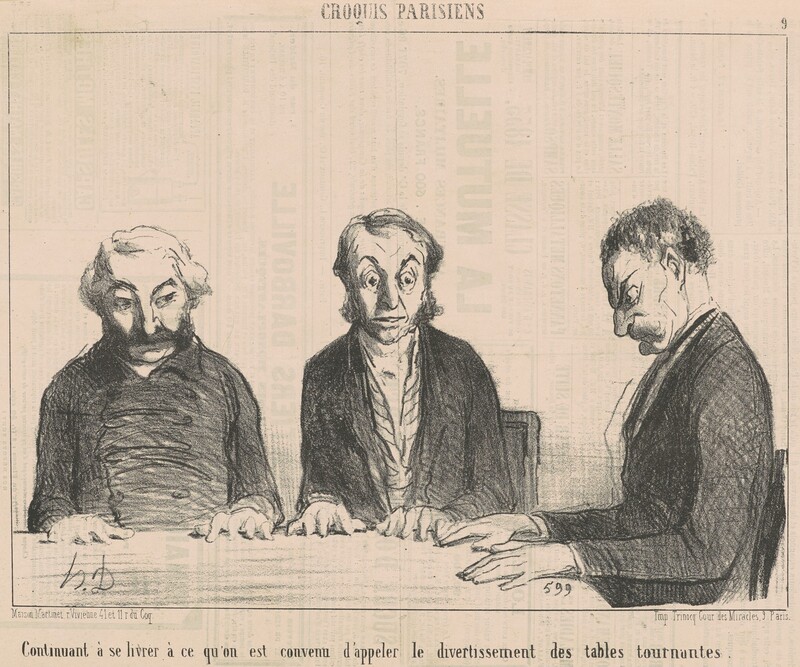
Honoré Daumier’s 1854 caricature of table-turning. Such gatherings belong to the historical setting in which movements and knocks could be interpreted as replies. The print satirises the participants’ absorption; it cannot establish that a sound occurred or identify its cause. Table movement and audible rapping are related practices, not identical events.
Honoré Daumier, 1854. National Gallery of Art, Washington. Open Access; public domain. · Image source ↗ · Public Domain
The Other World, edited by Frederick George Lee
Frederick George Lee’s The Other World collects cases where participants agree on signs before they ask a question. A knock can mark an answer or pick out a letter as someone reads or points. The conventions make it possible to record a reply in words. [6][7][8][9][10]
The conventions are not identical in every account. One gathering agrees on a single knock for no and two for yes; Wallace’s appended letter describes three affirmative raps while a sitter indicates letters. This practical difference matters when reconstructing a reported exchange. The reader needs to know how the participants passed from sounds to the words they recorded. [8][9][10]
A Clifton correspondent tries to strengthen the case by preparing questions in a book and asking for answers by number. The reported replies concern places, burial and a family remembrance. The writer takes their correctness as evidence against ordinary explanations. The questions nevertheless concern information known within the family; their numerical form and the interpretation of the replies remain parts of a narrated test, not an independently verified result. [11][12]
Wallace’s letter offers another revealing limit. He describes a name spelt backwards in two parts, but replaces the surname before publication because he has no authority to disclose it. The published name therefore cannot be used as the real person’s identity. His confidence in the experience is accompanied by an acknowledgment that he does not expect a sceptic simply to accept such facts on his testimony. [9][10]
The Angels’ Diary
In the volume attributed to Effie M. Shirey and Charles Samson, the New Thought discussion places rapping beside thought-made pictures and writing produced without a hand. A spiritual mind is said to send a vibratory thought outward and produce a knock without touching a visible substance. The passage asks how intention could become an audible event. [2][3][1]
The paragraph does not name a particular sitting, give a sequence of knocks or describe a witness testing them. It offers an explanation of a proposed effect. That makes it useful evidence for the book’s theory of thought, while leaving the circumstances of any particular communication to be investigated separately. [1]
The mother’s acknowledgment at the beginning describes another channel through which she believes her children communicated. There, Elizabeth Maud Weatherhead’s hand records the messages. Rapping appears later among the wider range of signs the book considers possible. The volume does not say that the diary itself was dictated by knocks. [4][1]
Sound alone would also leave the proposed speaker’s identity unresolved. The chapter supplies no code by which an audience could turn the raps into words. Its contribution to the concept is more limited and precise, an account of sound as a physical expression of spiritual thought. [1]
How the Library accounts compare
The Angels’ Diary says a thought can produce a knock without visible contact. Lee’s collected cases show how listeners assign noises a meaning. The two explanations address different steps: producing a sound and interpreting it as something a particular sender intended to say. [2][3][1][8][11][12][9][10]
See references (8)
- The Angels’ Diary and Celestion Study of Man, Reader page 200
- The Angels’ Diary and Celestion Study of Man, Reader page 198
- The Angels’ Diary and Celestion Study of Man, Reader page 199
- The Other World, Reader page 455
- The Other World, Reader page 494
- The Other World, Reader page 495
- The Other World, Reader page 475
- The Other World, Reader page 476
Read further in the library
The Angels’ Diary and Celestion Study of Man
Reading note
How thought becomes a knock. Read the original passage in the 1903 edition.
The Other World
Reading note
The separately titled account draws on exact passages in the consulted Library edition.
Sources
See references (12)
- The Angels’ Diary and Celestion Study of Man, Reader page 200Effie M. Shirey and Charles Samson, The Angels’ Diary and Celestion Study of Man (1903).Read this page in The Angels’ Diary and Celestion Study of Man ↗Return to text ↑
- The Angels’ Diary and Celestion Study of Man, Reader page 198Effie M. Shirey and Charles Samson, The Angels’ Diary and Celestion Study of Man (1903).Read this page in The Angels’ Diary and Celestion Study of Man ↗Return to text ↑
- The Angels’ Diary and Celestion Study of Man, Reader page 199Effie M. Shirey and Charles Samson, The Angels’ Diary and Celestion Study of Man (1903).Read this page in The Angels’ Diary and Celestion Study of Man ↗Return to text ↑
- The Angels’ Diary and Celestion Study of Man, Reader page 4Effie M. Shirey and Charles Samson, The Angels’ Diary and Celestion Study of Man (1903).Read this page in The Angels’ Diary and Celestion Study of Man ↗Return to text ↑
- Honoré Daumier, Continuant ... Le divertissement des tables tournantes ..., 1854 ↗Honoré Daumier, 1854. National Gallery of Art, Washington. Open Access; public domain.
- The Other World, Reader page 442Frederick George Lee, editor, The Other World; or, Glimpses of the Supernatural, two volumes, Henry S. King and Co., London, 1875. Exact consulted Library edition IMJ-0657-E001. Narratives and embedded quotations are attributed to this compilation; an original author is not represented as independently consulted merely because Lee quotes them. Reader positions are verified separately from printed pagination.Read this page in The Other World ↗Return to text ↑
- The Other World, Reader page 443Frederick George Lee, editor, The Other World; or, Glimpses of the Supernatural, two volumes, Henry S. King and Co., London, 1875. Exact consulted Library edition IMJ-0657-E001. Narratives and embedded quotations are attributed to this compilation; an original author is not represented as independently consulted merely because Lee quotes them. Reader positions are verified separately from printed pagination.Read this page in The Other World ↗Return to text ↑
- The Other World, Reader page 455Frederick George Lee, editor, The Other World; or, Glimpses of the Supernatural, two volumes, Henry S. King and Co., London, 1875. Exact consulted Library edition IMJ-0657-E001. Narratives and embedded quotations are attributed to this compilation; an original author is not represented as independently consulted merely because Lee quotes them. Reader positions are verified separately from printed pagination.Read this page in The Other World ↗Return to text ↑
- The Other World, Reader page 494Frederick George Lee, editor, The Other World; or, Glimpses of the Supernatural, two volumes, Henry S. King and Co., London, 1875. Exact consulted Library edition IMJ-0657-E001. Narratives and embedded quotations are attributed to this compilation; an original author is not represented as independently consulted merely because Lee quotes them. Reader positions are verified separately from printed pagination.Read this page in The Other World ↗Return to text ↑
- The Other World, Reader page 495Frederick George Lee, editor, The Other World; or, Glimpses of the Supernatural, two volumes, Henry S. King and Co., London, 1875. Exact consulted Library edition IMJ-0657-E001. Narratives and embedded quotations are attributed to this compilation; an original author is not represented as independently consulted merely because Lee quotes them. Reader positions are verified separately from printed pagination.Read this page in The Other World ↗Return to text ↑
- The Other World, Reader page 475Frederick George Lee, editor, The Other World; or, Glimpses of the Supernatural, two volumes, Henry S. King and Co., London, 1875. Exact consulted Library edition IMJ-0657-E001. Narratives and embedded quotations are attributed to this compilation; an original author is not represented as independently consulted merely because Lee quotes them. Reader positions are verified separately from printed pagination.Read this page in The Other World ↗Return to text ↑
- The Other World, Reader page 476Frederick George Lee, editor, The Other World; or, Glimpses of the Supernatural, two volumes, Henry S. King and Co., London, 1875. Exact consulted Library edition IMJ-0657-E001. Narratives and embedded quotations are attributed to this compilation; an original author is not represented as independently consulted merely because Lee quotes them. Reader positions are verified separately from printed pagination.Read this page in The Other World ↗Return to text ↑