Spirit boats
Spirit boats and floating lanterns give the dead a symbolic farewell. Read Hearn’s account of Bon at Yaizu and Ward’s account of paper offerings.
In this article
Boats and lights for the dead
A spirit boat is a vessel made or represented for the journey of the dead in a ritual or story. At some Japanese Bon observances, people send a small boat out with food, incense or a light. Elsewhere the farewell takes the form of lanterns set afloat. [2][3][4][5]
In Ghostly Japan by Lafcadio Hearn
In At Yaidzu, Lafcadio Hearn describes model fishing craft and junks sent away at night in parts of Japan. They may carry food, water, incense and a lantern. He contrasts them with what he saw at Yaizu, where the floating lanterns were the farewell objects themselves. [2][3]
Hearn arrives after the launch and swims close enough to see the lanterns’ four uprights and paper sides. Five colours, one on each side and two sharing the fourth, recall five Buddhist elements in his account. He sees a candle inside and no Buddhist names on the paper. [3][4][5]
The receding lights make him think of people separating across the sea. When two white figures startle him on the shore, they turn out to be his landlord and his landlord’s wife, who have come to look for him. [5][6]
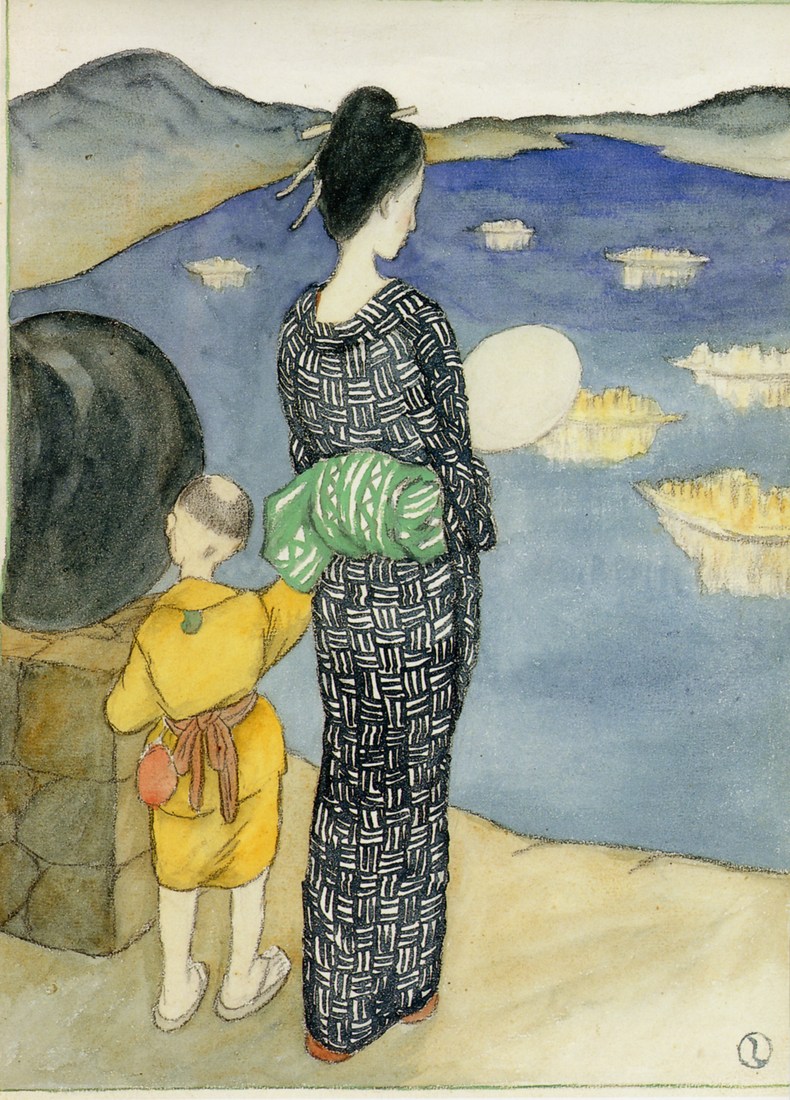
Takehisa Yumeji depicts floating farewell lights at Nagasaki in Tōrō-nagashi, from Twelve Scenes at Nagasaki (1920).
Takehisa Yumeji. Public domain; image via Wikimedia Commons. · Image source ↗ · Public Domain
A Subaltern in Spirit Land by J. S. M. Ward
In A Subaltern in Spirit Land, J. S. M. Ward asks about burning paper money and clothes for the dead among Chinese people in Burma. H. J. L., the book’s communicator, says the gift on the spirit plane shows that someone is remembered. On what he calls the astral plane, he claims the form of the paper object appears. [7][8]
What an offering carries
Hearn follows the parting lights out to sea. Ward describes a gift transformed by burning. Both accounts connect a tangible object with remembering the dead, and each gives the object a different destination. [3][4][5][6][7][8]
Read further in the library
In Ghostly Japan
Reading note
The separately titled account draws on exact passages in the consulted Library edition.
A Subaltern in Spirit Land: A Sequel to Gone West
Reading note
Separately attributed comparison with exact previously researched Library passages.
Sources
See references (8)
- Takehisa Yumeji, Tōrō-nagashi, from Twelve Scenes at Nagasaki, 1920 ↗Historical image and reuse status checked against the retained source record. Takehisa Yumeji. Public domain; image via Wikimedia Commons.
- In Ghostly Japan, Reader page 215Lafcadio Hearn, In Ghostly Japan, Little, Brown, and Company, Boston, 1899. Exact consulted Library edition IMJ-0654-E001, with title page visually checked. Persistent PageIDs and current Reader positions are verified from the supplied edition. Embedded stories, translations and quotations are attributed to Hearn’s presentation unless an original source has separately been consulted.Read this page in In Ghostly Japan ↗Return to text ↑
- In Ghostly Japan, Reader page 216Lafcadio Hearn, In Ghostly Japan, Little, Brown, and Company, Boston, 1899. Exact consulted Library edition IMJ-0654-E001, with title page visually checked. Persistent PageIDs and current Reader positions are verified from the supplied edition. Embedded stories, translations and quotations are attributed to Hearn’s presentation unless an original source has separately been consulted.Read this page in In Ghostly Japan ↗Return to text ↑
- In Ghostly Japan, Reader page 218Lafcadio Hearn, In Ghostly Japan, Little, Brown, and Company, Boston, 1899. Exact consulted Library edition IMJ-0654-E001, with title page visually checked. Persistent PageIDs and current Reader positions are verified from the supplied edition. Embedded stories, translations and quotations are attributed to Hearn’s presentation unless an original source has separately been consulted.Read this page in In Ghostly Japan ↗Return to text ↑
- In Ghostly Japan, Reader page 219Lafcadio Hearn, In Ghostly Japan, Little, Brown, and Company, Boston, 1899. Exact consulted Library edition IMJ-0654-E001, with title page visually checked. Persistent PageIDs and current Reader positions are verified from the supplied edition. Embedded stories, translations and quotations are attributed to Hearn’s presentation unless an original source has separately been consulted.Read this page in In Ghostly Japan ↗Return to text ↑
- In Ghostly Japan, Reader page 220Lafcadio Hearn, In Ghostly Japan, Little, Brown, and Company, Boston, 1899. Exact consulted Library edition IMJ-0654-E001, with title page visually checked. Persistent PageIDs and current Reader positions are verified from the supplied edition. Embedded stories, translations and quotations are attributed to Hearn’s presentation unless an original source has separately been consulted.Read this page in In Ghostly Japan ↗Return to text ↑
- A Subaltern in Spirit Land, printed p. 76, Reader page 91J. S. M. Ward, A Subaltern in Spirit Land: A Sequel to Gone West. William Rider & Son, London, 1920. Narrated experiences and explanations are attributed to Ward and his reported spirit contributors, especially his brother Rex (R. L. W.) and H. J. L.Read this page in A Subaltern in Spirit Land: A Sequel to Gone West ↗Return to text ↑
- A Subaltern in Spirit Land, printed p. 77, Reader page 92J. S. M. Ward, A Subaltern in Spirit Land: A Sequel to Gone West. William Rider & Son, London, 1920. Narrated experiences and explanations are attributed to Ward and his reported spirit contributors, especially his brother Rex (R. L. W.) and H. J. L.Read this page in A Subaltern in Spirit Land: A Sequel to Gone West ↗Return to text ↑