Silent spiritual influence
Vivekananda imagined unknown thinkers shaping public teachers. Thought-Forms proposed another way that a thought could influence someone at a distance.
In this article
Understanding the concept
Silent spiritual influence is the idea that a thought or disposition can reach other people without a word, an example they witness or any direct encounter. Two late nineteenth- and early twentieth-century occult and religious accounts picture how this might happen. [3][4][1]
Karma-Yoga by Swami Vivekananda
Swami Vivekananda imagines an unknown thinker whose ideas travel from a cave across mountains and oceans until other people give them public expression. He associates the quiet thinker with sattva, a quality of clarity and balance, and the more active teacher with a greater share of rajas, the quality of activity. [3][4][5]
Earlier in Karma-Yoga, Vivekananda compares minds to instruments tuned to respond to the same vibration. He proposes that a thought continues until it finds a receptive mind and can reinforce a helpful or harmful tendency there. [6][7][8]
That account sits alongside his insistence that most people still have work to do. The silent thinker represents an advanced condition in Vivekananda’s scheme. [4][5]
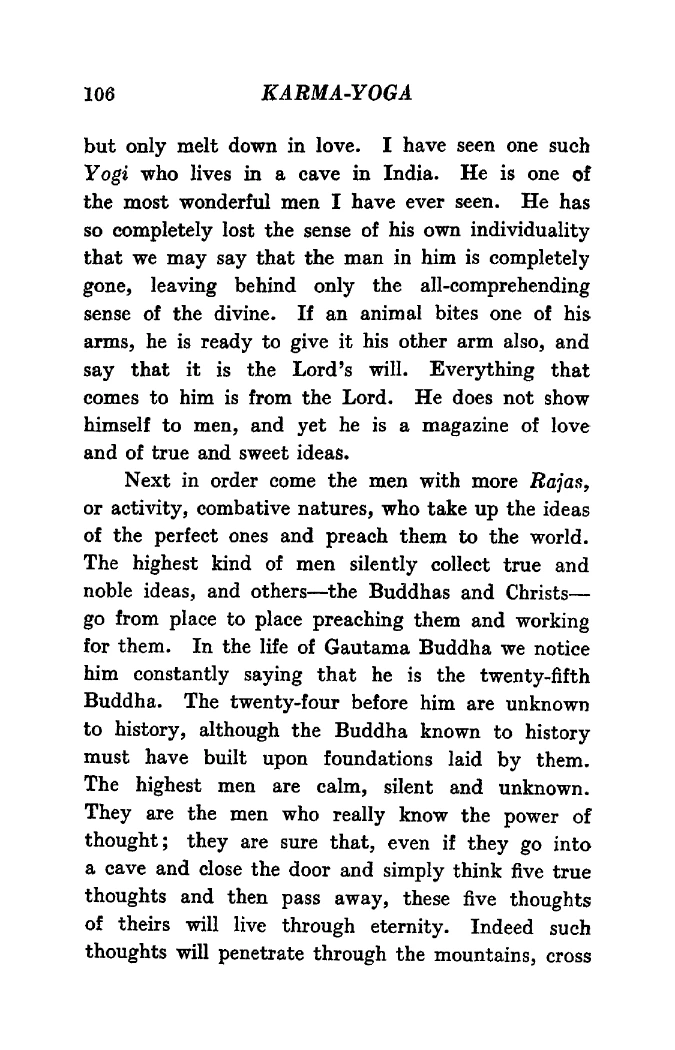
Vivekananda describes the quiet thinker and the more public teacher. Karma-Yoga (1939), Library reader p. 108.
Swami Vivekananda, Karma-Yoga, English second printing in the 1939 combined volume. Historical public-domain text, exact checksum-verified Library scan. · Image source ↗ · Public Domain
Thought-Forms by Annie Besant and C. W. Leadbeater
Annie Besant and Charles Webster Leadbeater say that a radiating thought can communicate its emotional character while leaving its subject behind. In their example, devotion to Krishna could stir devotion to another divine figure. In a separate series of experiments, the authors tried sending helpful thoughts at an appointed time and interpreted sketches returned by post as records of what the recipient perceived. [1][2]
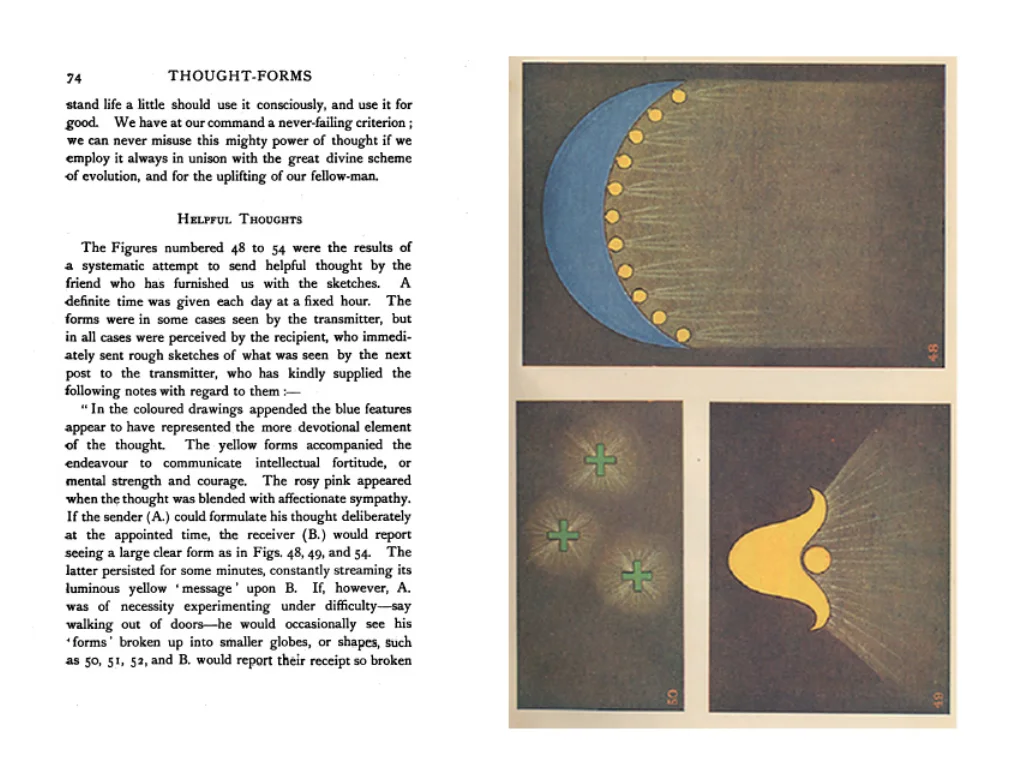
“Helpful Thoughts,” figures 48–50. Besant and Leadbeater read the returned sketches as responses to thoughts directed at a particular person. Thought-Forms, Library reader p. 58.
Annie Besant and C. W. Leadbeater, Thought-Forms. Historical public-domain colour plate from the exact Library source. · Image source ↗ · Public Domain
What is supposed to travel?
Vivekananda’s cave story imagines an idea reaching people who can put it into practice. The example in Thought-Forms imagines a feeling of devotion finding a new object in the person it reaches. The musical analogy and the sketches show how the authors pictured this influence. The connection between the people involved remains their interpretation. [1][2][6][4]
Read further in the library

Thought-Forms
Reading note
Separately attributed primary Library account, cited on exact verified Reader leaves.
Karma Yoga
Reading note
The separately titled account draws on exact passages in the consulted Library edition.
Sources
See references (8)
- How the Vibration Acts, the example of devotion (Library scan), Reader page 14Exact source retained from the earlier attributed Thought-forms account.Read this page in Thought-Forms ↗Return to text ↑
- Helpful Thoughts, printed page 74 and figures 48 to 50, Reader page 57Exact source retained from the earlier attributed Thought-forms account.Read this page in Thought-Forms ↗Return to text ↑
- Karma-Yoga, Reader page 107Swami Vivekananda, Karma-Yoga, in Karma-Yoga & Bhakti-Yoga, English second printing, Ramakrishna-Vivekananda Center of New York, Inc., 1939. Exact Library edition IMJ-0097-E002. Only the Karma-Yoga part is used in this crawl; the old Work slug mentioning Hindi does not identify this edition’s language.Read this page in Karma Yoga ↗Return to text ↑
- Karma-Yoga, Reader page 108Swami Vivekananda, Karma-Yoga, in Karma-Yoga & Bhakti-Yoga, English second printing, Ramakrishna-Vivekananda Center of New York, Inc., 1939. Exact Library edition IMJ-0097-E002. Only the Karma-Yoga part is used in this crawl; the old Work slug mentioning Hindi does not identify this edition’s language.Read this page in Karma Yoga ↗Return to text ↑
- Karma-Yoga, Reader page 109Swami Vivekananda, Karma-Yoga, in Karma-Yoga & Bhakti-Yoga, English second printing, Ramakrishna-Vivekananda Center of New York, Inc., 1939. Exact Library edition IMJ-0097-E002. Only the Karma-Yoga part is used in this crawl; the old Work slug mentioning Hindi does not identify this edition’s language.Read this page in Karma Yoga ↗Return to text ↑
- Karma-Yoga, Reader page 75Swami Vivekananda, Karma-Yoga, in Karma-Yoga & Bhakti-Yoga, English second printing, Ramakrishna-Vivekananda Center of New York, Inc., 1939. Exact Library edition IMJ-0097-E002. Only the Karma-Yoga part is used in this crawl; the old Work slug mentioning Hindi does not identify this edition’s language.Read this page in Karma Yoga ↗Return to text ↑
- Karma-Yoga, Reader page 76Swami Vivekananda, Karma-Yoga, in Karma-Yoga & Bhakti-Yoga, English second printing, Ramakrishna-Vivekananda Center of New York, Inc., 1939. Exact Library edition IMJ-0097-E002. Only the Karma-Yoga part is used in this crawl; the old Work slug mentioning Hindi does not identify this edition’s language.Read this page in Karma Yoga ↗Return to text ↑
- Karma-Yoga, Reader page 77Swami Vivekananda, Karma-Yoga, in Karma-Yoga & Bhakti-Yoga, English second printing, Ramakrishna-Vivekananda Center of New York, Inc., 1939. Exact Library edition IMJ-0097-E002. Only the Karma-Yoga part is used in this crawl; the old Work slug mentioning Hindi does not identify this edition’s language.Read this page in Karma Yoga ↗Return to text ↑