Śiva and Śakti
Śiva and Śakti can express the relation between consciousness and its creative power. Explore how The Serpent Power explains their unity.
In this article
Consciousness and creative power
Śiva and Śakti can express the unity of consciousness and its creative power. In the Śākta account discussed here, Śiva names awareness and Śakti names its power to know, act and take form. Hindu art can give the pair a personal form, as in images of Śiva with his consort Umā. [2][3][4][5]
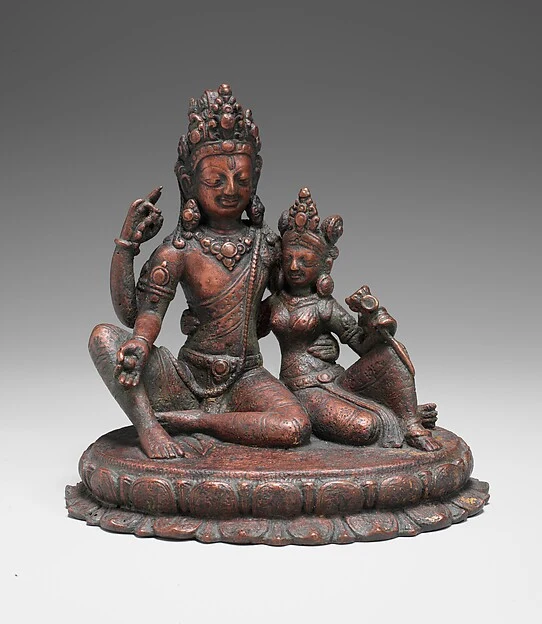
Śiva sits with Umā, his consort, in this sculpture from the Metropolitan Museum of Art. The paired figures give divine power a personal form.
The Metropolitan Museum of Art, 1982.456.2. Gift of Jeffrey B. Soref, 1982. · Image source ↗ · CC0
The Serpent Power in Arthur Avalon’s translation
Arthur Avalon opens The Serpent Power by explaining Śiva as pure consciousness and Śakti as its power. He distinguishes consciousness in its changeless aspect from the world of mind and body through which it manifests. [2][3][4]
Avalon describes awareness as self-illuminating. Its power also allows it to know itself and present what can be experienced. His account joins that ability to the emergence of distinct forms within consciousness. [5][6][7]
In Pūrṇānanda’s poem, Śakti takes the form of Kuṇḍalinī. She ascends through the lotuses to Śiva and their union is associated with liberation and bliss. She then returns to the root lotus. [8][9][10]
See references (9)
- The Serpent Power, Reader page 44
- The Serpent Power, Reader page 46
- The Serpent Power, printed p. 30, Reader page 47
- The Serpent Power, printed p. 33, Reader page 50
- The Serpent Power, printed p. 34, Reader page 51
- The Serpent Power, printed p. 42, Reader page 59
- The Serpent Power, printed p. 466, Reader page 491
- The Serpent Power, printed p. 473, Reader page 499
- The Serpent Power, printed p. 482, Reader page 509
Distinctions and comparisons
Avalon’s introduction asks how a world of distinct forms can appear through one consciousness. Pūrṇānanda’s poem gives that relationship the form of an ascent and union. It makes Śiva and Śakti part of a yogic account of liberation. [2][5][8][9][10]
In the library
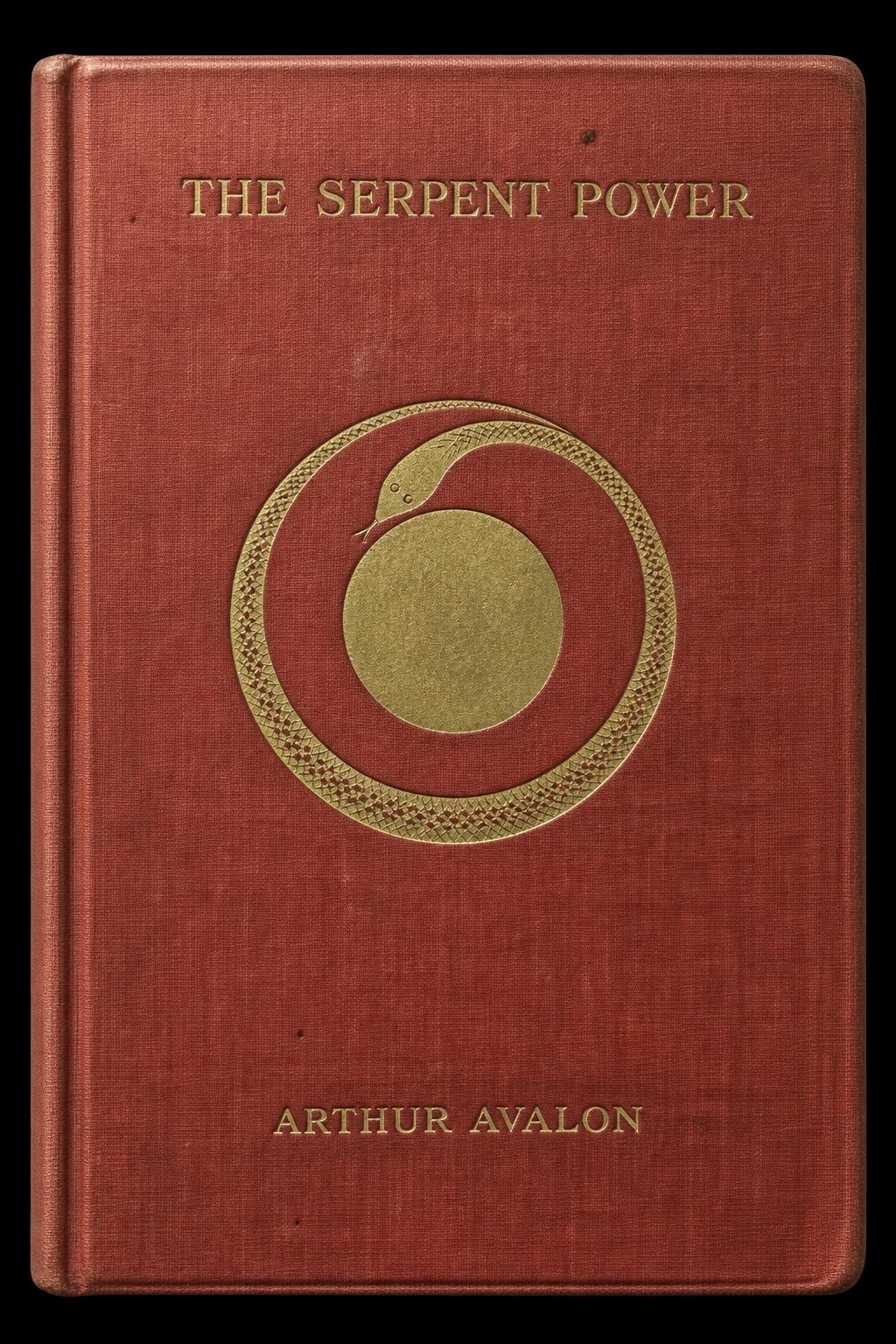
The Serpent Power
Reading note
The separately titled account draws on exact passages in the consulted Library edition.
Sources
See references (10)
- Shiva Seated with Uma (Umamaheshvara) ↗The Metropolitan Museum of Art, 1982.456.2. Gift of Jeffrey B. Soref, 1982.
- The Serpent Power, Reader page 44Arthur Avalon (Sir John Woodroffe), The Serpent Power, fifth enlarged edition, Ganesh & Co., Madras, 1953. Includes Pūrṇānanda’s Ṣaṭ-cakra-nirūpaṇa, Pādukā-pañcaka and Kālīcaraṇa’s commentary. Exact Library edition IMJ-0608-E001.Read this page in The Serpent Power ↗
- The Serpent Power, Reader page 46Arthur Avalon (Sir John Woodroffe), The Serpent Power, fifth enlarged edition, Ganesh & Co., Madras, 1953. Includes Pūrṇānanda’s Ṣaṭ-cakra-nirūpaṇa, Pādukā-pañcaka and Kālīcaraṇa’s commentary. Exact Library edition IMJ-0608-E001.Read this page in The Serpent Power ↗
- The Serpent Power, printed p. 30, Reader page 47Arthur Avalon (Sir John Woodroffe), The Serpent Power, fifth enlarged edition, Ganesh & Co., Madras, 1953. Includes Pūrṇānanda’s Ṣaṭ-cakra-nirūpaṇa, Pādukā-pañcaka and Kālīcaraṇa’s commentary. Exact Library edition IMJ-0608-E001.Read this page in The Serpent Power ↗
- The Serpent Power, printed p. 33, Reader page 50Arthur Avalon (Sir John Woodroffe), The Serpent Power, fifth enlarged edition, Ganesh & Co., Madras, 1953. Includes Pūrṇānanda’s Ṣaṭ-cakra-nirūpaṇa, Pādukā-pañcaka and Kālīcaraṇa’s commentary. Exact Library edition IMJ-0608-E001.Read this page in The Serpent Power ↗
- The Serpent Power, printed p. 34, Reader page 51Arthur Avalon (Sir John Woodroffe), The Serpent Power, fifth enlarged edition, Ganesh & Co., Madras, 1953. Includes Pūrṇānanda’s Ṣaṭ-cakra-nirūpaṇa, Pādukā-pañcaka and Kālīcaraṇa’s commentary. Exact Library edition IMJ-0608-E001.Read this page in The Serpent Power ↗
- The Serpent Power, printed p. 42, Reader page 59Arthur Avalon (Sir John Woodroffe), The Serpent Power, fifth enlarged edition, Ganesh & Co., Madras, 1953. Includes Pūrṇānanda’s Ṣaṭ-cakra-nirūpaṇa, Pādukā-pañcaka and Kālīcaraṇa’s commentary. Exact Library edition IMJ-0608-E001.Read this page in The Serpent Power ↗
- The Serpent Power, printed p. 466, Reader page 491Arthur Avalon (Sir John Woodroffe), The Serpent Power, fifth enlarged edition, Ganesh & Co., Madras, 1953. Includes Pūrṇānanda’s Ṣaṭ-cakra-nirūpaṇa, Pādukā-pañcaka and Kālīcaraṇa’s commentary. Exact Library edition IMJ-0608-E001.Read this page in The Serpent Power ↗
- The Serpent Power, printed p. 473, Reader page 499Arthur Avalon (Sir John Woodroffe), The Serpent Power, fifth enlarged edition, Ganesh & Co., Madras, 1953. Includes Pūrṇānanda’s Ṣaṭ-cakra-nirūpaṇa, Pādukā-pañcaka and Kālīcaraṇa’s commentary. Exact Library edition IMJ-0608-E001.Read this page in The Serpent Power ↗
- The Serpent Power, printed p. 482, Reader page 509Arthur Avalon (Sir John Woodroffe), The Serpent Power, fifth enlarged edition, Ganesh & Co., Madras, 1953. Includes Pūrṇānanda’s Ṣaṭ-cakra-nirūpaṇa, Pādukā-pañcaka and Kālīcaraṇa’s commentary. Exact Library edition IMJ-0608-E001.Read this page in The Serpent Power ↗