Shadow capture
In the Ramayana, Simhika stops Hanuman by seizing his shadow. Read how he recognises the danger and compare two accounts of how he escapes.
In this article
How Simhika catches Hanuman
Shadow capture is the folklore motif of holding someone by grasping their shadow. As Hanuman flies to Lanka in the Ramayana, Simhika seizes his shadow on the sea below. Although she is far beneath him, her grasp slows him down. The shadow gives her a way to reach someone out of reach. [3][1]
Simhika in the Sundara Kanda
In Sundara Kanda 5.1.182–199, translated by Kishore Kopalle, Hanuman first feels resistance like a ship facing a contrary wind. He looks down, sees a creature in the sea and remembers Sugriva’s warning about a shadow-grasper. He grows, then contracts to go through her mouth. [1]
To spectators, Hanuman’s disappearance looks like Rāhu swallowing the full moon. When he emerges, they credit him with courage, perception, intelligence and skill. [1]
Indian Myth and Legend by Donald A. Mackenzie
In Indian Myth and Legend, Donald A. Mackenzie describes Hanuman growing enormous for the leap. Surasa, mother of the Nagas, demands that he go through her mouth. He makes himself small enough to pass in and out, and she lets him continue. [3]
Simhika instead stops him by grasping his shadow before trying to swallow him. He again makes himself small and enters through her mouth, this time to kill a predator. [3]
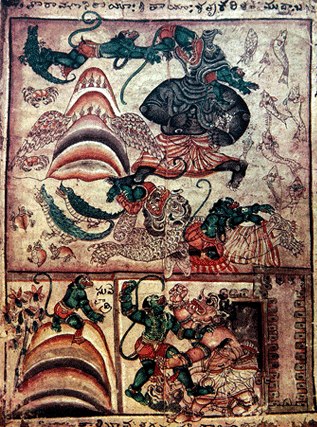
A painted Ramayana folio gathers Hanuman’s encounters with Surasa, Simhika and Lankini.
Andhra Ramayana painting, artist unrecorded. Wikimedia Commons, public domain reproduction. JPEG derivative. · Image source ↗ · Public Domain
Feeling the pull before seeing its cause
Mackenzie tells the reader what Simhika does as soon as she appears. The Sundara Kanda lets Hanuman feel the pull, search for its source and identify the creature himself. The eclipse image comes later, when the spectators see him disappear. [3][1]
Read further in the library
Indian Myth and Legend
Reading note
The separately titled account draws on exact passages in the consulted Library edition.
Sources
See references (3)
- Valmiki Ramayana, Sundara Kanda 5.1, translated by Kishore Kopalle ↗Verses 76–77, 167–169 and 182–199 consulted for the shadow on the water and the encounters with Surasa and Simhika.Return to text ↑
- Hanuman encounters Surasa, Simhika and Lankini, 17th–18th century, as catalogued on Commons ↗Andhra Ramayana painting, artist unrecorded. Wikimedia Commons, public domain reproduction. JPEG derivative.
- Indian Myth and Legend, Reader page 506Donald A. Mackenzie, Indian Myth and Legend, Gresham Publishing Company Limited, London, undated consulted impression. Library edition IMJ-0649-E001. Persistent PageIDs and current Reader positions verified against the supplied PDF and cached Reader manifest. Embedded translations are Mackenzie’s presentation unless a separately consulted primary text is named.Read this page in Indian Myth and Legend ↗Return to text ↑