Śabda and Artha
Śabda and artha connect sound, meaning and form. Arthur Avalon uses the word for a jar to explain how a sound brings an object to mind.
In this article
Word and meaning
Śabda is sound or word, and artha is what the sound signifies. Depending on the context, artha can be the object itself or the form it takes in the mind. The distinction makes it possible to ask what happens when a person understands a word for something they cannot see. [2][3][4][5]
The Serpent Power in Arthur Avalon’s translation
In The Serpent Power, Arthur Avalon considers ghaṭa, the Sanskrit word for a jar. Hearing the word can bring a jar to mind in its absence. Seeing a jar can produce a similar mental image. The sound and the object are two different ways of arriving at a form in thought. [3][4][5]
Avalon calls the mind’s act of distinguishing and naming subtle śabda. He calls the corresponding form assumed by the mind subtle artha. He then uses this pairing on a larger scale, describing how name and form arise together in manifestation. [2][3][5]
Avalon also records a disagreement about the status of spoken sound. Nyāya treats the uttered word as transient. In the Mīmāṃsā position he summarizes, a particular utterance makes lettered sound perceptible, and the lettered sound itself endures. [6][7]
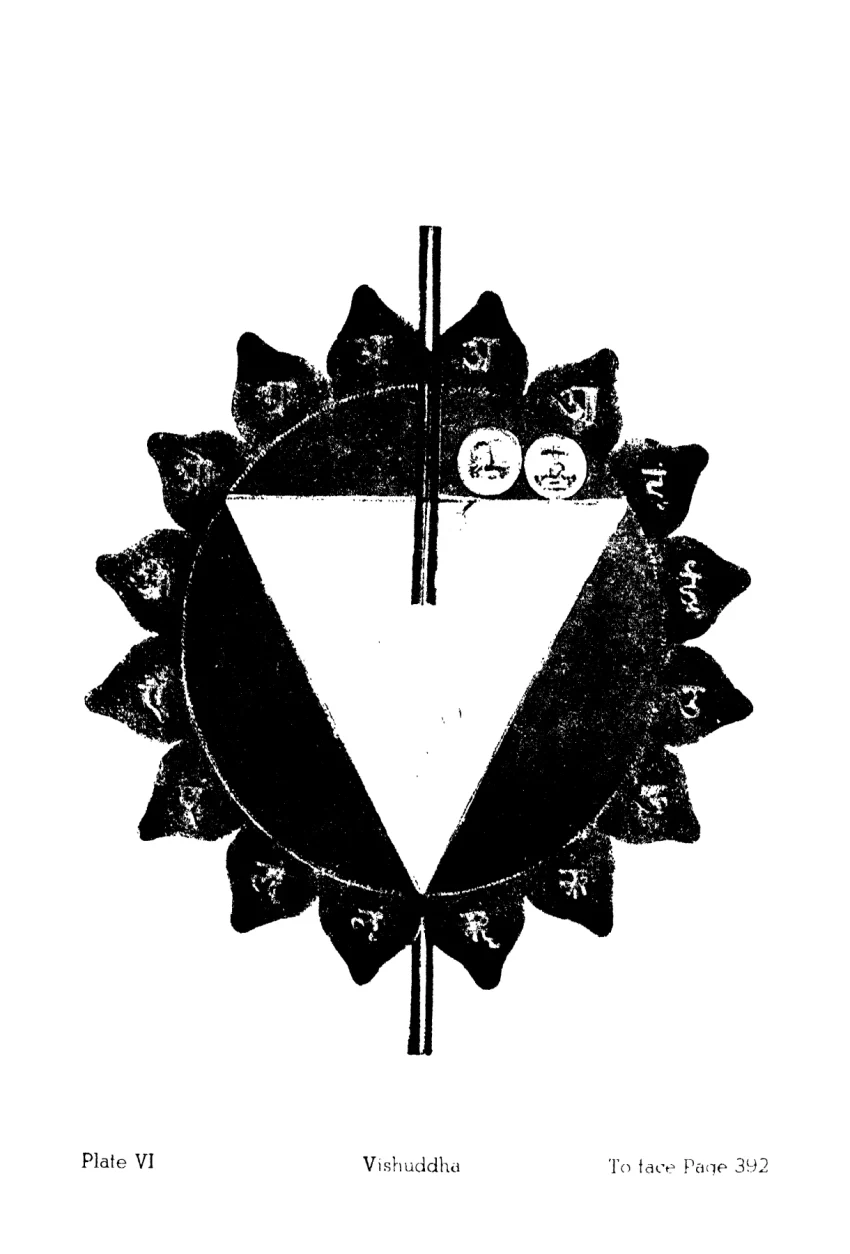
Plate VI shows Sanskrit letters on the petals of Viśuddha, the throat lotus. The diagram places lettered sound within the book’s map of the subtle body.
Illustrator unrecorded. The Serpent Power, Plate VI. Library facsimile, compared with the 1924 second edition. · Image source ↗ · Public Domain
See references (6)
Distinctions and comparisons
A seed mantra gives sound a different task. Ghaṭa calls a familiar object to mind, while Avalon presents the fire syllable as the audible expression of a subtle power. The example of the jar explains recognition. The example of the mantra explains a relation between sound and power. [8][5][9]
In the library
The Serpent Power
Reading note
Separately attributed primary Library account, cited on exact verified Reader leaves.
Sources
See references (9)
- The Serpent Power, Plate VI, Reader page 410Illustrator unrecorded. The Serpent Power, Plate VI. Library facsimile, compared with the 1924 second edition.Read this page in The Serpent Power ↗
- The Serpent Power, printed p. 88, Reader page 103Arthur Avalon (Sir John Woodroffe), The Serpent Power, fifth enlarged edition, Ganesh & Co., Madras, 1953. Includes Pūrṇānanda’s Ṣaṭ-cakra-nirūpaṇa, Pādukā-pañcaka and Kālīcaraṇa’s commentary. Exact Library edition IMJ-0608-E001.Read this page in The Serpent Power ↗
- The Serpent Power, printed p. 89, Reader page 104Arthur Avalon (Sir John Woodroffe), The Serpent Power, fifth enlarged edition, Ganesh & Co., Madras, 1953. Includes Pūrṇānanda’s Ṣaṭ-cakra-nirūpaṇa, Pādukā-pañcaka and Kālīcaraṇa’s commentary. Exact Library edition IMJ-0608-E001.Read this page in The Serpent Power ↗
- The Serpent Power, printed p. 90, Reader page 105Arthur Avalon (Sir John Woodroffe), The Serpent Power, fifth enlarged edition, Ganesh & Co., Madras, 1953. Includes Pūrṇānanda’s Ṣaṭ-cakra-nirūpaṇa, Pādukā-pañcaka and Kālīcaraṇa’s commentary. Exact Library edition IMJ-0608-E001.Read this page in The Serpent Power ↗
- The Serpent Power, printed p. 91, Reader page 106Arthur Avalon (Sir John Woodroffe), The Serpent Power, fifth enlarged edition, Ganesh & Co., Madras, 1953. Includes Pūrṇānanda’s Ṣaṭ-cakra-nirūpaṇa, Pādukā-pañcaka and Kālīcaraṇa’s commentary. Exact Library edition IMJ-0608-E001.Read this page in The Serpent Power ↗
- The Serpent Power, printed p. 86, Reader page 101Arthur Avalon (Sir John Woodroffe), The Serpent Power, fifth enlarged edition, Ganesh & Co., Madras, 1953. Includes Pūrṇānanda’s Ṣaṭ-cakra-nirūpaṇa, Pādukā-pañcaka and Kālīcaraṇa’s commentary. Exact Library edition IMJ-0608-E001.Read this page in The Serpent Power ↗
- The Serpent Power, printed p. 87, Reader page 102Arthur Avalon (Sir John Woodroffe), The Serpent Power, fifth enlarged edition, Ganesh & Co., Madras, 1953. Includes Pūrṇānanda’s Ṣaṭ-cakra-nirūpaṇa, Pādukā-pañcaka and Kālīcaraṇa’s commentary. Exact Library edition IMJ-0608-E001.Read this page in The Serpent Power ↗
- The Serpent Power, Reader page 98Arthur Avalon (Sir John Woodroffe), The Serpent Power, fifth enlarged edition, Ganesh & Co., Madras, 1953. Includes Pūrṇānanda’s Ṣaṭ-cakra-nirūpaṇa, Pādukā-pañcaka and Kālīcaraṇa’s commentary. Exact Library edition IMJ-0608-E001.Read this page in The Serpent Power ↗
- The Serpent Power, printed p. 97, Reader page 112Arthur Avalon (Sir John Woodroffe), The Serpent Power, fifth enlarged edition, Ganesh & Co., Madras, 1953. Includes Pūrṇānanda’s Ṣaṭ-cakra-nirūpaṇa, Pādukā-pañcaka and Kālīcaraṇa’s commentary. Exact Library edition IMJ-0608-E001.Read this page in The Serpent Power ↗