Seven Gods in a Cell
Why did Manly P. Hall assign planets to parts of a cell? Explore the sevenfold symbolism in his chapter The Story of the Cell.
In this article
A planetary map of a cell
The seven gods in a cell are planetary symbols that Manly P. Hall assigns to parts of a cell. He uses the cell as a small stage on which to picture the powers that he believed were at work in the formation of a body. [2][3][4][5]
Man the Grand Symbol of the Mysteries by Manly P. Hall
In Man the Grand Symbol of the Mysteries, Hall pairs the Sun with the cytoplasm, Saturn with the nucleus, the Moon with the centrosome, Mars with the region around the centrosome, and Venus with the nucleolus. He places Jupiter and Mercury within the field of the nucleolus. [2][3]
Hall describes the four outer assignments as builders and groups Venus, Jupiter and Mercury as an inner triad. A later passage connects the seven powers with alchemical planets and metals and pictures their result as a golden child. [4][5]
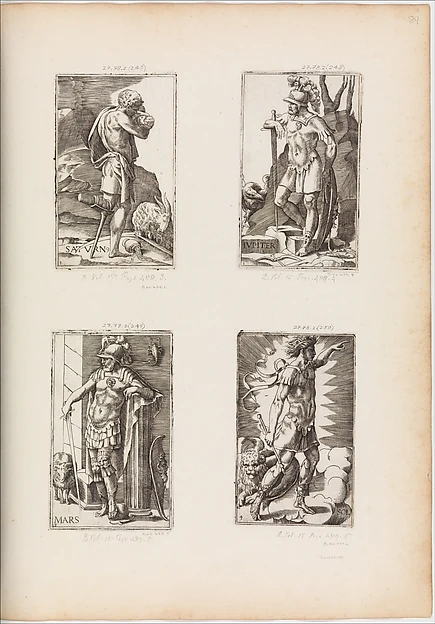
Giulio Bonasone personifies the Sun in his sixteenth-century print Sol. Hall gives the Sun a different place in his scheme, assigning it to the cytoplasm.
Giulio Bonasone, Sol, from Planets, plate 4. The Metropolitan Museum of Art. Harris Brisbane Dick Fund, 1927. · Image source ↗ · CC0
The same planets at two scales
Hall’s earlier discussion of the Zodiac Man locates planetary influences in the body. Here, he assigns planets to structures within a cell. The scale changes, and the same planet can stand for an organ in one scheme and a part of a cell in the other. [6][7][2][3][5]
See references (5)
- Man the Grand Symbol of the Mysteries, printed p. 153, Reader page 150
- Man the Grand Symbol of the Mysteries, printed p. 154, Reader page 151
- Man the Grand Symbol of the Mysteries, printed p. 156, Reader page 153
- Man the Grand Symbol of the Mysteries, printed p. 104, Reader page 102
- Man the Grand Symbol of the Mysteries, printed p. 105, Reader page 103
In the library
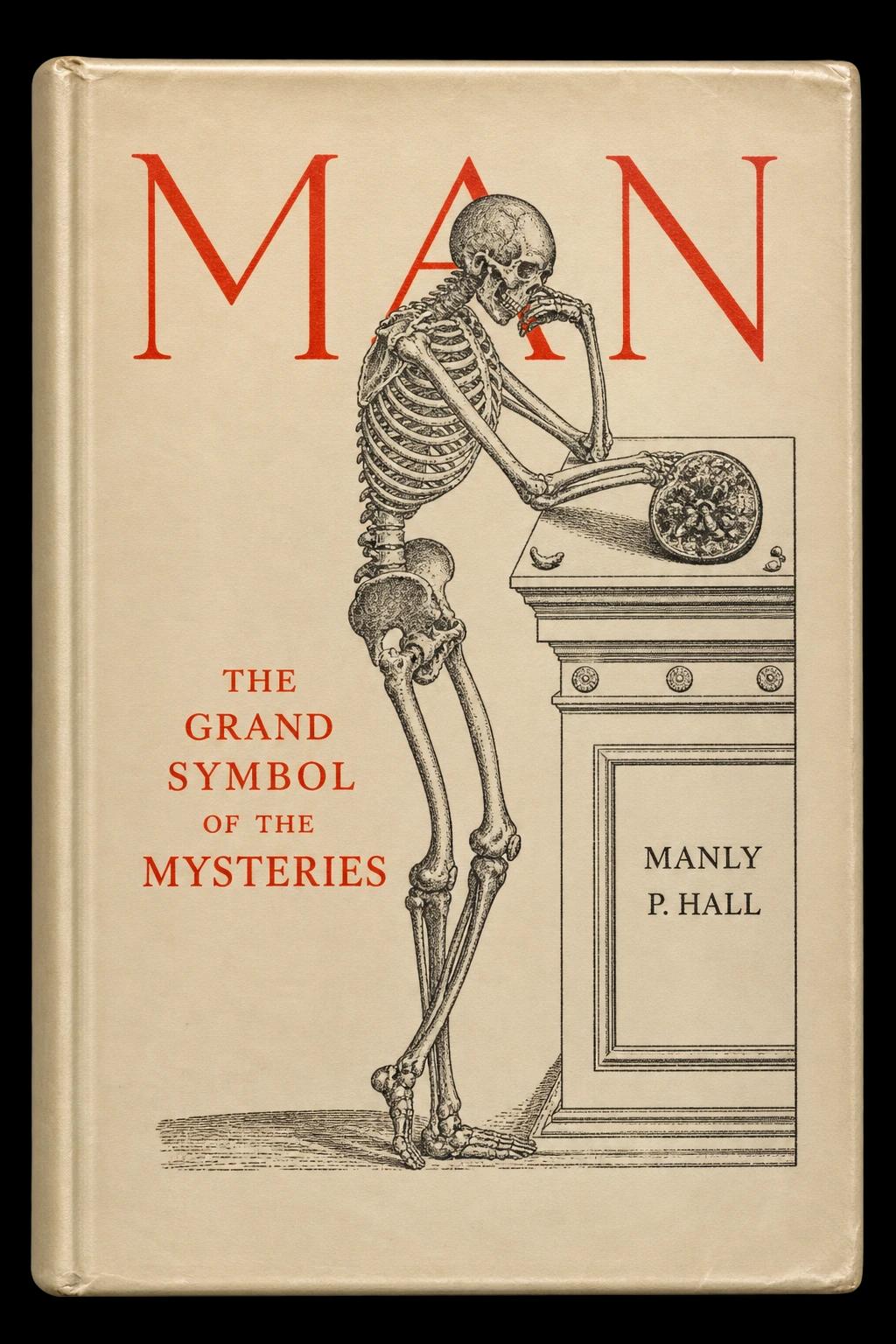
Man the Grand Symbol of the Mysteries
Reading note
The separately titled account draws on exact passages in the consulted Library edition.
Sources
See references (7)
- Giulio Bonasone, Sol, from Planets, plate 4 ↗Giulio Bonasone, Sol, from Planets, plate 4. The Metropolitan Museum of Art. Harris Brisbane Dick Fund, 1927.
- Man the Grand Symbol of the Mysteries, printed p. 153, Reader page 150Manly P. Hall, Man the Grand Symbol of the Mysteries, Fourth Edition, The Philosophers Press, Los Angeles, 1937. Lumitheca Library edition IMJ-0603-E001.Read this page in Man the Grand Symbol of the Mysteries ↗
- Man the Grand Symbol of the Mysteries, printed p. 154, Reader page 151Manly P. Hall, Man the Grand Symbol of the Mysteries, Fourth Edition, The Philosophers Press, Los Angeles, 1937. Lumitheca Library edition IMJ-0603-E001.Read this page in Man the Grand Symbol of the Mysteries ↗
- Man the Grand Symbol of the Mysteries, printed p. 155, Reader page 152Manly P. Hall, Man the Grand Symbol of the Mysteries, Fourth Edition, The Philosophers Press, Los Angeles, 1937. Lumitheca Library edition IMJ-0603-E001.Read this page in Man the Grand Symbol of the Mysteries ↗
- Man the Grand Symbol of the Mysteries, printed p. 156, Reader page 153Manly P. Hall, Man the Grand Symbol of the Mysteries, Fourth Edition, The Philosophers Press, Los Angeles, 1937. Lumitheca Library edition IMJ-0603-E001.Read this page in Man the Grand Symbol of the Mysteries ↗
- Man the Grand Symbol of the Mysteries, printed p. 104, Reader page 102Manly P. Hall, Man the Grand Symbol of the Mysteries, Fourth Edition, The Philosophers Press, Los Angeles, 1937. Lumitheca Library edition IMJ-0603-E001.Read this page in Man the Grand Symbol of the Mysteries ↗
- Man the Grand Symbol of the Mysteries, printed p. 105, Reader page 103Manly P. Hall, Man the Grand Symbol of the Mysteries, Fourth Edition, The Philosophers Press, Los Angeles, 1937. Lumitheca Library edition IMJ-0603-E001.Read this page in Man the Grand Symbol of the Mysteries ↗