Zodiac Man
The Zodiac Man maps the twelve signs onto the human body. See how early calendar woodcuts and Robert Fludd’s double zodiac pictured those correspondences.
In this article
What is the Zodiac Man?
The Zodiac Man is a historical diagram linking the twelve signs of the zodiac to parts of the body, from Aries at the head to Pisces at the feet. Some versions join signs to the figure with lines. Others place the symbols directly around it. [2][3][4]
The Strasbourg calendar woodcut below was used with an accompanying chart to indicate times and places on the body for bloodletting. That connection helps explain why a zodiac diagram appeared in a calendar. [2][3][1]
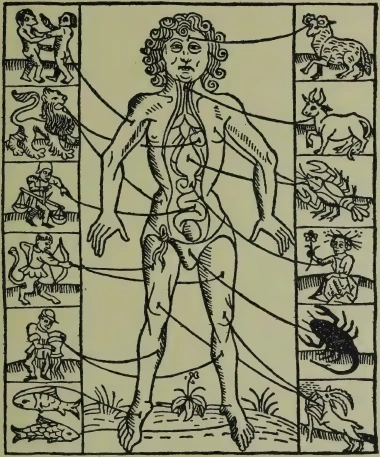
Zodiac Man from the Strasbourg Martyrologium, c. 1484, reproduced as figure 197.
Martyrologium der Heiligen nach dem Kalender, Strasbourg, c. 1484, as reproduced by De Givry. · Image source ↗ · Public Domain
Man the Grand Symbol of the Mysteries by Manly P. Hall
Manly P. Hall follows the familiar head-to-foot order, but his list contains a telling disagreement. Leo is given jurisdiction over the stomach, which Hall says most astrologers assign to Cancer. [5][6]
Hall also describes a scheme in which signs govern systems spread through the body. In that scheme Aries corresponds to marrow and Leo to arteries. A separate figure he reproduces gives the planets jurisdiction over individual organs. [7][8]
Witchcraft Magic & Alchemy by Grillot de Givry
Grillot de Givry reproduces a Strasbourg calendar woodcut beside a figure from the French Shepherds’ Calendar. In the first, signs are arranged in columns. Lines attach them to different regions of a central figure. In the French example, the signs themselves cover or surround the figure, so the same general order can be read without following the same set of lines. [3][4]
Robert Fludd’s body is ringed by two sets of zodiac marks. De Givry notes that where an earlier map gives an opening of the stomach to Cancer, Fludd assigns the stomach to Leo. The drawings agree on the overall body map while differing in particulars. [4]
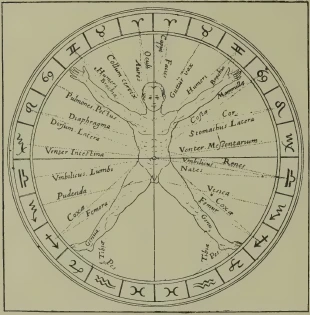
Robert Fludd’s double zodiac, reproduced as figure 199. It differs in several placements from the calendar figure.
Robert Fludd, Utriusque cosmi historia. Double zodiac reproduced by De Givry. · Image source ↗ · Public Domain
Body regions, organs and systems
The calendar assigns signs to bodily regions. Hall also records correspondences for tissues and bodily systems. Those different purposes explain why the same sign can carry more than one anatomical association. [3][4][5][6][7][8]
See references (6)
- Witchcraft Magic & Alchemy, printed p. 241, Reader page 234
- Witchcraft Magic & Alchemy, printed p. 242, Reader page 235
- Man the Grand Symbol of the Mysteries, printed p. 102, Reader page 100
- Man the Grand Symbol of the Mysteries, printed p. 103, Reader page 101
- Man the Grand Symbol of the Mysteries, printed p. 104, Reader page 102
- Man the Grand Symbol of the Mysteries, printed p. 105, Reader page 103
In the library
Witchcraft Magic and Alchemy
Reading note
The separately titled account draws on exact passages in the consulted Library edition.
Man the Grand Symbol of the Mysteries
Reading note
The separately titled account draws on exact passages in the consulted Library edition.
Sources
See references (8)
- Martyrologium, circa 1484 ↗Bernard Becker Medical Library Archives, Washington University School of Medicine. Catalogue description of the zodiac figure.
- Witchcraft Magic & Alchemy, printed p. 240, Reader page 233Grillot de Givry, Witchcraft Magic & Alchemy, translated by J. Courtenay Locke. Boston and New York, Houghton Mifflin Company, 1931.Read this page in Witchcraft Magic and Alchemy ↗
- Witchcraft Magic & Alchemy, printed p. 241, Reader page 234Grillot de Givry, Witchcraft Magic & Alchemy, translated by J. Courtenay Locke. Boston and New York, Houghton Mifflin Company, 1931.Read this page in Witchcraft Magic and Alchemy ↗
- Witchcraft Magic & Alchemy, printed p. 242, Reader page 235Grillot de Givry, Witchcraft Magic & Alchemy, translated by J. Courtenay Locke. Boston and New York, Houghton Mifflin Company, 1931.Read this page in Witchcraft Magic and Alchemy ↗
- Man the Grand Symbol of the Mysteries, printed p. 102, Reader page 100Manly P. Hall, Man the Grand Symbol of the Mysteries, Fourth Edition, The Philosophers Press, Los Angeles, 1937. Lumitheca Library edition IMJ-0603-E001.Read this page in Man the Grand Symbol of the Mysteries ↗
- Man the Grand Symbol of the Mysteries, printed p. 103, Reader page 101Manly P. Hall, Man the Grand Symbol of the Mysteries, Fourth Edition, The Philosophers Press, Los Angeles, 1937. Lumitheca Library edition IMJ-0603-E001.Read this page in Man the Grand Symbol of the Mysteries ↗
- Man the Grand Symbol of the Mysteries, printed p. 104, Reader page 102Manly P. Hall, Man the Grand Symbol of the Mysteries, Fourth Edition, The Philosophers Press, Los Angeles, 1937. Lumitheca Library edition IMJ-0603-E001.Read this page in Man the Grand Symbol of the Mysteries ↗
- Man the Grand Symbol of the Mysteries, printed p. 105, Reader page 103Manly P. Hall, Man the Grand Symbol of the Mysteries, Fourth Edition, The Philosophers Press, Los Angeles, 1937. Lumitheca Library edition IMJ-0603-E001.Read this page in Man the Grand Symbol of the Mysteries ↗