Seven Deadly Sins in Dante’s Purgatory
Dante’s seven deadly sins in order are pride, envy, wrath, sloth, avarice, gluttony and lust. Follow each terrace in Purgatorio with Cary’s illustrated edition.
Dante’s Divine Comedy Reading Order ↗In this article
Map of Dante’s seven terraces
Climb from Pride at the bottom to Lust at the top. The gate is below the first terrace. The Earthly Paradise is above the seventh.
Earthly Paradise above the seventh terrace
- 1PrideBent under stonesX–XII
- 2EnvyEyes sewn shutXIII–XV
- 3WrathBlinded by smokeXV–XVII
- 4SlothRunning without restXVII–XIX
- 5Avarice and prodigalityLying face downXIX–XXII
- 6GluttonyHunger and thirstXXII–XXV
- 7LustWalking through fireXXV–XXVII
Gate of Purgatory Canto IX
What are the seven deadly sins?
In Dante’s Purgatorio, the seven deadly sins in order from the bottom terrace to the top are pride, envy, wrath, sloth, avarice, gluttony and lust. The Catholic Catechism lists the same seven in a different sequence and calls them capital vices because they can give rise to other sins. For instance, envy can make another person’s success feel like a private loss and give rise to spiteful speech or acts. [1][5][6]
Why Dante puts the sins in this order
In Purgatorio XVII, Virgil sorts disordered love into three kinds. Pride, envy and wrath wish for some injury or loss to another person. Sloth puts too little effort into pursuing the good. Avarice, gluttony and lust give too much weight to lesser goods. The mountain makes this argument visible as a climb: the first three terraces address harm directed at others, the middle terrace addresses deficient love, and the upper three address excessive attachment. [5][6]
At the gate in Canto IX, an angel marks Dante’s forehead seven times. At the end of the first terrace an angel removes the first mark, and Dante notices that climbing has become easier. The body registers a moral change before the journey reaches its summit. The terraces are episodes of purification, and the people on them expect to leave when their work is done. [2][4][12]
The seven terraces, their penances and their cantos
- Pride, Cantos X–XII. The proud carry heavy stones and are bent towards the pavement. Look for the exemplars of humility on the wall and the images of ruined pride on the ground. A soul who once sought to stand above others now has to look down and move at the pace of the other penitents. [3][4][13]
- Envy, Cantos XIII–XV. The souls’ eyelids are sewn shut, and they lean on one another for support. Their dependence reverses the habit of seeing the good of a neighbour as a threat. The examples they hear give them a way to consider generosity without relying on sight. [14][12][13]
- Wrath, Cantos XV–XVII. Smoke blots out the landscape and obliges Dante to rely on another’s guidance. Here Marco Lombardo argues that the stars cannot relieve people of responsibility for their choices. His discussion belongs inside the smoke, where Dante must learn how to proceed without a clear view. [15][16][12][13]
- Sloth, Cantos XVII–XIX. The penitents run, calling out examples of zeal. Their movement answers the failing Virgil has just described. The particular sense of sloth here is insufficient eagerness for the good, which the runners counter with haste and sustained effort. [6][7]
- Avarice and prodigality, Cantos XIX–XXI, with the departure in XXII. The penitents lie face down. Pope Adrian V explains how earthly attachments held their eyes down during life. The poet Statius later explains that he purified the contrary fault of prodigality. Dante puts grasping and waste on the same terrace because both distort the use of wealth. [8][12][13]
- Gluttony, Cantos XXII–XXIV, with the climb in XXV. The souls grow thin as they pass a tree whose fruit and water sharpen their longing. Dante recognises Forese Donati by his voice. Putting that familiar voice into an unfamiliar, emaciated body makes visible the difference between a person and the appetite being corrected. [9][12]
- Lust, Cantos XXV–XXVII. The penitents walk in flames, sing and call out examples of chastity. Dante eventually has to cross the fire himself. Virgil’s reminder that Beatrice is beyond it changes what the barrier means for him. After the last terrace, Dante reaches the Earthly Paradise at the mountain’s summit. [10][17][12][13]
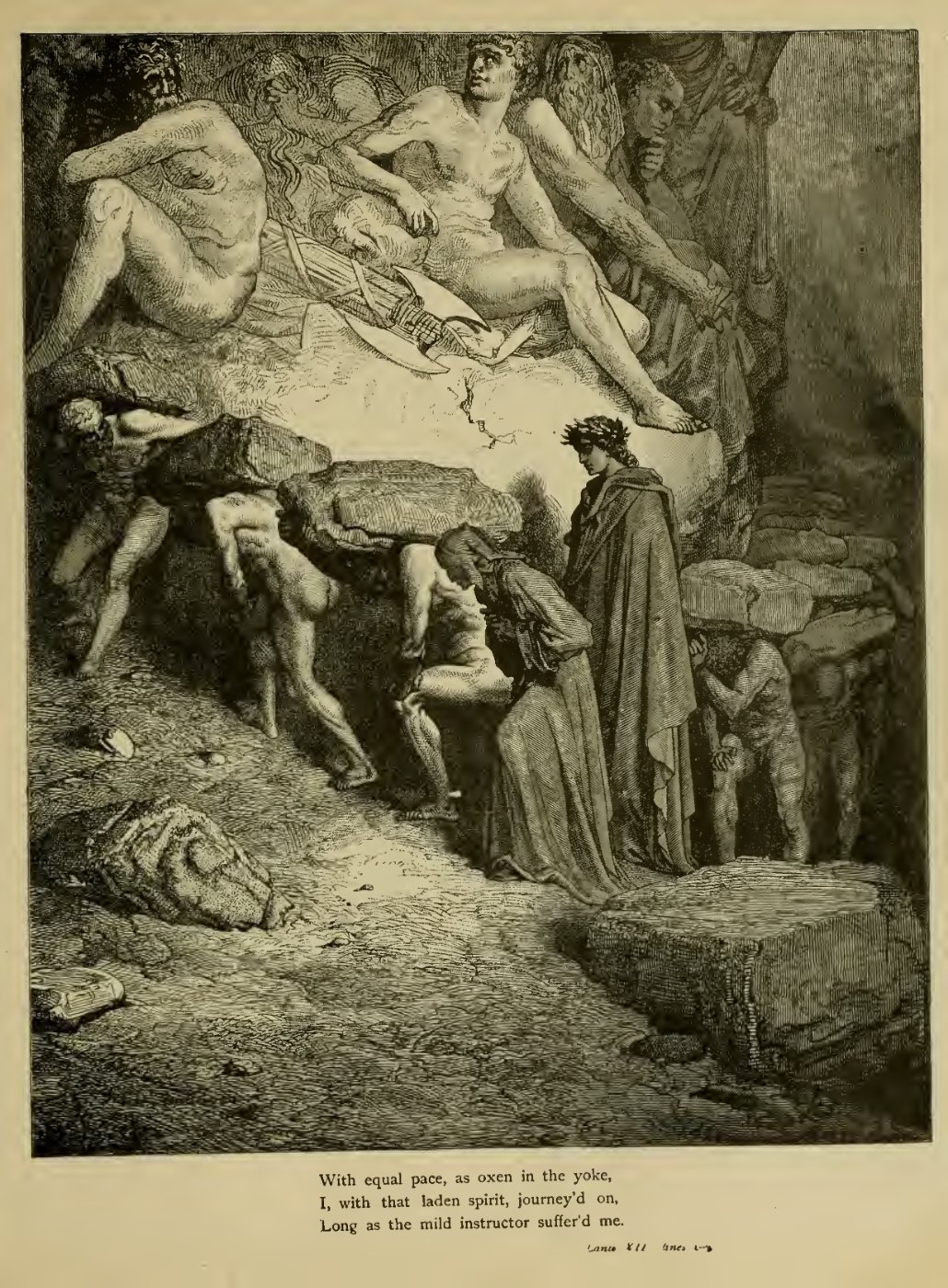
The burden of pride in Doré’s design for Purgatory XII. Dante lowers himself to walk beside a penitent. The image belongs to the poem’s corrective mountain, where the souls expect release.
Design by Gustave Doré. Purgatory and Paradise, Henry Francis Cary translation, Thompson & Thomas, Chicago, 1901. Public Domain. · Image source ↗ · Public Domain
See references (13)
- Purgatory and Paradise, Purgatory XI, Reader page 68
- Purgatory and Paradise, Purgatory XII, Reader page 76
- Purgatory and Paradise, Purgatory XVII, Reader page 106
- Purgatory and Paradise, Purgatory XVIII, Reader page 110
- Purgatory and Paradise, Purgatory XIX, Reader page 118
- Purgatory and Paradise, Purgatory XXIII, Reader page 138
- Purgatory and Paradise, Purgatory XXV, Reader page 153
- Danteworlds, Purgatorio and the terraces
- Princeton Dante Project, text of the Divine Comedy
- Purgatorio XIII · The wire that closes the eyes of the envious
- Purgatorio XVI · Marco Lombardo speaks through the smoke
- Purgatorio XVI · Marco Lombardo locates responsibility in human choice
- Purgatorio XXVII · Virgil brings Dante through the wall of fire
Are the seven sins the same as the circles of Hell?
Dante uses different structures for the two realms. Purgatorio has seven terraces for seven patterns of disordered love. Inferno has nine circles and includes categories such as heresy, violence, fraud and treachery. The lost souls in Hell stay where Dante meets them. In Purgatory, figures such as Statius can finish their penance and begin the climb again. Knowing which canticle you have open is the quickest way to resolve a conflicting list. [12][13]
Start with Virgil’s explanation in Canto XVII, then try the pride scenes in Cantos XI–XII and Pope Adrian’s explanation in Canto XIX. In Cary’s illustrated edition you can move between text and engraving. Keep the canticle and Roman canto number in your notes. The printed page and the Reader leaf identify a particular copy, while the canto number lets another reader find the passage in a different translation. [5][3][11][8]
See references (6)
- Purgatory and Paradise, Purgatory XI, Reader page 68
- Purgatory and Paradise, Purgatory XVII, Reader page 105
- Purgatory and Paradise, Purgatory XIX, Reader page 118
- Purgatory and Paradise, Purgatory XII, Reader page 73
- Danteworlds, Purgatorio and the terraces
- Princeton Dante Project, text of the Divine Comedy
Read further in the library
Purgatory and Paradise: The Vision of Dante
Reading note
A separately attributed account in the consulted Cary translation, with exact current Library Reader leaves.
Sources
See references (17)
- Catechism of the Catholic Church, 1865–1869: capital sins and vice ↗Catholic Church, official account of habitual vice and the seven capital sins.Return to text ↑
- Purgatory and Paradise, Purgatory IX, Reader page 59Dante Alighieri, The Divine Comedy, translated by Henry Francis Cary. Inferno: undated New Edition, Thompson & Thomas, Chicago. Purgatory and Paradise: New Edition, Thompson & Thomas, Chicago, 1901. Designs by Gustave Doré.Read this page in Purgatory and Paradise: The Vision of Dante ↗Return to text ↑
- Purgatory and Paradise, Purgatory XI, Reader page 68Dante Alighieri, The Divine Comedy, translated by Henry Francis Cary. Inferno: undated New Edition, Thompson & Thomas, Chicago. Purgatory and Paradise: New Edition, Thompson & Thomas, Chicago, 1901. Designs by Gustave Doré.Read this page in Purgatory and Paradise: The Vision of Dante ↗Return to text ↑
- Purgatory and Paradise, Purgatory XII, Reader page 76Dante Alighieri, The Divine Comedy, translated by Henry Francis Cary. Inferno: undated New Edition, Thompson & Thomas, Chicago. Purgatory and Paradise: New Edition, Thompson & Thomas, Chicago, 1901. Designs by Gustave Doré.Read this page in Purgatory and Paradise: The Vision of Dante ↗Return to text ↑
- Purgatory and Paradise, Purgatory XVII, Reader page 105Dante Alighieri, The Divine Comedy, translated by Henry Francis Cary. Inferno: undated New Edition, Thompson & Thomas, Chicago. Purgatory and Paradise: New Edition, Thompson & Thomas, Chicago, 1901. Designs by Gustave Doré.Read this page in Purgatory and Paradise: The Vision of Dante ↗Return to text ↑
- Purgatory and Paradise, Purgatory XVII, Reader page 106Dante Alighieri, The Divine Comedy, translated by Henry Francis Cary. Inferno: undated New Edition, Thompson & Thomas, Chicago. Purgatory and Paradise: New Edition, Thompson & Thomas, Chicago, 1901. Designs by Gustave Doré.Read this page in Purgatory and Paradise: The Vision of Dante ↗Return to text ↑
- Purgatory and Paradise, Purgatory XVIII, Reader page 110Dante Alighieri, The Divine Comedy, translated by Henry Francis Cary. Inferno: undated New Edition, Thompson & Thomas, Chicago. Purgatory and Paradise: New Edition, Thompson & Thomas, Chicago, 1901. Designs by Gustave Doré.Read this page in Purgatory and Paradise: The Vision of Dante ↗Return to text ↑
- Purgatory and Paradise, Purgatory XIX, Reader page 118Dante Alighieri, The Divine Comedy, translated by Henry Francis Cary. Inferno: undated New Edition, Thompson & Thomas, Chicago. Purgatory and Paradise: New Edition, Thompson & Thomas, Chicago, 1901. Designs by Gustave Doré.Read this page in Purgatory and Paradise: The Vision of Dante ↗Return to text ↑
- Purgatory and Paradise, Purgatory XXIII, Reader page 138Dante Alighieri, The Divine Comedy, translated by Henry Francis Cary. Inferno: undated New Edition, Thompson & Thomas, Chicago. Purgatory and Paradise: New Edition, Thompson & Thomas, Chicago, 1901. Designs by Gustave Doré.Read this page in Purgatory and Paradise: The Vision of Dante ↗Return to text ↑
- Purgatory and Paradise, Purgatory XXV, Reader page 153Dante Alighieri, The Divine Comedy, translated by Henry Francis Cary. Inferno: undated New Edition, Thompson & Thomas, Chicago. Purgatory and Paradise: New Edition, Thompson & Thomas, Chicago, 1901. Designs by Gustave Doré.Read this page in Purgatory and Paradise: The Vision of Dante ↗Return to text ↑
- Purgatory and Paradise, Purgatory XII, Reader page 73Dante Alighieri, The Divine Comedy, translated by Henry Francis Cary. Inferno: undated New Edition, Thompson & Thomas, Chicago. Purgatory and Paradise: New Edition, Thompson & Thomas, Chicago, 1901. Designs by Gustave Doré.Read this page in Purgatory and Paradise: The Vision of Dante ↗Return to text ↑
- Danteworlds, Purgatorio and the terraces ↗University of Texas at Austin, Danteworlds illustrated itineraryReturn to text ↑
- Princeton Dante Project, text of the Divine Comedy ↗Princeton Dante Project, Italian text and Dante resourcesReturn to text ↑
- Purgatorio XIII · The wire that closes the eyes of the enviousDante Alighieri, Purgatory and Paradise, translated by Henry Francis Cary, Thompson & Thomas, 1901.Read this page in Purgatory and Paradise: The Vision of Dante ↗Return to text ↑
- Purgatorio XVI · Marco Lombardo speaks through the smokeDante Alighieri, Purgatory and Paradise, translated by Henry Francis Cary, Thompson & Thomas, 1901.Read this page in Purgatory and Paradise: The Vision of Dante ↗Return to text ↑
- Purgatorio XVI · Marco Lombardo locates responsibility in human choiceDante Alighieri, Purgatory and Paradise, translated by Henry Francis Cary, Thompson & Thomas, 1901.Read this page in Purgatory and Paradise: The Vision of Dante ↗Return to text ↑
- Purgatorio XXVII · Virgil brings Dante through the wall of fireDante Alighieri, Purgatory and Paradise, translated by Henry Francis Cary, Thompson & Thomas, 1901.Read this page in Purgatory and Paradise: The Vision of Dante ↗Return to text ↑