Dante’s Divine Comedy Reading Order
Read the Divine Comedy in this order: Inferno, Purgatorio, Paradiso. Start with Inferno I in the dark wood, follow Virgil through Hell and up the mountain, then follow Beatrice through the heavens. The poem has 100 cantos across its three parts.
Read the three canticles in order
Begin with Inferno, continue to Purgatorio, then read Paradiso. Cary’s two illustrated Library volumes contain all three canticles. Purgatorio and Paradiso share a physical volume and each starts its own sequence of canto numbers.
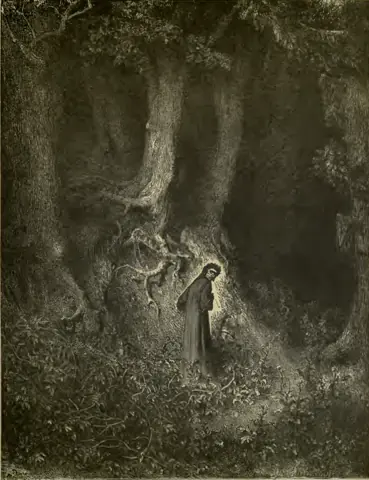
Inferno
34 cantosFrom the dark wood to the frozen centre, Dante learns the geography of Hell with Virgil.
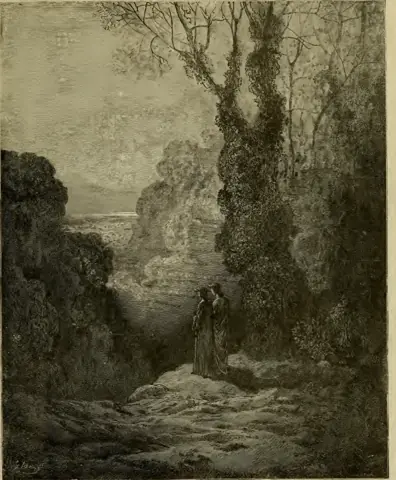
Purgatorio
33 cantosThe travellers reach the shore before climbing the mountain. Repentance and the possibility of change shape the ascent.
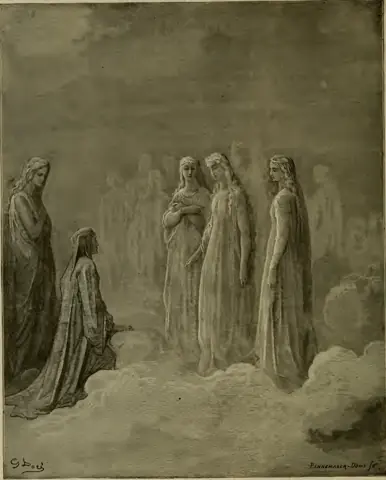
Paradiso
33 cantosBeatrice leads Dante through the heavens. Light, distance and vision take on new meanings as the journey proceeds.
Where to start and when to move on
Canto I opens with Dante lost in a wood. A path uphill looks promising until three beasts block it. Virgil then offers a way forward that begins by going down. Read that opening before looking up the nine circles. The wood, the hill and the change of route explain why the journey takes the shape it does.
At the end of Inferno the travellers climb away from the frozen centre and see the stars again. Purgatorio begins at the other end of that passage, in open air by the sea. Begin its own Canto I there. Paradiso continues from the garden at the top of the mountain, where Beatrice has already taken over from Virgil.
Follow the guides as the poem changes
Virgil guides Dante through Hell and most of Purgatory. Look for the moment when Dante turns to consult him in the Earthly Paradise and finds him gone. Beatrice then speaks for herself. The handover changes the kind of help Dante receives and gives their reunion a sharp edge.
Beatrice remains Dante’s principal guide through the heavens. Near the end of Paradiso, Bernard of Clairvaux takes her place as guide. The closing cantos shift from travelling between places to learning how to look. The river of light and the white rose are places to see that change in the language and in Doré’s plates.
Which translation should you read first?
Henry Francis Cary’s blank verse has an older English register and keeps the same voice across the three canticles. It is the translation printed beside the Doré illustrations in the Library. If you are following those images, keeping Cary open lets the printed scene and the book’s caption stay together.
If a phrase in Cary slows you down, compare the same canto at Dartmouth’s Dante Lab. The stable locator is the canticle and canto, followed by line numbers if available. Page numbers change by edition. Cary’s English volume uses Purgatory and Paradise for the books you will also see called Purgatorio and Paradiso.
For a short comparison, put Cary and Longfellow side by side at the opening of Inferno I. See where each translator places the wood, the lost road and the first-person speaker. Both write in unrhymed English verse. Dante’s interlocking Italian rhyme gives the opening another kind of movement, which you can hear even before you can follow every word.
From Acheron to the Styx
The first part of the descent passes from the threshold of Hell through Limbo and the cold rain of the third circle. The two ferrymen mark different crossings.
Charon, Dante’s Ferryman
The fiery-eyed boatman who gathers the dead at Acheron and objects to Dante’s living presence.
Limbo in the First Circle
The first circle, where worthy souls endure desire without hope of blessedness.
Cerberus in the Third Circle
The three-throated guardian among the gluttonous souls beneath ceaseless cold rain.
Ciacco and the Divided City
The Florentine soul who answers Dante’s questions about the city’s approaching strife.
Phlegyas, Ferryman of the Marsh
The angry boatman who carries the living traveller across the fifth circle.
The Stygian Lake
The dark marsh of the fifth circle, crossed before the city of Dis.
Filippo Argenti in the Mire
The Florentine spirit rejected from the boat during the Stygian crossing.
The descent into lower Hell
The Minotaur guards the broken passage into the seventh circle. Farther down, Dante finds Caina and Ptolomea among the divisions of the frozen ninth circle, where the kind of betrayal determines a soul’s place.
The Minotaur at the Broken Descent
The enraged guardian at the steep passage into the seventh circle.
Caina, the First Frozen Round
The first division of the frozen circle, introduced through entangled family figures.
Cocytus, the Frozen Lake
The lake of immobilising cold at the bottom of Dante’s Inferno.
Encounters in Purgatory
Sordello’s meeting with Virgil turns on their shared city of Mantua. Later, Marco Lombardo answers Dante’s question about whether the stars determine human conduct.