The Nine Circles of Hell in Dante’s Inferno
Dante’s Hell descends through nine circles. Limbo is the first, then come lust, gluttony, avarice and prodigality, wrath and sullenness, heresy, violence, fraud, and treachery. The vestibule stands before the first circle. The final three circles divide into smaller regions, and the journey ends at the frozen centre with Lucifer.
A map of the descent
Follow the circles down from Limbo to the ice at the centre. Each band jumps to the circle’s entry in the table.
All nine circles in order
| Circle | Canto | What happens | In the Reader |
|---|---|---|---|
| 1. Limbo | IV | The inhabitants sigh and live with desire without hope. Dante encounters Virgil’s fellow poets and other distinguished figures. | Read passage ↗ |
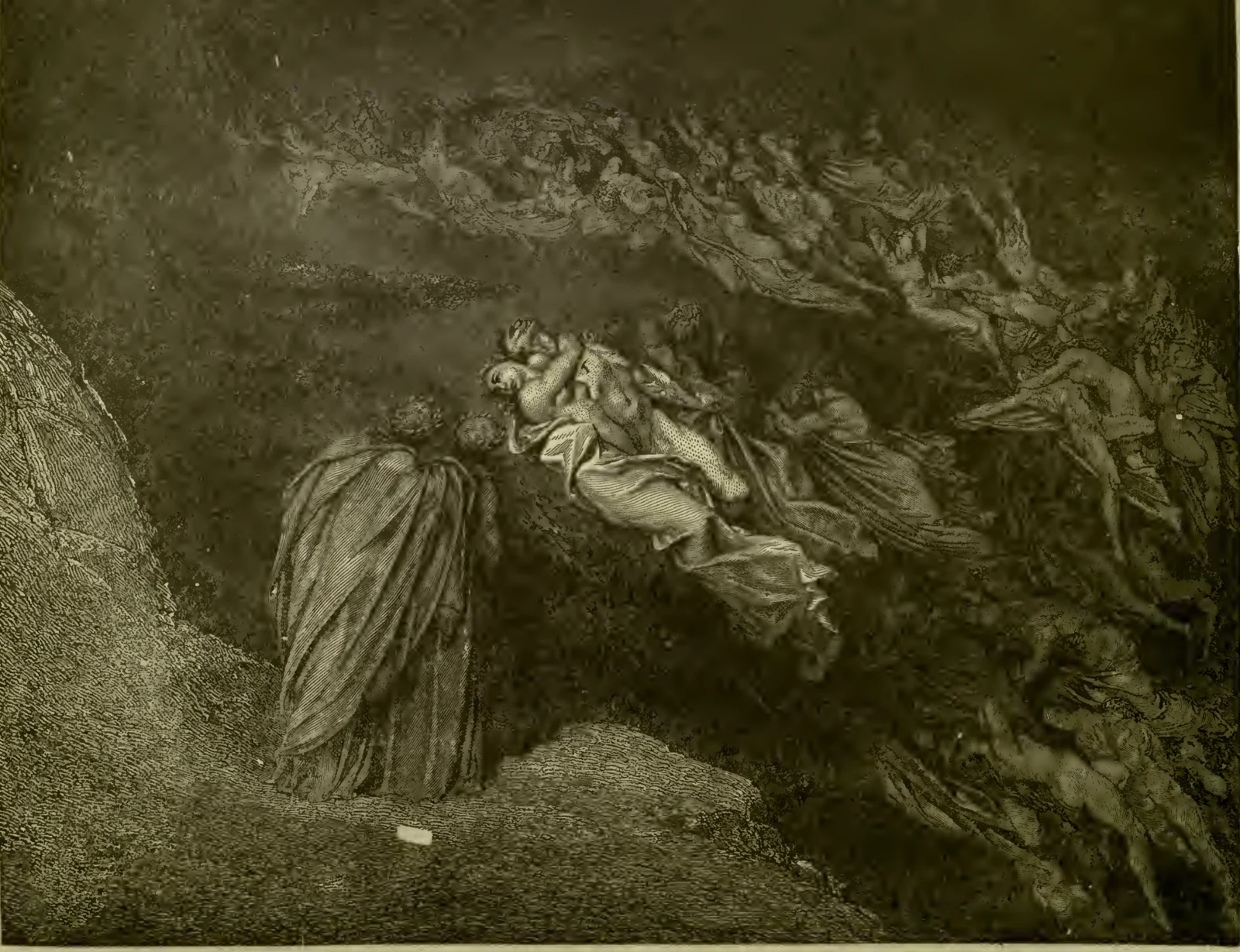
| 2. Lust | V | An unceasing wind sweeps the souls through darkness. Dante speaks to Francesca and hears how she and Paolo came to this place. | Read passage ↗ |
| 3. Gluttony | VI | Cold rain and hail fall on the souls in the mire. Cerberus barks over them and tears at them. | Read passage ↗ |
| 4. Avarice and prodigality | VII | Two crowds roll heavy weights in opposing directions and accuse each other of hoarding or squandering. | Read passage ↗ |
| 5. Wrath and sullenness | VII–VIII | The wrathful strike one another in the Styx. Those submerged beneath the surface make the water bubble with their speech. | Read passage ↗ |
| 6. Heresy | IX–XI | Inside Dis, the souls occupy burning tombs. Farinata rises from one and speaks to Dante about Florence. | Read passage ↗ |
| 7. Violence | XII–XVII | Three rings mark violence against others, against oneself, and against God, nature or art. They include a river of blood, a wood and burning sand. | Read passage ↗ |
| 8. Fraud | XVIII–XXX | Ten ditches called Malebolge separate kinds of fraud. Dante and Virgil approach them by riding on Geryon. | Read passage ↗ |
| 9. Treachery | XXXII–XXXIV | Cocytus holds betrayers in ice. Its four divisions lead inwards from Caina through Antenora and Ptolomea to Judecca. | Read passage ↗ |
The subdivisions of lower Hell
Circle seven: the three rings of violence
| Ring | Cantos | Landmark and punishment |
|---|---|---|
| Violence against others | XII | Tyrants and other killers are immersed at different depths in a river of boiling blood. Centaurs patrol the banks. |
| Violence against oneself | XIII | The suicides appear as trees whose branches the Harpies tear. The same wood contains the squanderers pursued by hounds. |
| Violence against God, nature and art | XIV–XVII | Fire falls on a plain of burning sand. Dante encounters blasphemers, people classified by the poem as violent against nature, and usurers. |
Circle eight: the ten ditches of Malebolge
| Ditch | Cantos | Who is there and what happens |
|---|---|---|
| 1. Panderers and seducers | XVIII | Two lines of shades move in opposite directions while demons whip them. |
| 2. Flatterers | XVIII | The shades are immersed in excrement. |
| 3. Simoniacs | XIX | People who trafficked in sacred offices stand headfirst in holes with flames at their feet. |
| 4. Diviners | XX | Their heads face backwards, so they walk without seeing the way ahead. |
| 5. Barrators | XXI–XXII | Corrupt public officials are held beneath boiling pitch by the Malebranche demons. |
| 6. Hypocrites | XXIII | Gilded cloaks lined with lead weigh down the procession. |
| 7. Thieves | XXIV–XXV | Serpents bind, burn or transform the thieves. |
| 8. Fraudulent counsellors | XXVI–XXVII | The shades are hidden inside tongues of flame. Ulysses and Diomedes share a double flame. |
| 9. Sowers of discord | XXVIII–XXIX | A sword repeatedly opens wounds that close between rounds of the ditch. |
| 10. Falsifiers | XXIX–XXX | Disease and bodily distress mark different kinds of falsification, including false coinage and impersonation. |
Circle nine: the four divisions of Cocytus
| Division | Cantos | The relationship betrayed |
|---|---|---|
| Caina | XXXII | Kin. The name refers to Cain’s killing of his brother Abel. |
| Antenora | XXXII–XXXIII | Homeland or political allegiance. Here Dante encounters Count Ugolino. |
| Ptolomea | XXXIII | Guests. The upturned shades’ tears freeze over their eyes. |
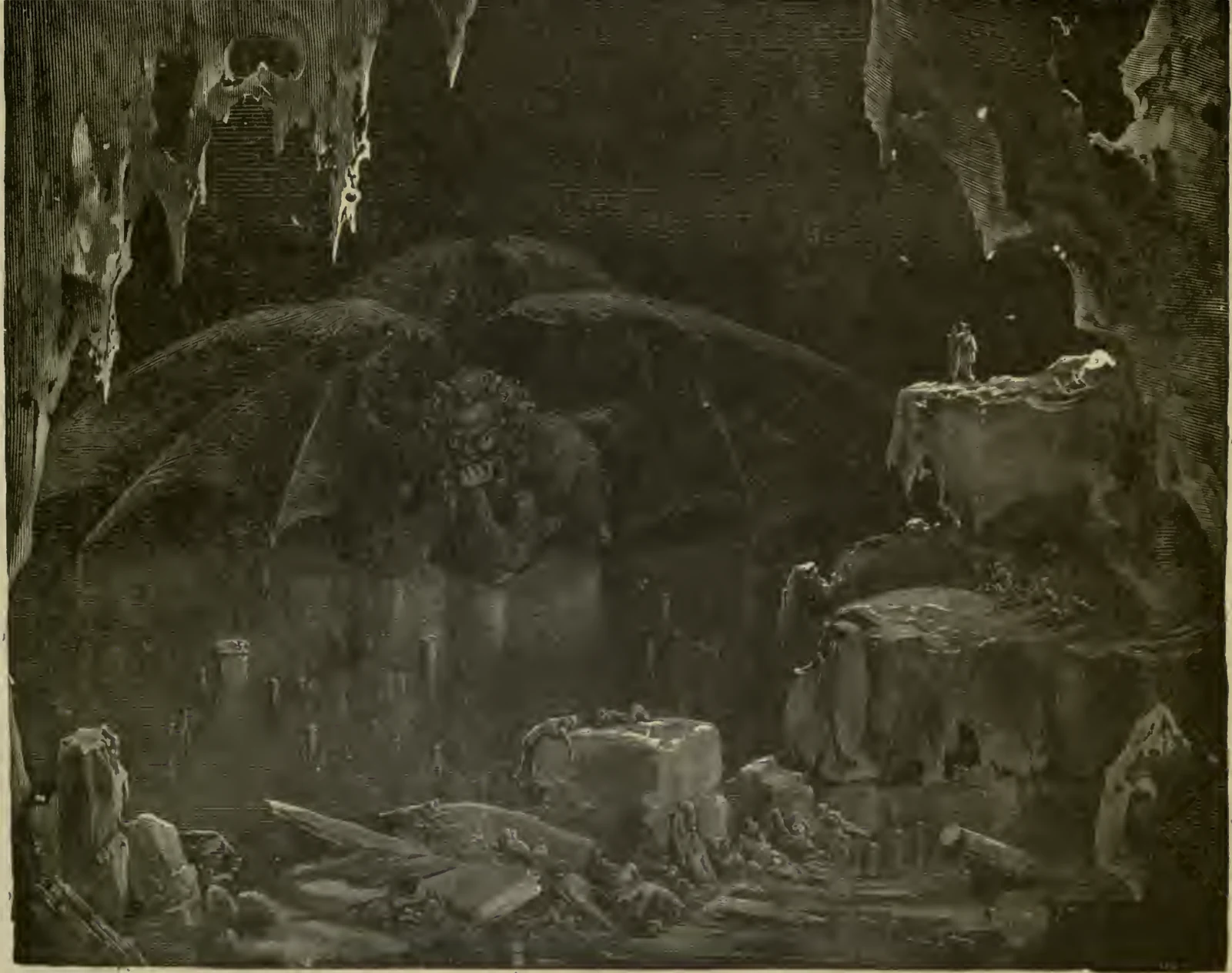
| Judecca | XXXIV | Lords or benefactors. The shades are wholly enclosed in the ice, near Lucifer. |
Follow the route from the seventh circle to the ice
The landmarks help keep the numbers straight. The Minotaur stands at the broken descent into the region of violence. After the river, the wood and the sand, Geryon carries the travellers down the cliff to Malebolge. Stone bridges cross its ditches and reach towards a central well. At that well, Antaeus lowers Dante and Virgil to the ice of Cocytus.
The giants at the well fill Canto XXXI, between the last ditch and the frozen floor. They are a useful landmark when a canto list seems to skip straight from XXX to XXXII. Compare the terrain on three pages of the Cary edition: the broken rock by the Minotaur, the stone ridges and ditches of Malebolge, and the glasslike surface of Cocytus.
How the nine circles differ from the seven deadly sins
Several familiar deadly sins appear in the upper circles, including lust, gluttony and avarice. Dante also gives separate circles to Limbo, heresy, violence, fraud and treachery. The seven terraces of Purgatorio are the closer counterpart to a seven-sin scheme. Their order follows a different moral logic, explained by Virgil in Purgatorio XVII.
In Inferno XI, Virgil explains why deceptive acts can occupy two different circles. There is a difference between deceiving someone who has no special reason to trust the offender and breaking an existing bond. That distinction becomes a physical one. Fraud occupies the ditches of Malebolge, while a breach of particular trust takes the reader down to the ice.
The wording of the divisions also varies by translation. Cary uses forms such as Ptolomea and Judecca. An edition that retains more Italian spelling may use Tolomea and Giudecca. Check the canto and its neighbours when a spelling leaves you unsure about where a figure belongs.
The gate, the vestibule and the first crossing
The descent begins in stages. Dante and Virgil enter through the gate and hear the crowd that never committed itself. Behind a moving banner the souls are driven to run, which gives a visible course to lives Dante describes as lacking one. Their place is before the nine circles. Charon then appears at the Acheron crossing and objects to taking a living passenger.
Limbo is the first numbered circle. Its inhabitants do not undergo the kind of bodily torments Dante sees later. Virgil describes their condition through the relation between desire and hope, and the group of poets Dante meets there temporarily draws attention to the life of learning they represent. The opening cantos distinguish several kinds of exclusion before the punishments begin to correspond more visibly to particular acts.
The Three Beasts in Dante’s Inferno
A spotted beast, a lion and a she-wolf interrupt the traveller’s attempt to climb.
The Vestibule of the Uncommitted
The region before Acheron occupied by those who committed themselves to neither good nor evil.
Charon, Dante’s Ferryman
The fiery-eyed boatman who gathers the dead at Acheron and objects to Dante’s living presence.
Limbo in the First Circle
The first circle, where worthy souls endure desire without hope of blessedness.
The boundary at Dis and Virgil’s explanation
The fifth circle takes Dante across the Styx to the walls of Dis. On the other side he finds the burning tombs and speaks with Farinata. The crossing and the encounter make good landmarks because the landscape changes at the same time as the categories of wrongdoing. Canto XI gives Virgil a pause in which to explain much of the arrangement.
The seventh circle separates three ranges of violence. The river, wood and burning sand give each ring its own setting. The descent on Geryon leads next to the ten ditches of Malebolge. Read those smaller divisions as subdivisions of circles seven and eight. They carry much of Dante’s detail without increasing the count of nine.
The City of Dis
The fortified entrance to the deeper infernal regions, initially closed against the travellers.
The Minotaur at the Broken Descent
The enraged guardian at the steep passage into the seventh circle.
Malebolge, the Ten Ditches
The eighth circle’s tenfold landscape of fraud, crossed by rocky bridges.
Why the lowest circle is made of ice
Cocytus contains four divisions, moving from Caina to Antenora, Ptolomea and Judecca. The names attach different relationships to betrayal. Family, political allegiance, hospitality and benefaction give the reader ways to follow a movement towards the inner ice. The severity of the landscape becomes clearest in the centre, where the shade has almost no room to move or speak.
Lucifer’s wings stir the wind that maintains the ice. The gesture makes the figure a cause of his surroundings even as he remains fixed in them. When Virgil climbs down Lucifer and changes direction at the centre of the earth, Dante’s sense of up and down changes with him. The reversal makes the exit part of the physical order of the poem.
How the punishments bring the circles into focus
The wind drives the people Dante meets in the second circle, while the fourth gives opposing groups a weight they must keep rolling. In the ninth, the movement almost stops altogether. Compare the actions the shades are made to repeat and the actions the landscape prevents. The scene gives readers a way to see the connection between a history and its punishment.
The pattern is often discussed under the name contrapasso. Some scenes echo an action, while others show a reversal or a consequence given visible form. In Canto XI, Virgil distinguishes fraud that breaks a particular bond of trust from other kinds of deceit. That distinction helps explain the separate places assigned to fraud in Malebolge and betrayal in Cocytus.