Magnetism in occult ritual
Occult writers use magnetism for a supposed influence between people. Compare Mesmer’s theory, Ward’s magnetic fluid, and Dion Fortune’s ritual fiction.
In this article
What did occult writers mean by magnetism?
In Western esoteric writing, magnetism can mean a supposed influence that passes between living beings. The name borrows the idea of attraction at a distance. In his 1779 Mémoire, Franz Anton Mesmer proposed a universal fluid that could transmit motion and affect bodies. [1][3][5]
In 1784, a French royal commission tested claims about animal magnetism. It found no evidence of the fluid. Participants could report effects when they thought a session was taking place, leading the commissioners to give expectation and imagination a central role. [1][2][5][6]
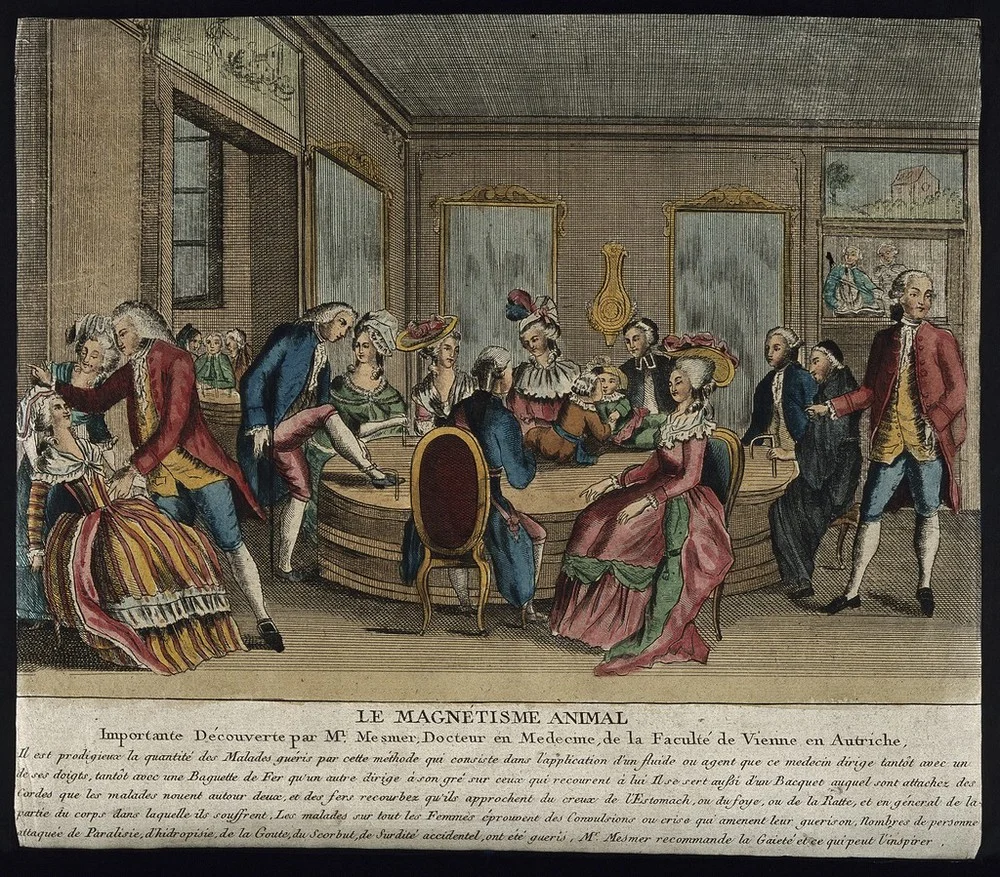
A coloured etching after Claude Louis Desrais shows a Paris session of animal magnetism. The group gathers around the baquet, a tub Mesmer treated as a reservoir of influence.
Coloured etching after Claude Louis Desrais. Wellcome Collection 17918i, CC BY 4.0. Resized and converted to WebP. · Image source ↗ · CC BY 4.0
Magnetic assistance in Gone West
In J. S. M. Ward’s Gone West, H. J. L. watches a helper make signs over a person with little strength of will. His guide says the helper is lending magnetic fluid and compares the act to the work of a magnetic healer on earth. [3]
Magnetism between Mona and Hugh in The Goat-Foot God
In Dion Fortune’s The Goat-Foot God, Mona uses magnetism to explain how people respond to one another. She thinks she has more initiative in her dealings with Hugh, although he turns to her as a friend. For her, the idea applies to friendships as well as to sexual attraction. [7][5][8]
During Mona’s Moon-dance, Jelkes sees her hand movements as an effort to draw magnetism from Hugh. In the later grove scene, Hugh feels the glow between him and Mona holding them together like a current. The two speakers give the supposed influence different forms. [6][9][10][11][12]
A fluid in one account and a felt bond in another
Ward’s guide invokes magnetic fluid to explain why one person might be able to strengthen another. Fortune uses magnetism to describe how attraction and attention feel to her characters while they try to understand each other. [3][5][6][9]
Mesmer proposed a physical explanation and the commissioners tested for it. Fortune describes what the bond feels like to Hugh inside a novel. The subjects of those accounts differ even when they use the same vocabulary. [1][2][11][12]
See references (8)
- Franz Anton Mesmer, Mémoire sur le magnétisme animal, propositions 1–11 and 23–27
- Royal Commission on Animal Magnetism, 1784, experiments and conclusion
- Gone West, printed p. 50, Reader page 63
- The Goat-Foot God, Reader page 157
- The Goat-Foot God, Reader page 315
- The Goat-Foot God, Reader page 316
- The Goat-Foot God, Reader page 351
- The Goat-Foot God, Reader page 352
Read further in the library

Gone West
Reading note
Separately attributed primary Library account, cited on exact verified Reader leaves.
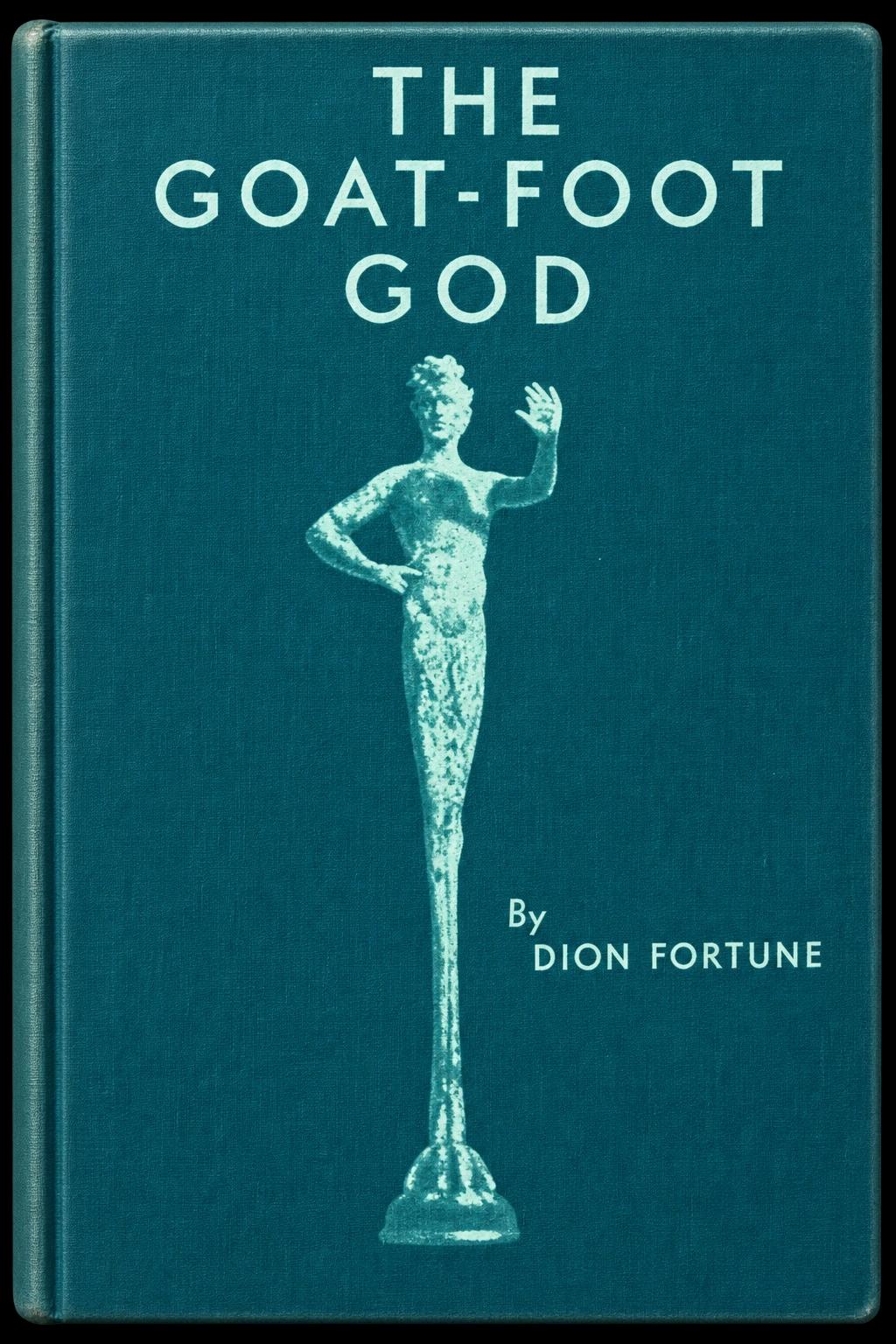
The Goat-Foot God
Reading note
The separately titled account draws on exact passages in the consulted Library edition.
Sources
See references (12)
- Franz Anton Mesmer, Mémoire sur le magnétisme animal, propositions 1–11 and 23–27 ↗Franz Anton Mesmer, Mémoire sur la découverte du magnétisme animal, P. F. Didot le jeune, 1779, concluding propositions.Return to text ↑
- Royal Commission on Animal Magnetism, 1784, experiments and conclusion ↗Royal Commission on Animal Magnetism, Report and Exposé (1784), English translation by I. M. L. Donaldson, Royal College of Physicians of Edinburgh.Return to text ↑
- Gone West, printed p. 50, Reader page 63J. S. M. Ward, Gone West: Three Narratives of After-Death Experiences, third impression, William Rider & Son, London, 1920, as reproduced in Geoff Cutler’s December 2009 digital transcription. Ward’s introduction is distinct from the supplied 1974 foreword.Read this page in Gone West ↗Return to text ↑
- Patients in Paris receiving Mesmer’s animal magnetism therapy ↗Coloured etching after Claude Louis Desrais. Wellcome Collection 17918i, CC BY 4.0. Resized and converted to WebP.
- The Goat-Foot God, Reader page 157Dion Fortune, The Goat-Foot God. Undated digital Library edition IMJ-0643-E001. Numbered references use the Library Reader sequence.Read this page in The Goat-Foot God ↗Return to text ↑
- The Goat-Foot God, Reader page 315Dion Fortune, The Goat-Foot God. Undated digital Library edition IMJ-0643-E001. Numbered references use the Library Reader sequence.Read this page in The Goat-Foot God ↗Return to text ↑
- The Goat-Foot God, Reader page 156Dion Fortune, The Goat-Foot God. Undated digital Library edition IMJ-0643-E001. Numbered references use the Library Reader sequence.Read this page in The Goat-Foot God ↗Return to text ↑
- The Goat-Foot God, Reader page 158Dion Fortune, The Goat-Foot God. Undated digital Library edition IMJ-0643-E001. Numbered references use the Library Reader sequence.Read this page in The Goat-Foot God ↗Return to text ↑
- The Goat-Foot God, Reader page 316Dion Fortune, The Goat-Foot God. Undated digital Library edition IMJ-0643-E001. Numbered references use the Library Reader sequence.Read this page in The Goat-Foot God ↗Return to text ↑
- The Goat-Foot God, Reader page 317Dion Fortune, The Goat-Foot God. Undated digital Library edition IMJ-0643-E001. Numbered references use the Library Reader sequence.Read this page in The Goat-Foot God ↗Return to text ↑
- The Goat-Foot God, Reader page 351Dion Fortune, The Goat-Foot God. Undated digital Library edition IMJ-0643-E001. Numbered references use the Library Reader sequence.Read this page in The Goat-Foot God ↗Return to text ↑
- The Goat-Foot God, Reader page 352Dion Fortune, The Goat-Foot God. Undated digital Library edition IMJ-0643-E001. Numbered references use the Library Reader sequence.Read this page in The Goat-Foot God ↗Return to text ↑