Magnetic fluid in Spiritualism
Magnetic fluid is a historical idea of transferable influence. Compare the help offered in J. S. M. Ward’s Gone West with the forces in Celestion Study of Man.
In this article
Understanding magnetic fluid in spiritualism
Magnetic fluid is a historical term for an influence believed to pass between beings. In J. S. M. Ward’s Gone West, a helper lends it to an exhausted spirit who is said to need strength of will. [1]
The word “fluid” describes what Ward’s guide believes is being passed from one person to another. The scene gives the influence a purpose: preparing the newcomer to join the refuge’s usual life. [1]
Mesmer’s animal magnetism
In his 1779 memoir on animal magnetism, Franz Anton Mesmer proposed a universal fluid that carried influence between celestial bodies, Earth and living things. The engraving shows a later depiction of that kind of influence between people. Ward uses the same vocabulary for a scene of assistance in an afterlife refuge. [10][8][1]
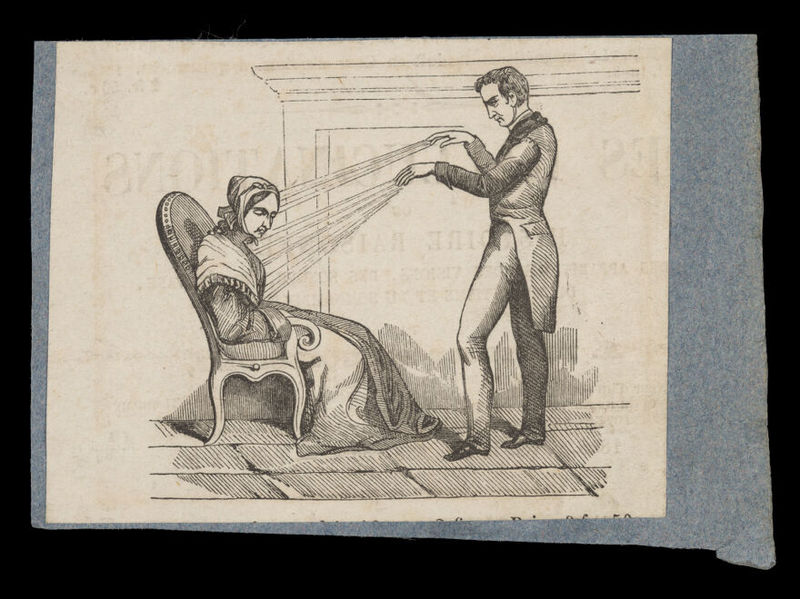
French wood engraving, about 1845. Rays represent the supposed influence of a mesmerist on a seated woman.
Wellcome Collection, 11823i. Public Domain Mark. · Image source ↗ · Public Domain
Gone West by J. S. M. Ward
J. S. M. Ward places the example in the House of Refuge, a transitional institution connecting care and education. Spirits arriving there are described as too weak to join classes immediately. A particular teacher attends to each newcomer before ordinary schooling becomes possible. [1]
H. J. L. first sees a helper playing a soothing hymn beside a distressed patient. In another room, a bright spirit makes signs over an exhausted person. The guide identifies this second action as lending magnetic fluid to someone weak in will-power and compares it with an earthly magnetic healer’s method. [1]
The signs over the weary spirit are what H. J. L. describes seeing. His guide calls the action a transfer of magnetic fluid and compares it with the work of an earthly magnetic healer. The interpretation gives the gesture its meaning within the story. [1]
The surrounding narrative makes recovery preparatory. The weakened person receives individual attention and later becomes able to learn. This differs from the classroom scenes where several teachers sustain order over a group through concentrated will. Both concern dependence and assistance, but they describe different kinds of influence. [2][3][1]
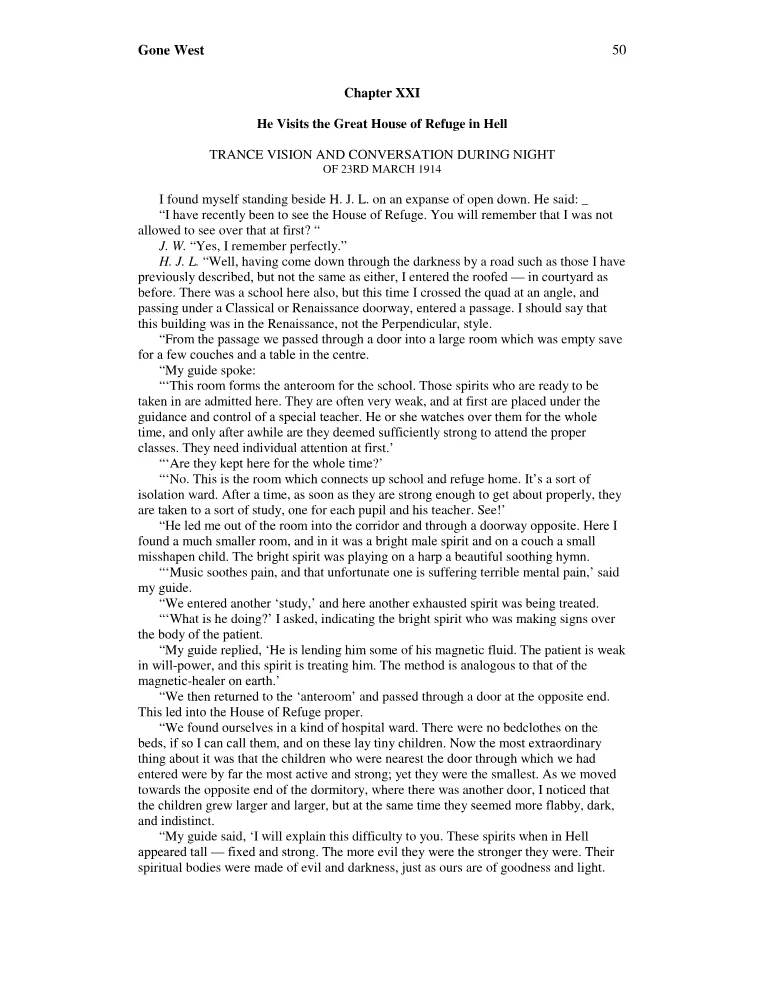
Gone West, printed p. 50, Library Reader page 63. The scene takes place in the room between the refuge and the school. Geoff Cutler’s 2009 digital transcription of Ward’s 1920 text.
J. S. M. Ward, Gone West, historical text in the public domain. Geoff Cutler’s 2009 transcription expressly permits reuse for any purpose on source leaf2. This image shows the digital transcription, not an original printed facsimile. · Image source ↗ · Public Domain
The Angels’ Diary and Celestion Study of Man
The volume attributes the material to Effie M. Shirey and Charles Samson as spirit communications, with Elizabeth Maud Weatherhead credited as the medium. Celestion Study of Man assigns magnetic force to the brain and body, and electrical force to the soul. It treats their balance as part of ordinary embodied life and says the electrical vibrations unite in spiritual existence after death. [5][6][7][9]
A force lent or a force renewed
In the refuge, magnetic assistance means lending strength to someone who needs it. Spirit obsession in Ward’s other accounts means taking vitality or seeking control. The difference lies in what the agent is trying to do to the person receiving the influence. [1][4]
The engraving pictures influence between people through a visible gesture. Ward’s guide invokes the work of an earthly magnetic healer to explain an unseen transfer in the refuge. The analogy tells us how the guide expects his listener to understand the scene. [1][8]
Ward describes an influence someone can lend. Celestion describes a force that the body uses and renews. The first explains a meeting between helper and recipient. The second explains the relation of spiritual power to bodily life. [5][6][7][1]
See references (6)
- Gone West, printed p. 50, Reader page 63
- Gone West, printed p. 165, Reader page 178
- The Angels’ Diary and Celestion Study of Man, Reader page 121
- The Angels’ Diary and Celestion Study of Man, Reader page 170
- The Angels’ Diary and Celestion Study of Man, Reader page 171
- A mesmerist using animal magnetism on a seated female patient, ca. 1845
Read further in the library
Gone West
Reading note
The separately titled account draws on exact passages in the consulted Library edition.
The Angels’ Diary and Celestion Study of Man
Reading note
Separately attributed comparison with exact previously researched Library passages.
Sources
See references (10)
- Gone West, printed p. 50, Reader page 63J. S. M. Ward, Gone West: Three Narratives of After-Death Experiences, third impression, William Rider & Son, London, 1920, as reproduced in Geoff Cutler’s December 2009 digital transcription. Ward’s introduction is distinct from the supplied 1974 foreword.Read this page in Gone West ↗Return to text ↑
- Gone West, printed p. 46, Reader page 59J. S. M. Ward, Gone West: Three Narratives of After-Death Experiences, third impression, William Rider & Son, London, 1920, as reproduced in Geoff Cutler’s December 2009 digital transcription. Ward’s introduction is distinct from the supplied 1974 foreword.Read this page in Gone West ↗Return to text ↑
- Gone West, printed p. 47, Reader page 60J. S. M. Ward, Gone West: Three Narratives of After-Death Experiences, third impression, William Rider & Son, London, 1920, as reproduced in Geoff Cutler’s December 2009 digital transcription. Ward’s introduction is distinct from the supplied 1974 foreword.Read this page in Gone West ↗Return to text ↑
- Gone West, printed p. 165, Reader page 178J. S. M. Ward, Gone West: Three Narratives of After-Death Experiences, third impression, William Rider & Son, London, 1920, as reproduced in Geoff Cutler’s December 2009 digital transcription. Ward’s introduction is distinct from the supplied 1974 foreword.Read this page in Gone West ↗Return to text ↑
- The Angels’ Diary and Celestion Study of Man, Reader page 121Effie M. Shirey and Charles Samson, The Angels’ Diary and Celestion Study of Man (1903), communicated through Elizabeth Maud Weatherhead according to the volume’s acknowledgment. Accounts below refer to the exact retained Library edition IMJ-0055-E001.Read this page in The Angels’ Diary and Celestion Study of Man ↗Return to text ↑
- The Angels’ Diary and Celestion Study of Man, Reader page 170Effie M. Shirey and Charles Samson, The Angels’ Diary and Celestion Study of Man (1903), communicated through Elizabeth Maud Weatherhead according to the volume’s acknowledgment. Accounts below refer to the exact retained Library edition IMJ-0055-E001.Read this page in The Angels’ Diary and Celestion Study of Man ↗Return to text ↑
- The Angels’ Diary and Celestion Study of Man, Reader page 171Effie M. Shirey and Charles Samson, The Angels’ Diary and Celestion Study of Man (1903), communicated through Elizabeth Maud Weatherhead according to the volume’s acknowledgment. Accounts below refer to the exact retained Library edition IMJ-0055-E001.Read this page in The Angels’ Diary and Celestion Study of Man ↗Return to text ↑
- A mesmerist using animal magnetism on a seated female patient, ca. 1845 ↗Wellcome Collection, 11823i. Anonymous wood engraving, approximately 1845, from a French newspaper. Current catalogue and image record carry Public Domain Mark.Return to text ↑
- The Angels’ Diary and Celestion Study of Man, Denver, 1903 ↗Library of Congress catalogue and preface note.Return to text ↑
- Franz Anton Mesmer, Mémoire sur la découverte du magnétisme animal (1779), proposition 2 ↗1779 edition digitised from the University of Toronto Libraries.Return to text ↑