Rich and Poor in Heaven
Swedenborg says rich and poor people can enter heaven. He asks what they love and how they use what they have. Compare Franchezzo’s Land of Misers.
In this article
Understanding the concept
Rich and poor people can enter heaven in Emanuel Swedenborg’s account. Earthly wealth by itself settles little. He asks what a person uses their possessions for and what they hope those possessions will give them. [1][2][3][4][5][6]
Money can support a household or serve a neighbour. It can also become the thing a person wants most or a means of controlling others. Swedenborg’s distinction turns on the purpose behind what they do with it. [2][7][3][4][5]
See references (7)
- Heaven and Its Wonders and Hell, printed p. 299, Reader page 306
- Heaven and Its Wonders and Hell, printed p. 300, Reader page 307
- Heaven and Its Wonders and Hell, printed p. 304, Reader page 311
- Heaven and Its Wonders and Hell, printed p. 305, Reader page 312
- Heaven and Its Wonders and Hell, printed p. 307, Reader page 314
- Heaven and Its Wonders and Hell, printed p. 308, Reader page 315
- Heaven and Its Wonders and Hell, printed p. 301, Reader page 308
Heaven and Its Wonders and Hell by Emanuel Swedenborg
Emanuel Swedenborg’s Heaven and Its Wonders and Hell introduces the question in §357. He rejects a reading in which all rich people are excluded and all poor people admitted. His interpretation distinguishes the natural and spiritual senses of scriptural wealth. [1][2]
Swedenborg allows ordinary pleasures, a suitable dwelling and lawful ways of acquiring wealth. He also asks readers to consider why someone acts honestly. Concern for a neighbour and fear of losing a good reputation can produce similar behaviour with different purposes. [2][7][8]
Riches can become instruments of useful life, providing for a household, community or neighbour. In the heavenly descriptions, magnificent possessions correspond to uses rather than self-admiration. The opposite case is wealth loved as a means of domination or indulgence, with no higher purpose. [3][4][9]
The poor are likewise considered through their lives, not a qualifying lack of money. Swedenborg then reads spiritual riches as knowledge of good and truth and spiritual poverty as lacking that knowledge while desiring it. This symbolic argument is a particular Christian interpretation of scripture, not an economic measure of virtue. [5][6][10][11]
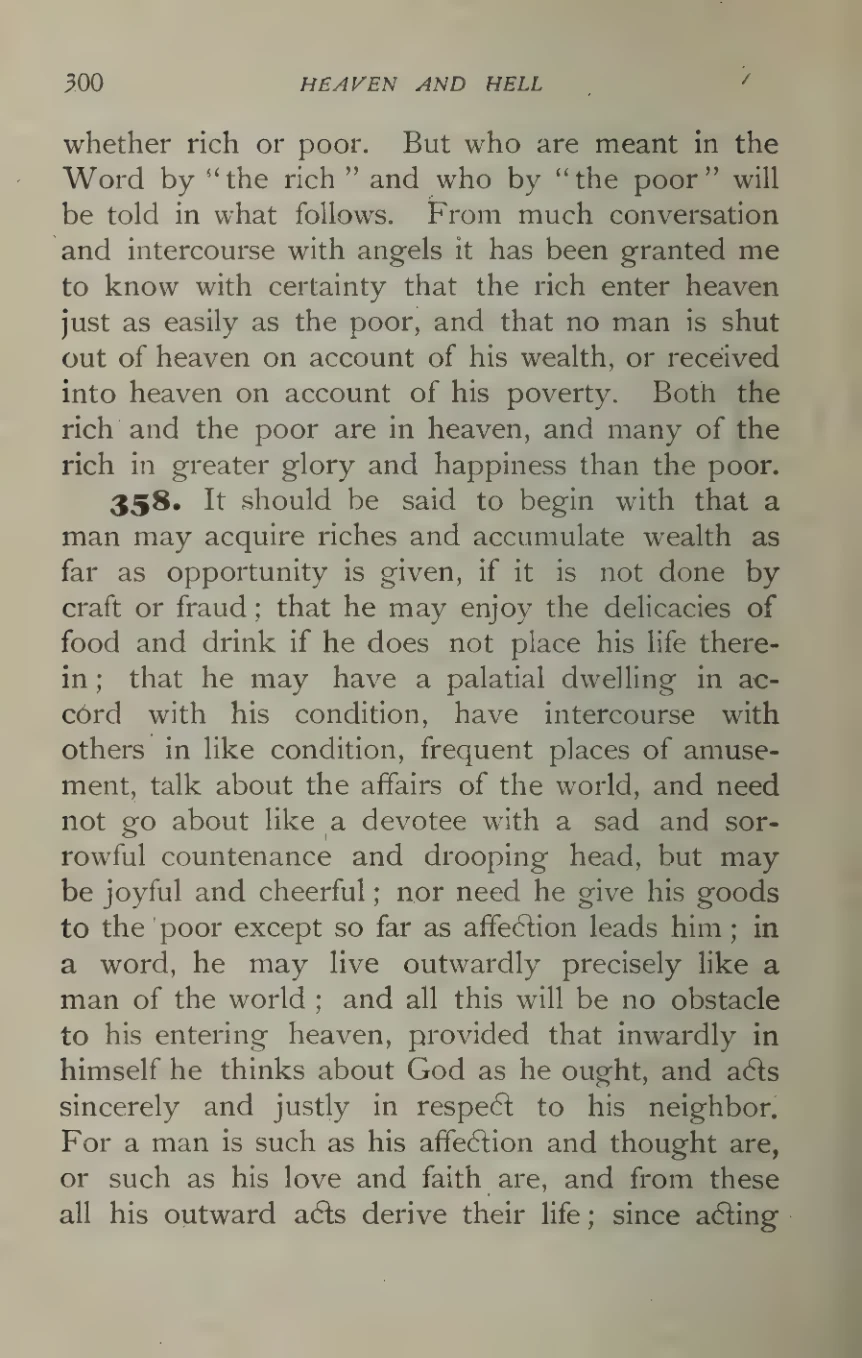
Heaven and Its Wonders and Hell (1916), printed p. 300, Library Reader page 307. Swedenborg considers the place of riches and ordinary enjoyments in a useful life.
Emanuel Swedenborg, Heaven and Its Wonders and Hell, J. C. Ager translation, New York, 1916. Public-domain historical page from the checksum-verified Library PDF. · Image source ↗ · Public Domain
See references (11)
- Heaven and Its Wonders and Hell, printed p. 299, Reader page 306
- Heaven and Its Wonders and Hell, printed p. 300, Reader page 307
- Heaven and Its Wonders and Hell, printed p. 304, Reader page 311
- Heaven and Its Wonders and Hell, printed p. 305, Reader page 312
- Heaven and Its Wonders and Hell, printed p. 307, Reader page 314
- Heaven and Its Wonders and Hell, printed p. 308, Reader page 315
- Heaven and Its Wonders and Hell, printed p. 301, Reader page 308
- Heaven and Its Wonders and Hell, printed p. 302, Reader page 309
- Heaven and Its Wonders and Hell, printed p. 306, Reader page 313
- Heaven and Its Wonders and Hell, printed p. 309, Reader page 316
- Heaven and Its Wonders and Hell, printed p. 310, Reader page 317
A Wanderer in the Spirit Lands: Franchezzo, transcribed by A. Farnese
In the account attributed to Franchezzo and transcribed by A. Farnese, the Land of Misers is a stretch of black soil where the dead dig for grains of gold and protect their little wallets. One digger briefly listens when Franchezzo offers help, then goes back to his search. [12]
What wealth is used for
Franchezzo keeps the scene close to a person who guards a hoard. The digger’s fear of losing it leaves little room for a neighbour. Swedenborg considers the wider range of things money can do, including serving a household or community. The action matters in each book because it makes the person’s purpose visible. [2][7][3][4][5][6][12]
See references (7)
- Heaven and Its Wonders and Hell, printed p. 300, Reader page 307
- Heaven and Its Wonders and Hell, printed p. 304, Reader page 311
- Heaven and Its Wonders and Hell, printed p. 305, Reader page 312
- Heaven and Its Wonders and Hell, printed p. 307, Reader page 314
- Heaven and Its Wonders and Hell, printed p. 308, Reader page 315
- Heaven and Its Wonders and Hell, printed p. 301, Reader page 308
- A Wanderer in the Spirit Lands, printed p. 45, Reader page 54
Read further in the library

Heaven and Its Wonders and Hell
Reading note
The separately titled account draws on exact passages in the consulted Library edition.

A Wanderer in the Spirit Lands
Reading note
Separately attributed comparison with exact previously researched Library passages.
Sources
See references (12)
- Heaven and Its Wonders and Hell, printed p. 299, Reader page 306Emanuel Swedenborg, Heaven and Its Wonders and Hell, From Things Heard and Seen, translated by J. C. Ager. American Swedenborg Printing and Publishing Society, New York, 1916. Latin original first published in 1758. Numbered sections and exact pages refer to this consulted edition. Claims of spiritual experience remain attributed.Read this page in Heaven and Its Wonders and Hell ↗Return to text ↑
- Heaven and Its Wonders and Hell, printed p. 300, Reader page 307Emanuel Swedenborg, Heaven and Its Wonders and Hell, From Things Heard and Seen, translated by J. C. Ager. American Swedenborg Printing and Publishing Society, New York, 1916. Latin original first published in 1758. Numbered sections and exact pages refer to this consulted edition. Claims of spiritual experience remain attributed.Read this page in Heaven and Its Wonders and Hell ↗Return to text ↑
- Heaven and Its Wonders and Hell, printed p. 304, Reader page 311Emanuel Swedenborg, Heaven and Its Wonders and Hell, From Things Heard and Seen, translated by J. C. Ager. American Swedenborg Printing and Publishing Society, New York, 1916. Latin original first published in 1758. Numbered sections and exact pages refer to this consulted edition. Claims of spiritual experience remain attributed.Read this page in Heaven and Its Wonders and Hell ↗Return to text ↑
- Heaven and Its Wonders and Hell, printed p. 305, Reader page 312Emanuel Swedenborg, Heaven and Its Wonders and Hell, From Things Heard and Seen, translated by J. C. Ager. American Swedenborg Printing and Publishing Society, New York, 1916. Latin original first published in 1758. Numbered sections and exact pages refer to this consulted edition. Claims of spiritual experience remain attributed.Read this page in Heaven and Its Wonders and Hell ↗Return to text ↑
- Heaven and Its Wonders and Hell, printed p. 307, Reader page 314Emanuel Swedenborg, Heaven and Its Wonders and Hell, From Things Heard and Seen, translated by J. C. Ager. American Swedenborg Printing and Publishing Society, New York, 1916. Latin original first published in 1758. Numbered sections and exact pages refer to this consulted edition. Claims of spiritual experience remain attributed.Read this page in Heaven and Its Wonders and Hell ↗Return to text ↑
- Heaven and Its Wonders and Hell, printed p. 308, Reader page 315Emanuel Swedenborg, Heaven and Its Wonders and Hell, From Things Heard and Seen, translated by J. C. Ager. American Swedenborg Printing and Publishing Society, New York, 1916. Latin original first published in 1758. Numbered sections and exact pages refer to this consulted edition. Claims of spiritual experience remain attributed.Read this page in Heaven and Its Wonders and Hell ↗Return to text ↑
- Heaven and Its Wonders and Hell, printed p. 301, Reader page 308Emanuel Swedenborg, Heaven and Its Wonders and Hell, From Things Heard and Seen, translated by J. C. Ager. American Swedenborg Printing and Publishing Society, New York, 1916. Latin original first published in 1758. Numbered sections and exact pages refer to this consulted edition. Claims of spiritual experience remain attributed.Read this page in Heaven and Its Wonders and Hell ↗Return to text ↑
- Heaven and Its Wonders and Hell, printed p. 302, Reader page 309Emanuel Swedenborg, Heaven and Its Wonders and Hell, From Things Heard and Seen, translated by J. C. Ager. American Swedenborg Printing and Publishing Society, New York, 1916. Latin original first published in 1758. Numbered sections and exact pages refer to this consulted edition. Claims of spiritual experience remain attributed.Read this page in Heaven and Its Wonders and Hell ↗Return to text ↑
- Heaven and Its Wonders and Hell, printed p. 306, Reader page 313Emanuel Swedenborg, Heaven and Its Wonders and Hell, From Things Heard and Seen, translated by J. C. Ager. American Swedenborg Printing and Publishing Society, New York, 1916. Latin original first published in 1758. Numbered sections and exact pages refer to this consulted edition. Claims of spiritual experience remain attributed.Read this page in Heaven and Its Wonders and Hell ↗Return to text ↑
- Heaven and Its Wonders and Hell, printed p. 309, Reader page 316Emanuel Swedenborg, Heaven and Its Wonders and Hell, From Things Heard and Seen, translated by J. C. Ager. American Swedenborg Printing and Publishing Society, New York, 1916. Latin original first published in 1758. Numbered sections and exact pages refer to this consulted edition. Claims of spiritual experience remain attributed.Read this page in Heaven and Its Wonders and Hell ↗Return to text ↑
- Heaven and Its Wonders and Hell, printed p. 310, Reader page 317Emanuel Swedenborg, Heaven and Its Wonders and Hell, From Things Heard and Seen, translated by J. C. Ager. American Swedenborg Printing and Publishing Society, New York, 1916. Latin original first published in 1758. Numbered sections and exact pages refer to this consulted edition. Claims of spiritual experience remain attributed.Read this page in Heaven and Its Wonders and Hell ↗Return to text ↑
- A Wanderer in the Spirit Lands, printed p. 45, Reader page 54A Wanderer in the Spirit Lands, attributed to the spirit Franchezzo and transcribed by A. Farnese. W. J. Sinkins, London. Title page undated; preface dated 1896. The narrator’s experiences and the guides’ explanations are reported claims, not independently established observations.Read this page in A Wanderer in the Spirit Lands ↗Return to text ↑