Ribhus
The Ribhus are the artisans of Vedic hymns. Discover why making four cups from one won them a share in sacrifice, and what else they could renew.
In this article
Who are the Ribhus?
The Ribhus are artisans celebrated in Vedic hymns for making and renewing things with extraordinary skill. In one hymn the gods ask them to make four drinking vessels from one and promise them a share in sacrifice. The same hymn credits them with giving an aged pair their youth again. [1][3][4]
The four chalices in Rigveda 1.161
In Ralph T. H. Griffith’s translation of Rigveda 1.161, Agni brings the commission to make four cups. Tvashtar objects to the treatment of the original vessel. The hymn recalls other feats, including bringing a cow out of a hide, equipping a chariot and restoring youth to an aged pair. It says the artisans obtain their share in sacrifice. [1]
Indian Myth and Legend by Donald A. Mackenzie
In Indian Myth and Legend, Donald A. Mackenzie recounts their renewal of aged parents and restoration of a cow and calf. The bowl Tvashtar makes can fill itself with Soma. Dividing it into four lets the Ribhus show what they can make out of something already marvellous. [3][4]
Mackenzie cites A. A. Macdonell’s suggestion that the bowl could represent the moon and the four cups its phases. He also compares the rivalry with stories of Germanic wonder-smiths. Both are readings the book brings to the tale. [4][3]
The chapter links the Ribhus with growth and the seasons, and with Indra as a bringer of fertility and rain. [4]
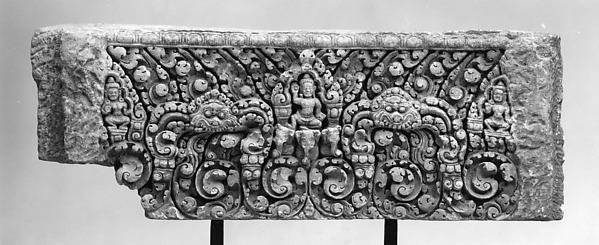
Indra and his attendants on a Thai lintel, eleventh to twelfth century. The attendants are unnamed in the museum record.
The Metropolitan Museum of Art, Gift of Mr. and Mrs. Earl Morse, 1972, 1972.214. Open Access CC0; resized and converted to JPEG. · Image source ↗ · CC0
Why the four cups matter
The hymn gives the task an explicit reward: a place in the sacrifice. The lunar reading asks what the number four might also signify. The rejuvenated pair broadens the accomplishment beyond making objects to restoring life. [4][1][3]
Read further in the library
Indian Myth and Legend
Reading note
The separately titled account draws on exact passages in the consulted Library edition.
Sources
See references (4)
- Rigveda 1.161, verses 1–9, translated by Ralph T. H. Griffith ↗Verses 1–9 directly consulted for the four chalices, Agni’s embassy, crafting feats, Tvastar and participation in sacrifice. Later verses are not used to support an inferred lunar or seasonal code.Return to text ↑
- Lintel with Indra and Two Attendants, 11th–12th century ↗The Metropolitan Museum of Art, Gift of Mr. and Mrs. Earl Morse, 1972, 1972.214. Open Access CC0; resized and converted to JPEG.
- Indian Myth and Legend, Reader page 69Donald A. Mackenzie, Indian Myth and Legend, Gresham Publishing Company Limited, London, undated consulted impression. Library edition IMJ-0649-E001. Persistent PageIDs and current Reader positions verified against the supplied PDF and cached Reader manifest. Embedded translations are Mackenzie’s presentation unless a separately consulted primary text is named.Read this page in Indian Myth and Legend ↗Return to text ↑
- Indian Myth and Legend, Reader page 70Donald A. Mackenzie, Indian Myth and Legend, Gresham Publishing Company Limited, London, undated consulted impression. Library edition IMJ-0649-E001. Persistent PageIDs and current Reader positions verified against the supplied PDF and cached Reader manifest. Embedded translations are Mackenzie’s presentation unless a separately consulted primary text is named.Read this page in Indian Myth and Legend ↗Return to text ↑