Puʻuhonua
A puʻuhonua is a Hawaiian place of refuge. Learn who could seek sanctuary and how protection worked at Hōnaunau and in stories of Paʻakalani.
In this article
Who could seek refuge?
A puʻuhonua is a Hawaiian place of refuge. Someone pursued for breaking a kapu could gain protection by reaching it. Defeated warriors and people sheltering from war could seek safety there too. [1]
The refuge at Hōnaunau
At Hōnaunau on Hawaiʻi Island, the Great Wall separates the royal grounds from the refuge. Near the wall stood Hale o Keawe, a house that held the remains of aliʻi, or chiefs. Their mana helped make the place sacred. [1][2]
The Legends and Myths of Hawaii by David Kalākaua
In his introduction to David Kalākaua’s 1888 volume, Rollin Mallory Daggett names Hōnaunau and Paʻakalani in Waipiʻo. He describes priests guarding access and says that even a king could not seize a person who was already inside. He is less certain about the location of other refuges. [7]
The Kīha-pū story tests the boundaries of sanctuary. Kīha wonders whether an accused man can claim protection at Paʻakalani after being brought there by order. In the ʻUmi story, Hākau demands that the refuge close to his opponents. The priest Laeanui refuses. [8][9][4]
In the Lānaʻi story of Kaala, Kaaialii pursues a man he thinks has harmed her. Two priests tell him the man can leave if he wishes, but they must shelter him while he stays inside the enclosure. [5][6]
The chapter on Keaulumoku returns to Hōnaunau. Mourners carry the remains of Kalaniʻōpuʻu to Hale o Keawe. After the burial, the chiefs assemble to hear Kīwalaʻō announce the succession. [10][11]
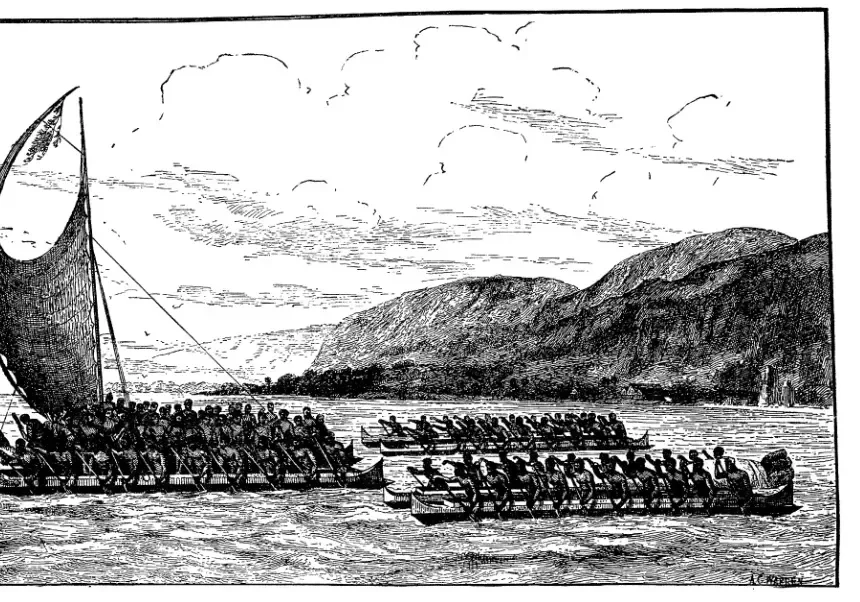
Double canoes convey Kalaniʻōpuʻu’s remains to Hōnaunau in this 1888 engraving after a Royal Palace painting.
Engraving after a painting in the Royal Palace, as credited in the edition. The Legends and Myths of Hawaii, Charles L. Webster & Company, 1888. Public domain. Cropped from the Library scan. · Image source ↗ · Public Domain
See references (8)
- The Legends and Myths of Hawaii, Reader page 301
- The Legends and Myths of Hawaii, Reader page 424
- The Legends and Myths of Hawaii, Reader page 425
- The Legends and Myths of Hawaii, Reader page 47
- The Legends and Myths of Hawaii, Reader page 265
- The Legends and Myths of Hawaii, Reader page 266
- The Legends and Myths of Hawaii, Reader page 364
- The Legends and Myths of Hawaii, Reader page 365
Hōnaunau in history and sanctuary in the stories
Both Daggett and missionary William Ellis compared Hawaiian refuge with sanctuary in the Bible. The National Park Service traces the park’s former name, “City of Refuge,” to Ellis’s comparison. The Hawaiian name identifies the refuge with Hōnaunau and its chiefly history. [7][2]
At Hōnaunau, the Great Wall and the reconstruction of Hale o Keawe show how the refuge was set apart. The Lānaʻi story lets readers see what that protection could require of a priest when a pursuer refused to recognise it. [5][6][1][2]
Read further in the library
The Legends and Myths of Hawaii
Reading note
The separately titled account draws on exact passages in the consulted Library edition.
Sources
See references (11)
- Puʻuhonua o Hōnaunau National Historical Park Foundation Document ↗National Park Service, park significance statements concerning sanctuary, cultural continuity and the stone wall.Return to text ↑
- Hale o Keawe and the Great Wall in the park collections ↗National Park Service, “Hale o Keawe” and “The Great Wall” sections.Return to text ↑
- Conveying the Body of Kalaniopuu to Honaunau ↗Engraving after a painting in the Royal Palace, as credited in the edition. The Legends and Myths of Hawaii, Charles L. Webster & Company, 1888. Public domain. Cropped from the Library scan.
- The Legends and Myths of Hawaii, Reader page 301David Kalākaua, The Legends and Myths of Hawaii, edited with an introduction by Rollin Mallory Daggett, Charles L. Webster & Company, 1888. Exact Library edition IMJ-0646-E001. When the introduction or a signed editorial passage is used, its author is identified in the article.Read this page in The Legends and Myths of Hawaii ↗Return to text ↑
- The Legends and Myths of Hawaii, Reader page 424David Kalākaua, The Legends and Myths of Hawaii, edited with an introduction by Rollin Mallory Daggett, Charles L. Webster & Company, 1888. Exact Library edition IMJ-0646-E001. When the introduction or a signed editorial passage is used, its author is identified in the article.Read this page in The Legends and Myths of Hawaii ↗Return to text ↑
- The Legends and Myths of Hawaii, Reader page 425David Kalākaua, The Legends and Myths of Hawaii, edited with an introduction by Rollin Mallory Daggett, Charles L. Webster & Company, 1888. Exact Library edition IMJ-0646-E001. When the introduction or a signed editorial passage is used, its author is identified in the article.Read this page in The Legends and Myths of Hawaii ↗Return to text ↑
- The Legends and Myths of Hawaii, Reader page 47David Kalākaua, The Legends and Myths of Hawaii, edited with an introduction by Rollin Mallory Daggett, Charles L. Webster & Company, 1888. Exact Library edition IMJ-0646-E001. When the introduction or a signed editorial passage is used, its author is identified in the article.Read this page in The Legends and Myths of Hawaii ↗Return to text ↑
- The Legends and Myths of Hawaii, Reader page 265David Kalākaua, The Legends and Myths of Hawaii, edited with an introduction by Rollin Mallory Daggett, Charles L. Webster & Company, 1888. Exact Library edition IMJ-0646-E001. When the introduction or a signed editorial passage is used, its author is identified in the article.Read this page in The Legends and Myths of Hawaii ↗Return to text ↑
- The Legends and Myths of Hawaii, Reader page 266David Kalākaua, The Legends and Myths of Hawaii, edited with an introduction by Rollin Mallory Daggett, Charles L. Webster & Company, 1888. Exact Library edition IMJ-0646-E001. When the introduction or a signed editorial passage is used, its author is identified in the article.Read this page in The Legends and Myths of Hawaii ↗Return to text ↑
- The Legends and Myths of Hawaii, Reader page 364David Kalākaua, The Legends and Myths of Hawaii, edited with an introduction by Rollin Mallory Daggett, Charles L. Webster & Company, 1888. Exact Library edition IMJ-0646-E001. When the introduction or a signed editorial passage is used, its author is identified in the article.Read this page in The Legends and Myths of Hawaii ↗Return to text ↑
- The Legends and Myths of Hawaii, Reader page 365David Kalākaua, The Legends and Myths of Hawaii, edited with an introduction by Rollin Mallory Daggett, Charles L. Webster & Company, 1888. Exact Library edition IMJ-0646-E001. When the introduction or a signed editorial passage is used, its author is identified in the article.Read this page in The Legends and Myths of Hawaii ↗Return to text ↑