Pūloʻuloʻu
A pūloʻuloʻu is a kapa-topped staff used to mark kapu and chiefly authority. Follow the emblem from protected entrances to the Hawaiian coat of arms.
In this article
What does a pūloʻuloʻu mark?
A pūloʻuloʻu is a staff topped by a rounded bundle of kapa, or Hawaiian barkcloth. It could mark a place under kapu or travel with a chief. At an entrance, the staff told anyone approaching that access was restricted. [4][5][1]
Pūloʻuloʻu also appear in two quarters of the coat of arms adopted by the Hawaiian Kingdom in 1845. On the shield, the staves evoke the protection and rank of chiefs. [1]
The Legends and Myths of Hawaii by David Kalākaua
In his introduction to David Kalākaua’s The Legends and Myths of Hawaii, Rollin Mallory Daggett describes white or black kapa at the top of a staff. Among the places a pūloʻuloʻu might mark were a spring, a path, a temple entrance and a bathing place. [4][5]
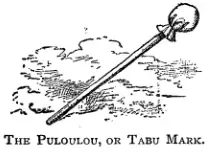
A pūloʻuloʻu, with its rounded kapa head, from printed page 32 of the 1888 edition.
The Legends and Myths of Hawaii, Charles L. Webster & Company, 1888. Public domain. Cropped from the Library scan. · Image source ↗ · Public Domain
At a doorway, on a canoe and at a refuge
Two staves stand at the entrance to Kahalaopuna’s house in the story set in Mānoa. They mark her chiefly rank. The narrator returns to them when describing the sheltered life her standing affords her. [6][7]
In the chapter adapted from Haleʻole’s Lāʻieikawai, a pūloʻuloʻu stands on Aiwohikupua’s double canoe as he travels to marry Poliʻahu. The staff, the kapa and the feather cloaks make the rank of the party visible on the water. [8][9]
A priest carries a pūloʻuloʻu when he prevents Kaaialii from seizing a man in a Lānaʻi refuge. The glossary describes the bundle of kapa that gives the object its rounded shape. [10][11][12]
See references (7)
- The Legends and Myths of Hawaii, Reader page 516
- The Legends and Myths of Hawaii, Reader page 521
- The Legends and Myths of Hawaii, Reader page 460
- The Legends and Myths of Hawaii, Reader page 471
- The Legends and Myths of Hawaii, Reader page 424
- The Legends and Myths of Hawaii, Reader page 425
- The Legends and Myths of Hawaii, Reader page 532
Pūloʻuloʻu on the coat of arms and the difference from kāhili
In the 1888 book, a staff can tell a visitor where a boundary lies. In Nanea Armstrong-Wassel’s account of the Kingdom’s coat of arms, it carries the associations of chiefly protection and rank onto the shield. [4][5][1]
A kāhili is also a chiefly emblem, but its head is made of feathers. Mary Kawena Pukui writes about the care families gave to kāhili and the obligations that came with them. [4][5][2]
Read further in the library
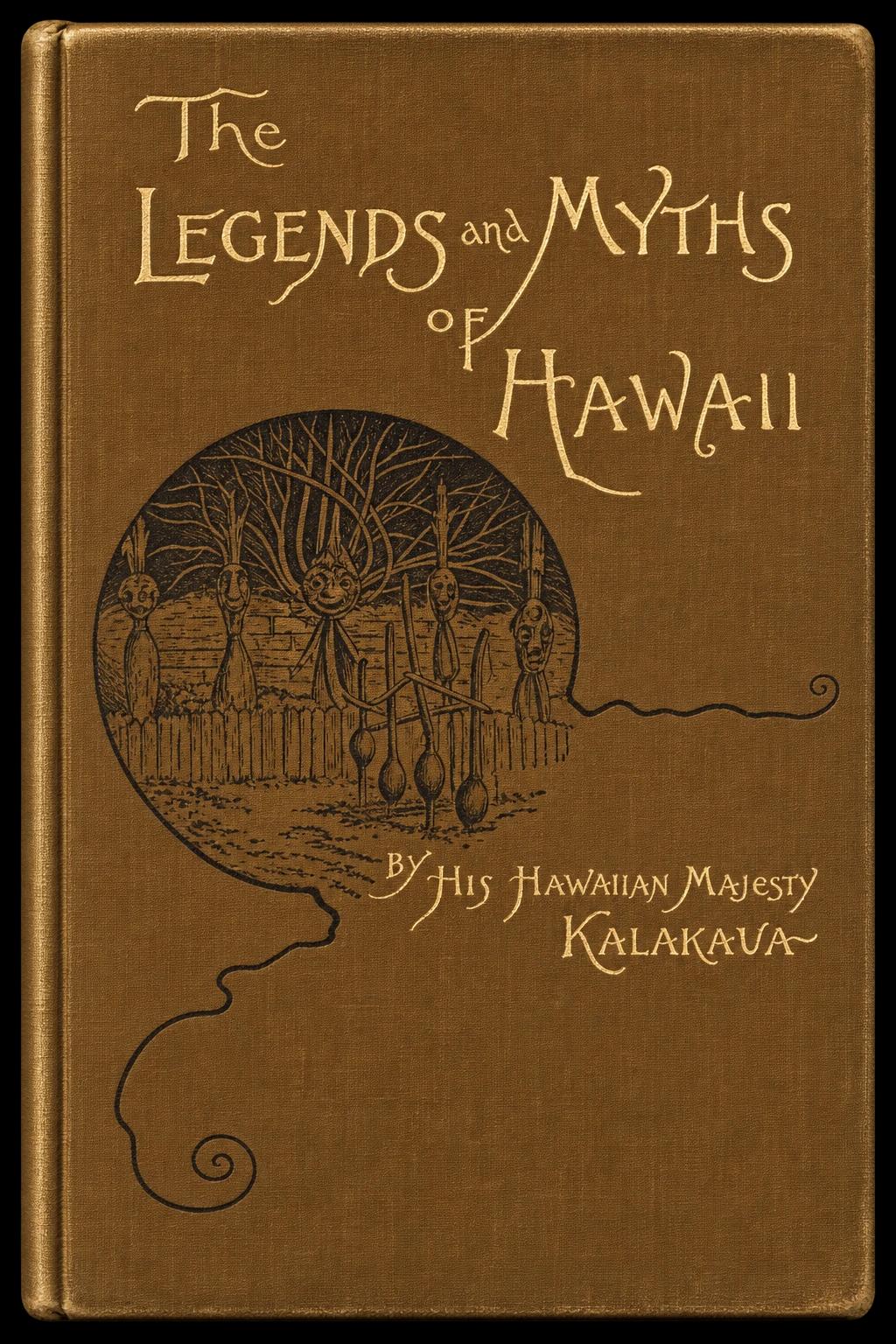
The Legends and Myths of Hawaii
Reading note
The separately titled account draws on exact passages in the consulted Library edition.
Sources
See references (12)
- Nanea Armstrong-Wassel, Coat of Arms of the Kingdom of Hawaiʻi ↗Nanea Armstrong-Wassel, Hoʻokahua, Kaʻiwakīloumoku Hawaiian Cultural Center.Return to text ↑
- Mary Kawena Pukui, Featherwork ↗Mary Kawena Pukui Collection, presented by Kaʻiwakīloumoku, the Hawaiian Cultural Center at Kamehameha Schools.Return to text ↑
- Pūloʻuloʻu, printed page 32 ↗The Legends and Myths of Hawaii, Charles L. Webster & Company, 1888. Public domain. Cropped from the Library scan.
- The Legends and Myths of Hawaii, printed p. 32, Reader page 33David Kalākaua, The Legends and Myths of Hawaii, edited with an introduction by Rollin Mallory Daggett, Charles L. Webster & Company, 1888. Exact Library edition IMJ-0646-E001. When the introduction or a signed editorial passage is used, its author is identified in the article.Read this page in The Legends and Myths of Hawaii ↗Return to text ↑
- The Legends and Myths of Hawaii, printed p. 33, Reader page 34David Kalākaua, The Legends and Myths of Hawaii, edited with an introduction by Rollin Mallory Daggett, Charles L. Webster & Company, 1888. Exact Library edition IMJ-0646-E001. When the introduction or a signed editorial passage is used, its author is identified in the article.Read this page in The Legends and Myths of Hawaii ↗Return to text ↑
- The Legends and Myths of Hawaii, Reader page 516David Kalākaua, The Legends and Myths of Hawaii, edited with an introduction by Rollin Mallory Daggett, Charles L. Webster & Company, 1888. Exact Library edition IMJ-0646-E001. When the introduction or a signed editorial passage is used, its author is identified in the article.Read this page in The Legends and Myths of Hawaii ↗Return to text ↑
- The Legends and Myths of Hawaii, Reader page 521David Kalākaua, The Legends and Myths of Hawaii, edited with an introduction by Rollin Mallory Daggett, Charles L. Webster & Company, 1888. Exact Library edition IMJ-0646-E001. When the introduction or a signed editorial passage is used, its author is identified in the article.Read this page in The Legends and Myths of Hawaii ↗Return to text ↑
- The Legends and Myths of Hawaii, Reader page 460David Kalākaua, The Legends and Myths of Hawaii, edited with an introduction by Rollin Mallory Daggett, Charles L. Webster & Company, 1888. Exact Library edition IMJ-0646-E001. When the introduction or a signed editorial passage is used, its author is identified in the article.Read this page in The Legends and Myths of Hawaii ↗Return to text ↑
- The Legends and Myths of Hawaii, Reader page 471David Kalākaua, The Legends and Myths of Hawaii, edited with an introduction by Rollin Mallory Daggett, Charles L. Webster & Company, 1888. Exact Library edition IMJ-0646-E001. When the introduction or a signed editorial passage is used, its author is identified in the article.Read this page in The Legends and Myths of Hawaii ↗Return to text ↑
- The Legends and Myths of Hawaii, Reader page 424David Kalākaua, The Legends and Myths of Hawaii, edited with an introduction by Rollin Mallory Daggett, Charles L. Webster & Company, 1888. Exact Library edition IMJ-0646-E001. When the introduction or a signed editorial passage is used, its author is identified in the article.Read this page in The Legends and Myths of Hawaii ↗Return to text ↑
- The Legends and Myths of Hawaii, Reader page 425David Kalākaua, The Legends and Myths of Hawaii, edited with an introduction by Rollin Mallory Daggett, Charles L. Webster & Company, 1888. Exact Library edition IMJ-0646-E001. When the introduction or a signed editorial passage is used, its author is identified in the article.Read this page in The Legends and Myths of Hawaii ↗Return to text ↑
- The Legends and Myths of Hawaii, Reader page 532David Kalākaua, The Legends and Myths of Hawaii, edited with an introduction by Rollin Mallory Daggett, Charles L. Webster & Company, 1888. Exact Library edition IMJ-0646-E001. When the introduction or a signed editorial passage is used, its author is identified in the article.Read this page in The Legends and Myths of Hawaii ↗Return to text ↑