Prenatal spirit influence
Prenatal spirit influence is a Spiritualist claim about impressions before birth. Explore how the Humanitarian Spirit uses it to explain a life of charitable work.
In this article
Understanding prenatal spirit influence
Prenatal spirit influence is the belief that spirits can affect someone before birth. In the story J. R. Francis prints, a group of helpers is said to direct images and impressions towards a sleeping mother. [1][2][3][4][5]
The speaker uses those imagined impressions to account for a vocation of charity. The story links a life’s work to the feelings that moved the person, then asks whose purposes those feelings expressed. [4][5][6][7]
See references (7)
- The Encyclopaedia of Death and Life in the Spirit-World, Volume I, printed p. 184, Reader page 183
- The Encyclopaedia of Death and Life in the Spirit-World, Volume I, printed p. 185, Reader page 184
- The Encyclopaedia of Death and Life in the Spirit-World, Volume I, printed p. 186, Reader page 185
- The Encyclopaedia of Death and Life in the Spirit-World, Volume I, printed p. 187, Reader page 186
- The Encyclopaedia of Death and Life in the Spirit-World, Volume I, printed p. 188, Reader page 187
- The Encyclopaedia of Death and Life in the Spirit-World, Volume I, printed p. 189, Reader page 188
- The Encyclopaedia of Death and Life in the Spirit-World, Volume I, printed p. 190, Reader page 189
The Encyclopaedia of Death and Life, Volume I, compiled by J. R. Francis
J. R. Francis introduces the text as a message purporting to come from a Humanitarian who lived centuries earlier. He says he publishes it for the lessons it offers. His introduction gives no name for the speaker or the medium. [1][8]
The spirit claims to have learned the history after death. A circle of helpers approaches the sleeping mother and offers images of gardens, flowers and music. The resulting feelings are said to shape the child’s appreciation of beauty and benevolence. The language of spiritual canvas, magnetism and a developing circle gives the account its particular imaginative machinery. [2][3][4]
The speaker describes twelve spirits who supposedly took part in his formation. Their charitable purposes felt to him like impulses of his own. When he describes himself as the weakest member of a circle of thirteen, he makes that account a reason to question how much credit he can claim for his actions. [5][6]
The account develops inspiration beyond spoken messages or inventions. Its speaker explains practical relief of suffering as the emotional channel of the helpers’ influence. After his mother dies, her affection joins that influence. The story is therefore about the origin of a moral vocation as well as a proposed prenatal process. [4][6][7][9]
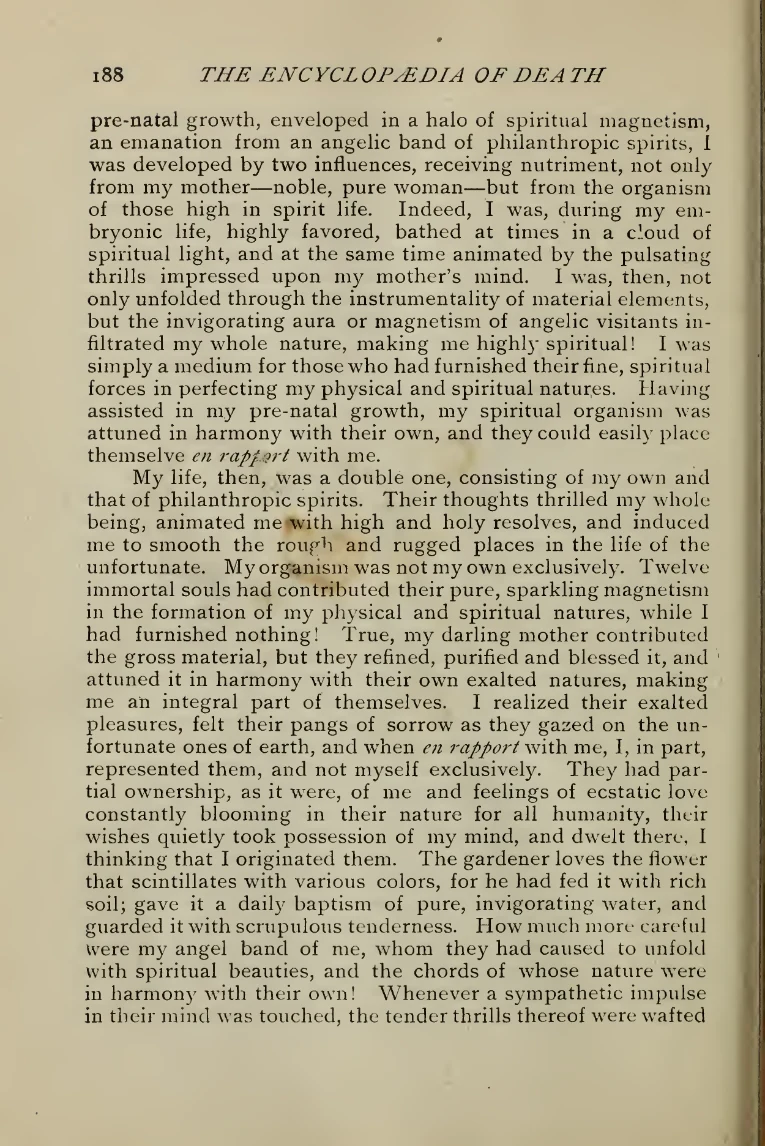
Source facsimile: The Encyclopaedia of Death and Life in the Spirit-World, Volume I (1903), printed p. 188, Reader page 187.
The Encyclopaedia of Death and Life in the Spirit-World, Volume I, fourth edition, 1903. Public-domain historical page extracted from the checksum-verified Library PDF. · Image source ↗ · Public Domain
See references (9)
- The Encyclopaedia of Death and Life in the Spirit-World, Volume I, printed p. 184, Reader page 183
- The Encyclopaedia of Death and Life in the Spirit-World, Volume I, printed p. 185, Reader page 184
- The Encyclopaedia of Death and Life in the Spirit-World, Volume I, printed p. 186, Reader page 185
- The Encyclopaedia of Death and Life in the Spirit-World, Volume I, printed p. 187, Reader page 186
- The Encyclopaedia of Death and Life in the Spirit-World, Volume I, printed p. 188, Reader page 187
- The Encyclopaedia of Death and Life in the Spirit-World, Volume I, printed p. 189, Reader page 188
- The Encyclopaedia of Death and Life in the Spirit-World, Volume I, printed p. 190, Reader page 189
- The Encyclopaedia of Death and Life in the Spirit-World, Volume I, printed p. 199, Reader page 198
- The Encyclopaedia of Death and Life in the Spirit-World, Volume I, printed p. 191, Reader page 190
Celestion Study of Man by Charles Samson
Celestion Study of Man, attributed to Charles Samson, distinguishes ordinary conscious thought from a deeper mind of the soul. It connects that inward life with memory and activity during sleep. These passages supply a theory of an individual’s hidden capacities. [10][11][12][13]
An inward capacity or another person’s influence
Reincarnation concerns a person being born into another life. The Humanitarian describes several helpers contributing to the formation of one person. His account depends on their purposes becoming intertwined while each keeps a place in the group. [5][6]
Celestion Study of Man gives the person a deeper mind of their own. The Humanitarian explains some impulses through cooperation with other persons. Francis’s introduction treats that second account as the speaker’s claim, while the speaker himself offers it with confidence. [1][8][10][11][12][13][3][4][5][7]
See references (11)
- The Encyclopaedia of Death and Life in the Spirit-World, Volume I, printed p. 184, Reader page 183
- The Encyclopaedia of Death and Life in the Spirit-World, Volume I, printed p. 186, Reader page 185
- The Encyclopaedia of Death and Life in the Spirit-World, Volume I, printed p. 187, Reader page 186
- The Encyclopaedia of Death and Life in the Spirit-World, Volume I, printed p. 188, Reader page 187
- The Encyclopaedia of Death and Life in the Spirit-World, Volume I, printed p. 189, Reader page 188
- The Encyclopaedia of Death and Life in the Spirit-World, Volume I, printed p. 190, Reader page 189
- The Encyclopaedia of Death and Life in the Spirit-World, Volume I, printed p. 199, Reader page 198
- The Angels’ Diary and Celestion Study of Man, Reader page 115
- The Angels’ Diary and Celestion Study of Man, Reader page 117
- The Angels’ Diary and Celestion Study of Man, Reader page 126
- The Angels’ Diary and Celestion Study of Man, Reader page 127
Read further in the library
The Encyclopaedia of Death and Life in the Spirit-World, Volume I
Reading note
The separately titled account draws on exact passages in the consulted Library edition.
The Angels’ Diary and Celestion Study of Man
Reading note
Separately attributed comparison with exact previously researched Library passages.
Sources
See references (13)
- The Encyclopaedia of Death and Life in the Spirit-World, Volume I, printed p. 184, Reader page 183J. R. Francis (compiler), The Encyclopaedia of Death and Life in the Spirit-World, Volume I, fourth edition. The Progressive Thinker Publishing House, Chicago, 1903. Individual authors, communicators and quoted sources identified in each account.Read this page in The Encyclopaedia of Death and Life in the Spirit-World, Volume I ↗Return to text ↑
- The Encyclopaedia of Death and Life in the Spirit-World, Volume I, printed p. 185, Reader page 184J. R. Francis (compiler), The Encyclopaedia of Death and Life in the Spirit-World, Volume I, fourth edition. The Progressive Thinker Publishing House, Chicago, 1903. Individual authors, communicators and quoted sources identified in each account.Read this page in The Encyclopaedia of Death and Life in the Spirit-World, Volume I ↗Return to text ↑
- The Encyclopaedia of Death and Life in the Spirit-World, Volume I, printed p. 186, Reader page 185J. R. Francis (compiler), The Encyclopaedia of Death and Life in the Spirit-World, Volume I, fourth edition. The Progressive Thinker Publishing House, Chicago, 1903. Individual authors, communicators and quoted sources identified in each account.Read this page in The Encyclopaedia of Death and Life in the Spirit-World, Volume I ↗Return to text ↑
- The Encyclopaedia of Death and Life in the Spirit-World, Volume I, printed p. 187, Reader page 186J. R. Francis (compiler), The Encyclopaedia of Death and Life in the Spirit-World, Volume I, fourth edition. The Progressive Thinker Publishing House, Chicago, 1903. Individual authors, communicators and quoted sources identified in each account.Read this page in The Encyclopaedia of Death and Life in the Spirit-World, Volume I ↗Return to text ↑
- The Encyclopaedia of Death and Life in the Spirit-World, Volume I, printed p. 188, Reader page 187J. R. Francis (compiler), The Encyclopaedia of Death and Life in the Spirit-World, Volume I, fourth edition. The Progressive Thinker Publishing House, Chicago, 1903. Individual authors, communicators and quoted sources identified in each account.Read this page in The Encyclopaedia of Death and Life in the Spirit-World, Volume I ↗Return to text ↑
- The Encyclopaedia of Death and Life in the Spirit-World, Volume I, printed p. 189, Reader page 188J. R. Francis (compiler), The Encyclopaedia of Death and Life in the Spirit-World, Volume I, fourth edition. The Progressive Thinker Publishing House, Chicago, 1903. Individual authors, communicators and quoted sources identified in each account.Read this page in The Encyclopaedia of Death and Life in the Spirit-World, Volume I ↗Return to text ↑
- The Encyclopaedia of Death and Life in the Spirit-World, Volume I, printed p. 190, Reader page 189J. R. Francis (compiler), The Encyclopaedia of Death and Life in the Spirit-World, Volume I, fourth edition. The Progressive Thinker Publishing House, Chicago, 1903. Individual authors, communicators and quoted sources identified in each account.Read this page in The Encyclopaedia of Death and Life in the Spirit-World, Volume I ↗Return to text ↑
- The Encyclopaedia of Death and Life in the Spirit-World, Volume I, printed p. 199, Reader page 198J. R. Francis (compiler), The Encyclopaedia of Death and Life in the Spirit-World, Volume I, fourth edition. The Progressive Thinker Publishing House, Chicago, 1903. Individual authors, communicators and quoted sources identified in each account.Read this page in The Encyclopaedia of Death and Life in the Spirit-World, Volume I ↗Return to text ↑
- The Encyclopaedia of Death and Life in the Spirit-World, Volume I, printed p. 191, Reader page 190J. R. Francis (compiler), The Encyclopaedia of Death and Life in the Spirit-World, Volume I, fourth edition. The Progressive Thinker Publishing House, Chicago, 1903. Individual authors, communicators and quoted sources identified in each account.Read this page in The Encyclopaedia of Death and Life in the Spirit-World, Volume I ↗Return to text ↑
- The Angels’ Diary and Celestion Study of Man, Reader page 115Effie M. Shirey and Charles Samson, The Angels’ Diary and Celestion Study of Man (1903), communicated through Elizabeth Maud Weatherhead according to the volume’s acknowledgment. Accounts below refer to the exact retained Library edition IMJ-0055-E001.Read this page in The Angels’ Diary and Celestion Study of Man ↗Return to text ↑
- The Angels’ Diary and Celestion Study of Man, Reader page 117Effie M. Shirey and Charles Samson, The Angels’ Diary and Celestion Study of Man (1903), communicated through Elizabeth Maud Weatherhead according to the volume’s acknowledgment. Accounts below refer to the exact retained Library edition IMJ-0055-E001.Read this page in The Angels’ Diary and Celestion Study of Man ↗Return to text ↑
- The Angels’ Diary and Celestion Study of Man, Reader page 126Effie M. Shirey and Charles Samson, The Angels’ Diary and Celestion Study of Man (1903), communicated through Elizabeth Maud Weatherhead according to the volume’s acknowledgment. Accounts below refer to the exact retained Library edition IMJ-0055-E001.Read this page in The Angels’ Diary and Celestion Study of Man ↗Return to text ↑
- The Angels’ Diary and Celestion Study of Man, Reader page 127Effie M. Shirey and Charles Samson, The Angels’ Diary and Celestion Study of Man (1903), communicated through Elizabeth Maud Weatherhead according to the volume’s acknowledgment. Accounts below refer to the exact retained Library edition IMJ-0055-E001.Read this page in The Angels’ Diary and Celestion Study of Man ↗Return to text ↑