Would You Choose the Same Life Again? Plato’s Myth of Er
Read Plato’s Myth of Er through the draw, the choice of lives, Odysseus and the river of forgetting. Follow each episode in Republic Book X.
In this article
Follow the choice from lot to forgetting
Compare what is decided by the lot, what the soul chooses and what it remembers.
- 614b–615a
Er receives a task
A witness is sent back
Read who asks Er to observe the different paths. - 616b–618b
The lots fall
The order of choice is set
Distinguish the lots from the examples of lives on the ground. - 618c–619d
A tyranny is chosen
The first chooser rushes
Look for what he overlooks when he sees the most powerful life. - 620a–620d
Odysseus draws last
An ordinary life remains
Read why he would make the same choice with a different number. - 620e–621d
The drink of forgetting
Choice is fixed before the souls return
Compare what happens to the other travellers with the exception made for Er.
Who is Er and why does he come back?
Socrates tells Glaucon about Er, a Pamphylian killed in battle. When his body is placed on the funeral pyre, he returns and reports what he saw. The judges appoint him to observe and bring back an account. Other souls take roads after judgement or return from them. Er’s task gives the dialogue a witness who can relate what happens at the choice of another life. [1][9]
The story changes its question as it goes. The opening asks what follows from the life a person has lived. At the spindle the next question is what kind of life they will choose. The rest of the story turns on how much their former experience helps with that choice. [1][3][6]
The spindle, the Fates and the draw
Er sees a spindle with eight whorls and hears the harmony of the Sirens. The three Fates sing of past, present and future. A herald then places the souls in order, gives them their lots and sets out more possible lives than there are souls. The lot determines who chooses first. The chooser has to consider what comes with the life they select. [2][3]
In the engraving below, you can see three different actions applied to thread. In Plato’s story, Lachesis is associated with the drawing and with sending each soul its chosen guardian. Clotho ratifies the choice and Atropos makes it irreversible. The difference is a useful way to see what work the Fates do in this particular text. [10][2][8]
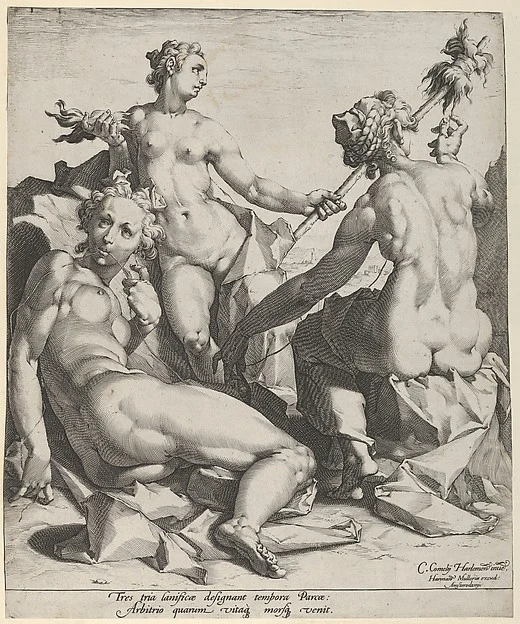
Muller’s engraving shows the Fates spinning, measuring and cutting thread. Plato gives them a different sequence of work around the cosmic spindle.
Jan Muller, after Cornelis Cornelisz. van Haarlem, The Three Fates: Clotho, Lachesis and Atropos, engraving, The Metropolitan Museum of Art, 56.597.7. Public domain. · Image source ↗ · Public Domain
Why the first chooser takes a tyranny
The first person has the widest choice and takes the greatest tyranny in haste. Only afterwards does he see the suffering that accompanies it. The text makes his earlier life matter. He had lived under good political arrangements and acquired decent habits, but his habits had not prepared him to examine the tempting life now on offer. [4][5]
Socrates interrupts the account of available lives to explain what should be compared. Wealth, status, beauty and strength come in combinations, with consequences for the kind of person the chooser may become. His standard for sorting those combinations is whether a life will make the soul more just. The drawn number tells the chooser when to act, while this inquiry gives a reason for what to choose. [3][4]
What Odysseus learns from his former life
Several choices carry the pattern of an earlier life forward. Ajax remembers his grievance over Achilles’ armour and selects a lion’s life. Atalanta is drawn by the honours of an athlete. Odysseus remembers the strain of his former adventures and searches for an inconspicuous life. He finds one of the lives that others have passed by. [6][7]
Odysseus draws last and says he would have chosen the same quiet life with the first lot. He has changed what he values. Put him beside the first chooser to see why the numbers matter without deciding everything. One person’s large selection leaves him open to a hurried choice, and the other person knows enough to look carefully through what remains. [5][7]
What the souls remember and what they forget
Memories of former lives are still active while the souls choose. Afterwards, the Fates ratify the choice. At the river on the Plain of Oblivion, each soul drinks and forgets. The separation between these episodes matters. Memory can shape the selection of a life even though the account has the travellers lose it before their next birth. [6][7][8]
Er is forbidden to drink. He returns to the pyre with the story, and Socrates closes by asking Glaucon to pursue justice with wisdom. The last instruction gives the myth an audience in the present. It puts the kind of attention shown by Odysseus within reach of a reader who is choosing how to live now. [8][9]
Sources
See references (10)
- Er’s return and the first sights beyond death ↗Plato, Republic X, 614b–615a, trans. Paul Shorey. Numbers refer to the standard Stephanus divisions.Return to text ↑
- The turning spindle and the surrounding circles ↗Plato, Republic X, 616b–617d, trans. Paul Shorey. Numbers refer to the standard Stephanus divisions.Return to text ↑
- The order of choosing and the patterns of lives ↗Plato, Republic X, 617e–618b, trans. Paul Shorey. Numbers refer to the standard Stephanus divisions.Return to text ↑
- How Socrates thinks a life should be judged ↗Plato, Republic X, 618c–619b, trans. Paul Shorey. Numbers refer to the standard Stephanus divisions.Return to text ↑
- The first chooser’s error ↗Plato, Republic X, 619b–619d, trans. Paul Shorey. Numbers refer to the standard Stephanus divisions.Return to text ↑
- How former lives shape the choices ↗Plato, Republic X, 619e–620c, trans. Paul Shorey. Numbers refer to the standard Stephanus divisions.Return to text ↑
- Odysseus chooses the overlooked life ↗Plato, Republic X, 620c–620e, trans. Paul Shorey. Numbers refer to the standard Stephanus divisions.Return to text ↑
- Ratification, the river and forgetting ↗Plato, Republic X, 620e–621b, trans. Paul Shorey. Numbers refer to the standard Stephanus divisions.Return to text ↑
- What Socrates asks Glaucon to take from the story ↗Plato, Republic X, 621c–621d, trans. Paul Shorey. Numbers refer to the standard Stephanus divisions.Return to text ↑
- Muller’s engraving of the three Fates ↗Jan Muller, after Cornelis Cornelisz. van Haarlem, The Three Fates: Clotho, Lachesis and Atropos, engraving, The Metropolitan Museum of Art, 56.597.7. Public domain.Return to text ↑