Perispirit
The perispirit is the subtle envelope of a spirit in Allan Kardec’s teaching. Compare his account with Flammarion’s spiritual sight and Magica Sexualis.
In this article
Understanding perispirit
The perispirit is the subtle envelope of a spirit in Allan Kardec’s Spiritist teaching. Kardec says a spirit draws this covering from the world it inhabits. Through it, the spirit can assume a form and, in some circumstances, appear to others. [1][3][4]
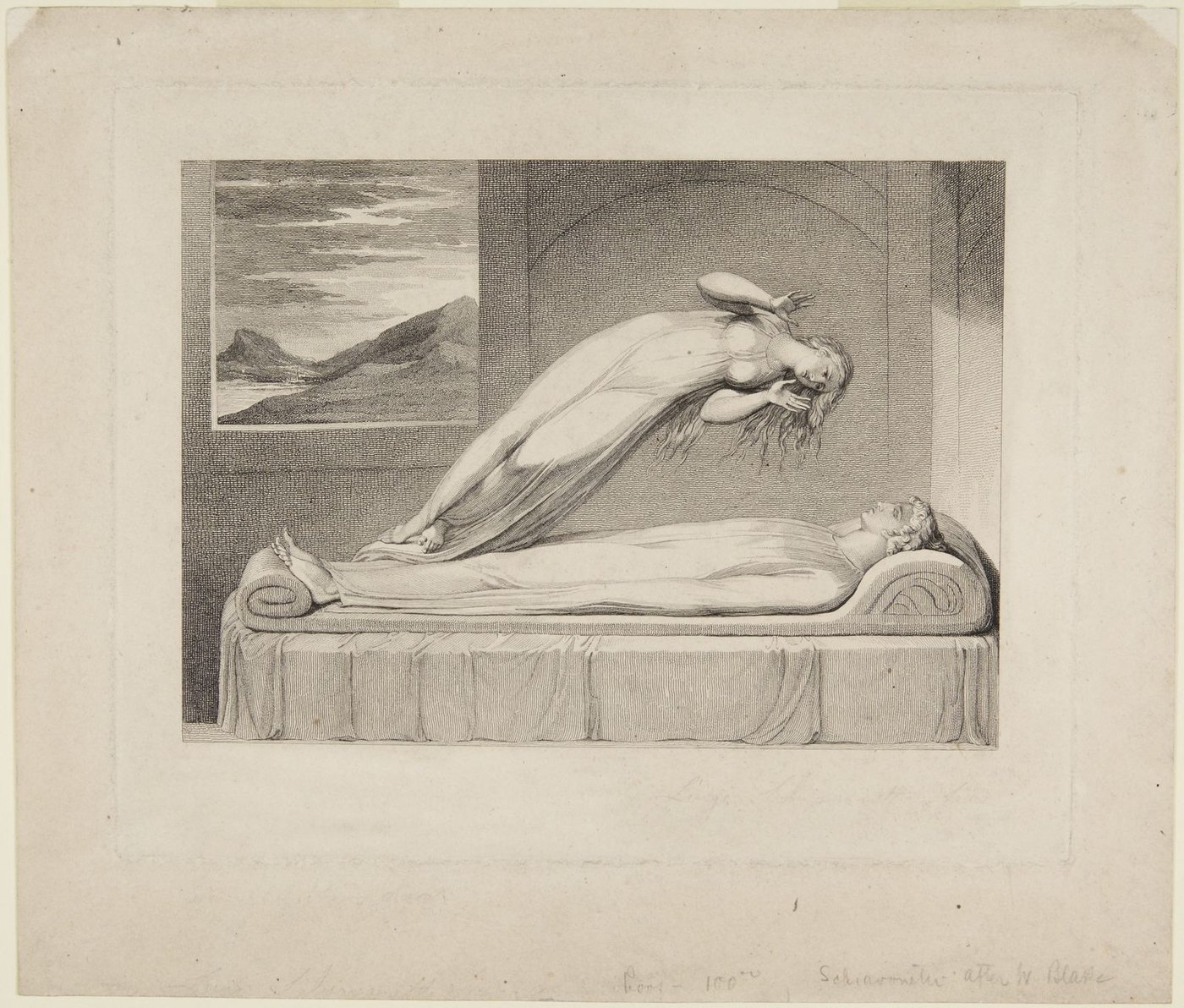
Luigi Schiavonetti after William Blake, The Soul Hovering over the Body Reluctantly Parting with Life (1805–08). The print was made for Robert Blair’s The Grave.
Princeton University Art Museum. Gift of Frank Jewett Mather Jr., x1947-85. Public Domain. · Image source ↗ · Public Domain
Accounts of the spirit’s envelope
The Spirits’ Book by Allan Kardec
In The Spirits’ Book, questions 93–95, Allan Kardec compares the perispirit to the covering around a seed. It is drawn from a world’s universal fluid, so a spirit takes a different covering when it enters another world. In the dialogue a spirit can give this envelope forms that become visible or tangible. [1]
Lumen by Camille Flammarion
In Lumen, Camille Flammarion’s narrator gives the perispirit its own eye. The rays reaching it are said to enter in parallel, so distance does not diminish the apparent size of a visible detail. The special retina still has a limited field and may show only a portion of a large object. [5][3][4]
Elsewhere Quaerens asks how a distant traveller could see through clouds or into buildings. Lumen invokes perception through the ether beyond the ordinary retina and optic nerve. He also describes taking on a form like that of the inhabitants near Capella. The dialogue gives the spirit both a form suited to its setting and unusual powers of sight. [6][7][8][9][10][11][5][3][4]
Magica Sexualis by Émile Laurent and Paul Nagour
In Magica Sexualis, Émile Laurent and Paul Nagour summarise Kardec and Delanne using the word ectoplasm for the fluidic covering. The account attributed to Delanne makes it a vehicle of impressions during bodily life and says it leaves the body with the soul at death. [12][13][14]
The book uses this covering to explain temporary apparitions, table movements, raps and writing. It also describes further dematerialisation as allowing the spirit to recall earlier lives. [14][15]
One term, different faculties
Kardec explains how a spirit can change its appearance as it moves between worlds. Flammarion asks how such a being would see. Laurent and Nagour explain manifestations through a covering they call ectoplasm. Their use of the word belongs to the account they give. [1][9][10][3][4][13][14]
Read further in the library

Lumen
Reading note
The separately titled account draws on exact passages in the consulted Library edition.

Magica Sexualis
Reading note
The separately titled account draws on exact passages in the consulted Library edition.
Sources
See references (15)
- Allan Kardec, The Spirits’ Book, Book Two, chapter I, Perispirit, questions 93–95 ↗Allan Kardec’s primary question-and-answer text, consulted in KardecPedia’s English transcription. Questions93–95 identify the passage; the translator of this displayed transcription is not assigned here. No newly verified printed pagination or Library edition is claimed.Return to text ↑
- Luigi Schiavonetti after William Blake, The Soul Hovering over the Body Reluctantly Parting with Life, 1805–08. ↗Princeton University Art Museum. Gift of Frank Jewett Mather Jr., x1947-85. Public Domain.
- Lumen, printed p. 205, Reader page 211Camille Flammarion, Lumen, authorised English translation by A. A. M. and R. M., Dodd, Mead and Company, New York, 1897. Exact selected Library edition IMJ-0398-E001. Lumen and Quaerens are speakers in the dialogue; claims made by the narrator are attributed to this text. Original PageIDs and current Reader positions are verified separately from printed pagination.Read this page in Lumen ↗Return to text ↑
- Lumen, Reader page 212Camille Flammarion, Lumen, authorised English translation by A. A. M. and R. M., Dodd, Mead and Company, New York, 1897. Exact selected Library edition IMJ-0398-E001. Lumen and Quaerens are speakers in the dialogue; claims made by the narrator are attributed to this text. Original PageIDs and current Reader positions are verified separately from printed pagination.Read this page in Lumen ↗Return to text ↑
- Lumen, Reader page 104Camille Flammarion, Lumen, authorised English translation by A. A. M. and R. M., Dodd, Mead and Company, New York, 1897. Exact selected Library edition IMJ-0398-E001. Lumen and Quaerens are speakers in the dialogue; claims made by the narrator are attributed to this text. Original PageIDs and current Reader positions are verified separately from printed pagination.Read this page in Lumen ↗Return to text ↑
- Lumen, Reader page 112Camille Flammarion, Lumen, authorised English translation by A. A. M. and R. M., Dodd, Mead and Company, New York, 1897. Exact selected Library edition IMJ-0398-E001. Lumen and Quaerens are speakers in the dialogue; claims made by the narrator are attributed to this text. Original PageIDs and current Reader positions are verified separately from printed pagination.Read this page in Lumen ↗Return to text ↑
- Lumen, Reader page 113Camille Flammarion, Lumen, authorised English translation by A. A. M. and R. M., Dodd, Mead and Company, New York, 1897. Exact selected Library edition IMJ-0398-E001. Lumen and Quaerens are speakers in the dialogue; claims made by the narrator are attributed to this text. Original PageIDs and current Reader positions are verified separately from printed pagination.Read this page in Lumen ↗Return to text ↑
- Lumen, Reader page 21Camille Flammarion, Lumen, authorised English translation by A. A. M. and R. M., Dodd, Mead and Company, New York, 1897. Exact selected Library edition IMJ-0398-E001. Lumen and Quaerens are speakers in the dialogue; claims made by the narrator are attributed to this text. Original PageIDs and current Reader positions are verified separately from printed pagination.Read this page in Lumen ↗Return to text ↑
- Lumen, Reader page 22Camille Flammarion, Lumen, authorised English translation by A. A. M. and R. M., Dodd, Mead and Company, New York, 1897. Exact selected Library edition IMJ-0398-E001. Lumen and Quaerens are speakers in the dialogue; claims made by the narrator are attributed to this text. Original PageIDs and current Reader positions are verified separately from printed pagination.Read this page in Lumen ↗Return to text ↑
- Lumen, Reader page 23Camille Flammarion, Lumen, authorised English translation by A. A. M. and R. M., Dodd, Mead and Company, New York, 1897. Exact selected Library edition IMJ-0398-E001. Lumen and Quaerens are speakers in the dialogue; claims made by the narrator are attributed to this text. Original PageIDs and current Reader positions are verified separately from printed pagination.Read this page in Lumen ↗Return to text ↑
- Lumen, Reader page 24Camille Flammarion, Lumen, authorised English translation by A. A. M. and R. M., Dodd, Mead and Company, New York, 1897. Exact selected Library edition IMJ-0398-E001. Lumen and Quaerens are speakers in the dialogue; claims made by the narrator are attributed to this text. Original PageIDs and current Reader positions are verified separately from printed pagination.Read this page in Lumen ↗Return to text ↑
- Magica Sexualis, Reader page 33Émile Laurent and Paul Nagour, Magica Sexualis, privately printed by Falstaff Press Inc., New York, undated inspected edition. Exact original Library edition IMJ-0105-E001. The work is a historical compilation; its quoted fiction, trial allegations and medical interpretations are not treated as independently verified facts. Current Reader positions are mapped separately from printed pagination.Read this page in Magica Sexualis ↗Return to text ↑
- Magica Sexualis, printed p. 26, Reader page 34Émile Laurent and Paul Nagour, Magica Sexualis, privately printed by Falstaff Press Inc., New York, undated inspected edition. Exact original Library edition IMJ-0105-E001. The work is a historical compilation; its quoted fiction, trial allegations and medical interpretations are not treated as independently verified facts. Current Reader positions are mapped separately from printed pagination.Read this page in Magica Sexualis ↗Return to text ↑
- Magica Sexualis, printed p. 27, Reader page 35Émile Laurent and Paul Nagour, Magica Sexualis, privately printed by Falstaff Press Inc., New York, undated inspected edition. Exact original Library edition IMJ-0105-E001. The work is a historical compilation; its quoted fiction, trial allegations and medical interpretations are not treated as independently verified facts. Current Reader positions are mapped separately from printed pagination.Read this page in Magica Sexualis ↗Return to text ↑
- Magica Sexualis, Reader page 36Émile Laurent and Paul Nagour, Magica Sexualis, privately printed by Falstaff Press Inc., New York, undated inspected edition. Exact original Library edition IMJ-0105-E001. The work is a historical compilation; its quoted fiction, trial allegations and medical interpretations are not treated as independently verified facts. Current Reader positions are mapped separately from printed pagination.Read this page in Magica Sexualis ↗Return to text ↑