Myths of the origin of death
Why did people begin to die? Compare Pandora’s jar, a lost power of renewal, the Hare’s changed message and Māui’s attempt to overcome death.
In this article
Understanding myths of the origin of death
Myths of the origin of death ask how mortality became part of human life. A story can answer through a lost power of renewal, a message that goes wrong, a prohibition or a failed attempt to undo death. [1][2][3][4][5][6]
The stories give different acts weight. In a skin-shedding tale, a grandmother can become young again but is no longer recognised by her favourite grandchild. The choice to restore that relationship costs her the power to renew her body. [3]
See references (6)
- The Encyclopaedia of Death and Life in the Spirit-World, Volume I, printed p. 16, Reader page 15
- The Encyclopaedia of Death and Life in the Spirit-World, Volume I, printed p. 17, Reader page 16
- The Encyclopaedia of Death and Life in the Spirit-World, Volume I, printed p. 18, Reader page 17
- The Encyclopaedia of Death and Life in the Spirit-World, Volume I, printed p. 19, Reader page 18
- The Encyclopaedia of Death and Life in the Spirit-World, Volume I, printed p. 21, Reader page 20
- The Encyclopaedia of Death and Life in the Spirit-World, Volume I, printed p. 22, Reader page 21
The Encyclopaedia of Death and Life, Volume I, compiled by J. R. Francis
J. R. Francis reprints an essay in which Andrew Lang groups stories about mortality by what changes the course of events: prohibition, omission, accident or failed enterprise. He compares the plots across communities. His categories help describe what the turning point does in each story, while his ranking of cultures reflects his own period. [7][1][2]
Lang reports a story, attributed in his source to the Ningphos of Bengal, in which bathing in a forbidden pool makes death possible. An Australian tree-and-bat story also turns on a prohibition. Lang himself raises the possibility of missionary influence in the latter, so his anthology is not evidence that every form he prints is independent or unchanged. [2][3]
The skin-shedding episode has a different cause. A grandmother renews her body, but her favourite grandchild no longer recognises her. She puts her old skin back on. The story says that this return ends the human capacity to renew life. Lang groups it with an interrupted custom, rather than simply with deliberate wrongdoing. [3]
Lang compares these examples with the story of Pandora. He observes that Hesiod gives the opening of the jar less explanation than later interpretations built around forbidden curiosity. [3][9]
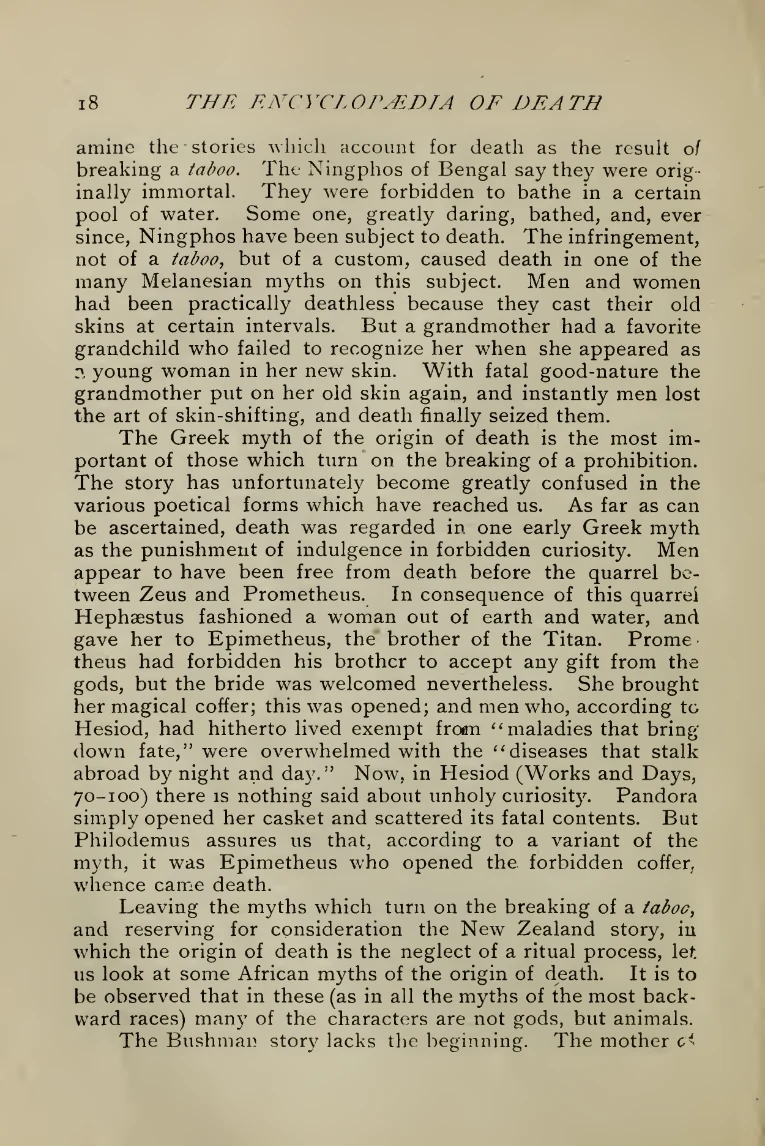
Source facsimile: The Encyclopaedia of Death and Life in the Spirit-World, Volume I (1903), printed p. 18, Reader page 17.
The Encyclopaedia of Death and Life in the Spirit-World, Volume I, fourth edition, 1903. Public-domain historical page extracted from the checksum-verified Library PDF. · Image source ↗ · Public Domain
See references (5)
- The Encyclopaedia of Death and Life in the Spirit-World, Volume I, printed p. 16, Reader page 15
- The Encyclopaedia of Death and Life in the Spirit-World, Volume I, printed p. 17, Reader page 16
- The Encyclopaedia of Death and Life in the Spirit-World, Volume I, printed p. 18, Reader page 17
- The Encyclopaedia of Death and Life in the Spirit-World, Volume I, printed p. 13, Reader page 12
- Hesiod, Works and Days, lines 54–105
Pandora’s jar in Hesiod
In Hesiod’s Works and Days, Zeus answers the theft of fire with a gift that brings hardship. Pandora opens a jar, and troubles spread among people who had lived without severe toil and disease. Hope remains inside. The poem describes the act and its consequences and gives Zeus’s decision a role in bringing them about. [9]
What brings renewal to an end?
The grandmother keeps the identity that her grandchild recognises by taking her old skin back. Reincarnation concerns another embodied life. Her choice also differs from a deliberate breach of a rule: the story gives affection and recognition a part in the loss of renewal. [3]
In the Hare’s story, the failure is in what people are told. In the Māui story, an attempt to reverse the course of life fails. The different endings help explain what each telling treats as the decisive loss. [4][8][5][6]
See references (5)
- The Encyclopaedia of Death and Life in the Spirit-World, Volume I, printed p. 18, Reader page 17
- The Encyclopaedia of Death and Life in the Spirit-World, Volume I, printed p. 19, Reader page 18
- The Encyclopaedia of Death and Life in the Spirit-World, Volume I, printed p. 21, Reader page 20
- The Encyclopaedia of Death and Life in the Spirit-World, Volume I, printed p. 22, Reader page 21
- The Encyclopaedia of Death and Life in the Spirit-World, Volume I, printed p. 20, Reader page 19
Read further in the library

The Encyclopaedia of Death and Life in the Spirit-World, Volume I
Reading note
The separately titled account draws on exact passages in the consulted Library edition.
Sources
See references (9)
- The Encyclopaedia of Death and Life in the Spirit-World, Volume I, printed p. 16, Reader page 15J. R. Francis (compiler), The Encyclopaedia of Death and Life in the Spirit-World, Volume I, fourth edition. The Progressive Thinker Publishing House, Chicago, 1903. Individual authors, communicators and quoted sources identified in each account.Read this page in The Encyclopaedia of Death and Life in the Spirit-World, Volume I ↗Return to text ↑
- The Encyclopaedia of Death and Life in the Spirit-World, Volume I, printed p. 17, Reader page 16J. R. Francis (compiler), The Encyclopaedia of Death and Life in the Spirit-World, Volume I, fourth edition. The Progressive Thinker Publishing House, Chicago, 1903. Individual authors, communicators and quoted sources identified in each account.Read this page in The Encyclopaedia of Death and Life in the Spirit-World, Volume I ↗Return to text ↑
- The Encyclopaedia of Death and Life in the Spirit-World, Volume I, printed p. 18, Reader page 17J. R. Francis (compiler), The Encyclopaedia of Death and Life in the Spirit-World, Volume I, fourth edition. The Progressive Thinker Publishing House, Chicago, 1903. Individual authors, communicators and quoted sources identified in each account.Read this page in The Encyclopaedia of Death and Life in the Spirit-World, Volume I ↗Return to text ↑
- The Encyclopaedia of Death and Life in the Spirit-World, Volume I, printed p. 19, Reader page 18J. R. Francis (compiler), The Encyclopaedia of Death and Life in the Spirit-World, Volume I, fourth edition. The Progressive Thinker Publishing House, Chicago, 1903. Individual authors, communicators and quoted sources identified in each account.Read this page in The Encyclopaedia of Death and Life in the Spirit-World, Volume I ↗Return to text ↑
- The Encyclopaedia of Death and Life in the Spirit-World, Volume I, printed p. 21, Reader page 20J. R. Francis (compiler), The Encyclopaedia of Death and Life in the Spirit-World, Volume I, fourth edition. The Progressive Thinker Publishing House, Chicago, 1903. Individual authors, communicators and quoted sources identified in each account.Read this page in The Encyclopaedia of Death and Life in the Spirit-World, Volume I ↗Return to text ↑
- The Encyclopaedia of Death and Life in the Spirit-World, Volume I, printed p. 22, Reader page 21J. R. Francis (compiler), The Encyclopaedia of Death and Life in the Spirit-World, Volume I, fourth edition. The Progressive Thinker Publishing House, Chicago, 1903. Individual authors, communicators and quoted sources identified in each account.Read this page in The Encyclopaedia of Death and Life in the Spirit-World, Volume I ↗Return to text ↑
- The Encyclopaedia of Death and Life in the Spirit-World, Volume I, printed p. 13, Reader page 12J. R. Francis (compiler), The Encyclopaedia of Death and Life in the Spirit-World, Volume I, fourth edition. The Progressive Thinker Publishing House, Chicago, 1903. Individual authors, communicators and quoted sources identified in each account.Read this page in The Encyclopaedia of Death and Life in the Spirit-World, Volume I ↗Return to text ↑
- The Encyclopaedia of Death and Life in the Spirit-World, Volume I, printed p. 20, Reader page 19J. R. Francis (compiler), The Encyclopaedia of Death and Life in the Spirit-World, Volume I, fourth edition. The Progressive Thinker Publishing House, Chicago, 1903. Individual authors, communicators and quoted sources identified in each account.Read this page in The Encyclopaedia of Death and Life in the Spirit-World, Volume I ↗Return to text ↑
- Hesiod, Works and Days, lines 54–105 ↗Hesiod, Works and Days, Harvard Center for Hellenic Studies translation.Return to text ↑