Omamori
Omamori are Japanese protective amulets. Explore portable shrine charms, a small Buddha image in Hearn’s ghost story and protection for fishing boats.
In this article
What is an omamori?
An omamori is a Japanese amulet associated with protection or help for a particular purpose. It often takes the form of a small pouch that can be carried. In older accounts, the term mamori also covers other objects, including miniature sacred figures and charms used on boats. [3][4][1][5][6]
Portable charms in Himeji Jinja’s account
Himeji Jinja describes its standard omamori as a small sealed pouch. It also gives stickers and key rings as forms of travel protection. The shrine describes home veneration separately under its account of ofuda. [1]
In Ghostly Japan by Lafcadio Hearn
In Lafcadio Hearn’s Peony Lantern tale, a priest lends Shinzaburō a tiny gold image of the Sea-Sounding Tathāgata to wear. The ghost cannot approach while he wears it. His servant Tomozō steals the image and puts a copper image of Fudō in its place, leaving Shinzaburō unaware of the loss. [3][5][7][8][9][10]
In At Yaidzu, Hearn observes fishing boats with Buddhist or Shinto charms at their prows. For one written shugo he translates a pledge: in return for success in fishing, the owner would undertake austerities honouring the divinity of Mount Fuji. Protection here is tied to work and a promise. [4][6][11]
See references (9)
A historical dog-amulet image
The Metropolitan Museum of Art identifies Shitayama’s carving as a netsuke shaped like an inu hariko, or dog amulet. The catalogue associates these dog charms with childbirth, young girls and household safety. [2]
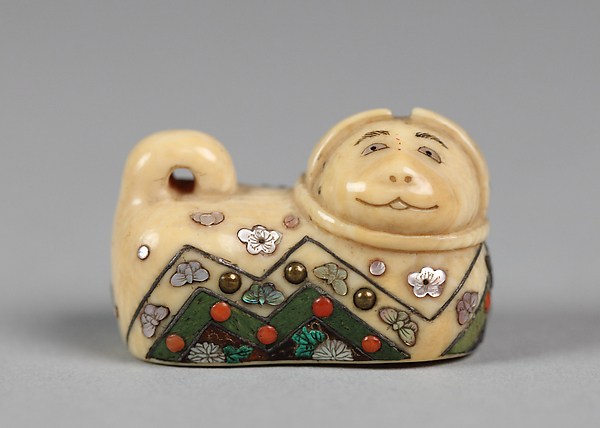
Shitayama’s mid-nineteenth-century netsuke takes the shape of an inu hariko dog amulet.
The Metropolitan Museum of Art, Gift of Mrs. Russell Sage, 1910, 10.211.309. Open Access CC0; resized and converted to JPEG. · Image source ↗ · CC0
Protection worn, carried or attached
The image in Hearn’s ghost story is meant to be worn, while the boat charm remains at the prow. Himeji Jinja’s examples show how a protective object can still take different forms according to what the person seeks help with. [3][4][1][2]
Read further in the library

In Ghostly Japan
Reading note
The separately titled account draws on exact passages in the consulted Library edition.
Sources
See references (11)
- Himeji Jinja: Omamori, Goshuin, Ofuda ↗The shrine’s own explanation of portable amulets and home veneration, directly read. Descriptive comparison only; current prices and advice are not reproduced.Return to text ↑
- Shitayama, Dog Amulet (Inu Hariko), mid-19th century ↗The Metropolitan Museum of Art, Gift of Mrs. Russell Sage, 1910, 10.211.309. Open Access CC0; resized and converted to JPEG.Return to text ↑
- In Ghostly Japan, Reader page 95Lafcadio Hearn, In Ghostly Japan, Little, Brown, and Company, Boston, 1899. Exact consulted Library edition IMJ-0654-E001, with title page visually checked. Persistent PageIDs and current Reader positions are verified from the supplied edition. Embedded stories, translations and quotations are attributed to Hearn’s presentation unless an original source has separately been consulted.Read this page in In Ghostly Japan ↗Return to text ↑
- In Ghostly Japan, Reader page 212Lafcadio Hearn, In Ghostly Japan, Little, Brown, and Company, Boston, 1899. Exact consulted Library edition IMJ-0654-E001, with title page visually checked. Persistent PageIDs and current Reader positions are verified from the supplied edition. Embedded stories, translations and quotations are attributed to Hearn’s presentation unless an original source has separately been consulted.Read this page in In Ghostly Japan ↗Return to text ↑
- In Ghostly Japan, Reader page 96Lafcadio Hearn, In Ghostly Japan, Little, Brown, and Company, Boston, 1899. Exact consulted Library edition IMJ-0654-E001, with title page visually checked. Persistent PageIDs and current Reader positions are verified from the supplied edition. Embedded stories, translations and quotations are attributed to Hearn’s presentation unless an original source has separately been consulted.Read this page in In Ghostly Japan ↗Return to text ↑
- In Ghostly Japan, Reader page 213Lafcadio Hearn, In Ghostly Japan, Little, Brown, and Company, Boston, 1899. Exact consulted Library edition IMJ-0654-E001, with title page visually checked. Persistent PageIDs and current Reader positions are verified from the supplied edition. Embedded stories, translations and quotations are attributed to Hearn’s presentation unless an original source has separately been consulted.Read this page in In Ghostly Japan ↗Return to text ↑
- In Ghostly Japan, Reader page 105Lafcadio Hearn, In Ghostly Japan, Little, Brown, and Company, Boston, 1899. Exact consulted Library edition IMJ-0654-E001, with title page visually checked. Persistent PageIDs and current Reader positions are verified from the supplied edition. Embedded stories, translations and quotations are attributed to Hearn’s presentation unless an original source has separately been consulted.Read this page in In Ghostly Japan ↗Return to text ↑
- In Ghostly Japan, Reader page 106Lafcadio Hearn, In Ghostly Japan, Little, Brown, and Company, Boston, 1899. Exact consulted Library edition IMJ-0654-E001, with title page visually checked. Persistent PageIDs and current Reader positions are verified from the supplied edition. Embedded stories, translations and quotations are attributed to Hearn’s presentation unless an original source has separately been consulted.Read this page in In Ghostly Japan ↗Return to text ↑
- In Ghostly Japan, Reader page 107Lafcadio Hearn, In Ghostly Japan, Little, Brown, and Company, Boston, 1899. Exact consulted Library edition IMJ-0654-E001, with title page visually checked. Persistent PageIDs and current Reader positions are verified from the supplied edition. Embedded stories, translations and quotations are attributed to Hearn’s presentation unless an original source has separately been consulted.Read this page in In Ghostly Japan ↗Return to text ↑
- In Ghostly Japan, Reader page 108Lafcadio Hearn, In Ghostly Japan, Little, Brown, and Company, Boston, 1899. Exact consulted Library edition IMJ-0654-E001, with title page visually checked. Persistent PageIDs and current Reader positions are verified from the supplied edition. Embedded stories, translations and quotations are attributed to Hearn’s presentation unless an original source has separately been consulted.Read this page in In Ghostly Japan ↗Return to text ↑
- In Ghostly Japan, Reader page 214Lafcadio Hearn, In Ghostly Japan, Little, Brown, and Company, Boston, 1899. Exact consulted Library edition IMJ-0654-E001, with title page visually checked. Persistent PageIDs and current Reader positions are verified from the supplied edition. Embedded stories, translations and quotations are attributed to Hearn’s presentation unless an original source has separately been consulted.Read this page in In Ghostly Japan ↗Return to text ↑