Necromancy
Necromancy is the attempted consultation of the dead. Explore Saul at Endor and compare accounts of summoning, spirit identity and testimony.
In this article
What is necromancy?
Necromancy is the attempted consultation of the dead for knowledge or help. Saul at Endor seeks news of his future. Other accounts ask a departed person to solve a mystery or carry a message. The life of the practice in literature turns partly on a question: how would a person know who had answered? [3][4][5][6]
The term can cover a rite involving a corpse or an attempt to contact a departed spirit. An unexpected apparition is an encounter of a different kind. The attempt to obtain an answer gives these stories their common shape. [4][7]
First Samuel: Saul at Endor
In 1 Samuel 28:3–20, Saul receives no answer from God and asks a woman at Endor to bring up Samuel. She sees an old man wrapped in a robe. Saul recognises Samuel from her description and hears him foretell defeat. The story gives the woman the sight of the figure and Saul the recognition. [2]
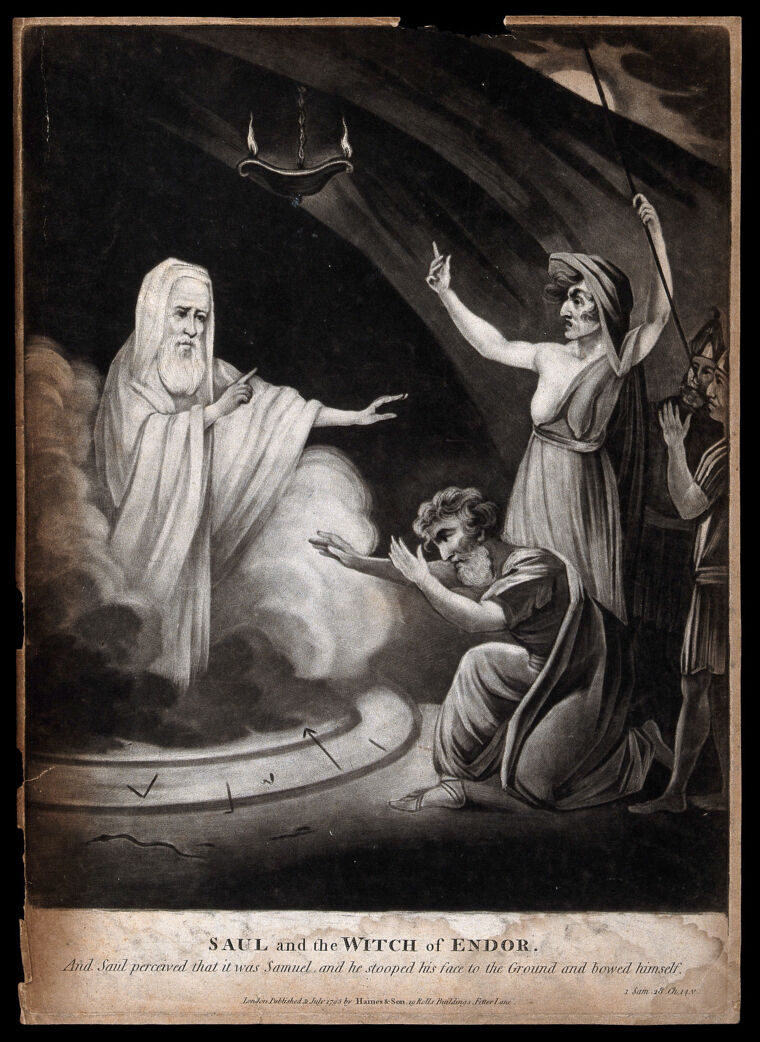
Saul and the Witch of Endor, mezzotint published by Haines & son, London, 31 July 1795. The print gives bodily form to the encounter narrated in First Samuel. Its dramatic arrangement is an artistic interpretation, not an additional witness to the event.
Wellcome Collection, 40549i. Public Domain Mark. Artist not established here. · Image source ↗ · Public Domain
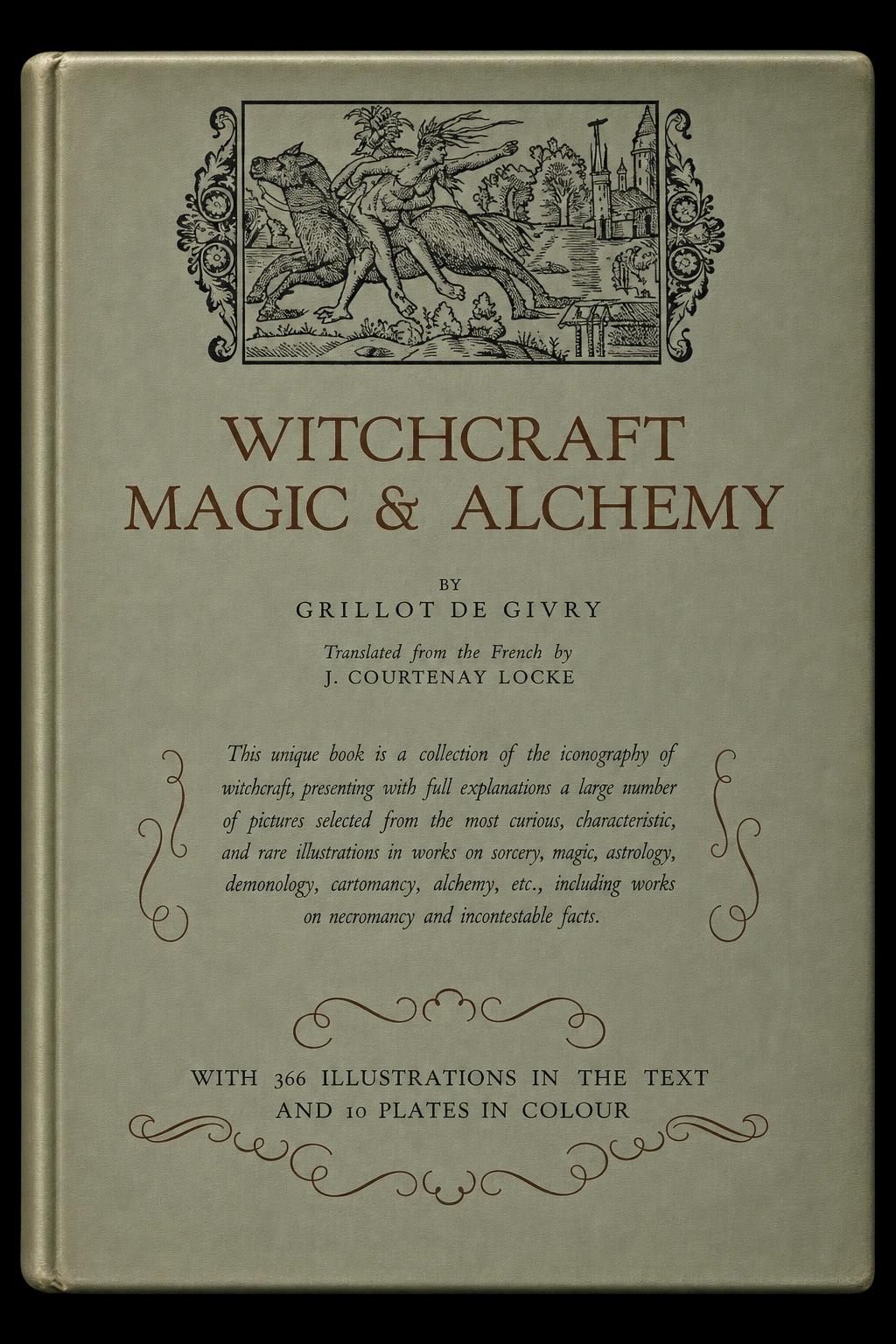
Witchcraft Magic & Alchemy by Grillot de Givry
Grillot de Givry opens his chapter by distinguishing consultation of the dead from the summoning of demons. He takes the woman of Endor as his leading example and studies an engraving that gives the consultation a tomb, a circle and a torch. He treats details of the scene as part of the visual vocabulary later artists could draw on when picturing necromancy. [17][18]
A later graveyard picture places John Dee beside Edward Kelley. De Givry describes Kelley as the principal actor and Dee as the person holding the light. He also has difficulty placing the reported event in Dee’s career. The page shows how confidently a picture can assign roles and settings even when the historian has trouble identifying an occasion for the scene. [19]
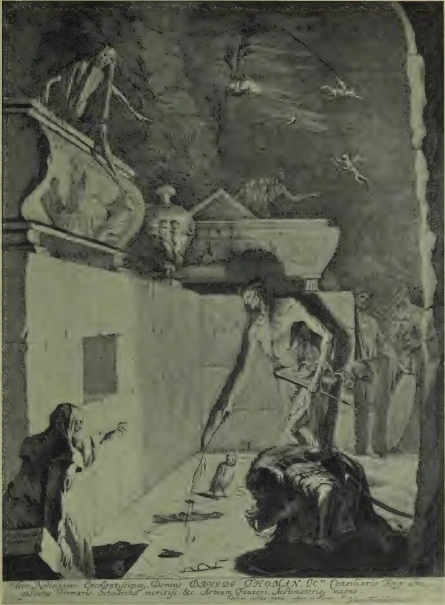
Gabriel Ehinger after Johann Heinrich Schönfeld depicts the consultation at Endor as a scene beside a tomb. The print supplies visual details beyond those in 1 Samuel.
Gabriel Ehinger after Johann Heinrich Schönfeld, Saul and the Witch of Endor, seventeenth century. Reproduced by De Givry. · Image source ↗ · Public Domain
How artists pictured a consultation
The Endor engraving gives a visible shape to an encounter the biblical account narrates largely through speech and recognition. The Dee and Kelley picture makes a different consultation immediately legible by assigning conspicuous roles to its two men. Those are choices made by artists, and they affect what a reader remembers about each story. [17][18][19][16]
The Other World, edited by Frederick George Lee
In The Other World, Frederick George Lee defines necromancy as formally summoning departed spirits to ask about the present or future, or to enlist their help. He treats it as forbidden and links it to biblical prohibitions on divination. [3][4]
Lee supports the condemnation with biblical prohibitions, including the passage in Deuteronomy that lists several kinds of divination and consultation. He also places these activities within a larger account of powers allegedly obtained from the devil. This brings necromancy into a theological category of illicit agency, even when a practitioner might describe the intended conversation as one with a deceased human being. [4][8][9]
Lee quotes a witness identified as Mr. Chevalier. Asked whether it was his child who was communicating, the table reportedly returned a negative answer. Chevalier took the speaker for a fallen spirit. The episode shows how a witness could receive a message and still have to decide who sent it. [5]
Lee then argues that evil spirits commonly impersonate the departed. He draws on Father Perrone’s interpretation of the phenomena and treats allegedly anti-Christian messages as evidence of malicious agency. His conclusion therefore depends partly on the content’s relation to his theology, not simply on the occurrence of a rap, movement or written answer. [10][6]
In another episode, a planchette gives written replies that connect a haunting to a murder. The replies that purport to give names are marked unintelligible. Lee says the participants eventually discard the instrument. [11][12][13]
A warning quoted from J. H. Jung-Stilling distinguishes deliberately seeking intercourse with spirits from an encounter received without seeking it and under divine guidance. Whatever one makes of the prohibition, the distinction limits its scope. Lee’s collection can oppose deliberate consultation while still defending some unsolicited appearances. It does not follow that every ghost story in the book is an example of the same forbidden act. [7]
See references (11)
- The Other World, Reader page 158
- The Other World, Reader page 159
- The Other World, Reader page 483
- The Other World, Reader page 485
- The Other World, Reader page 523
- The Other World, Reader page 160
- The Other World, Reader page 161
- The Other World, Reader page 484
- The Other World, Reader page 520
- The Other World, Reader page 521
- The Other World, Reader page 522
Gone West by J. S. M. Ward
J. S. M. Ward’s Gone West presents H. J. L. as a deceased relative communicating through visions and later proposing automatic writing. The contributor wishes to reassure Carrie, Ward’s wife, and says learning and receptivity affect his ability to reach her. He also admits that he cannot answer Ward’s question about devils from his own knowledge. The book gives the speaker a limited perspective rather than treating every utterance as omniscient. [14][15]
Moonchild by Aleister Crowley
Aleister Crowley introduces Dr. Victor Vesquit as a coroner and necromancer whose occult interests centre on the dead body. After Gates dies, Douglas wants Vesquit to learn what happened. He also expects the dead man’s previous dealings with Cyril Grey’s circle to give the group a connection it can exploit. They seek both information and leverage. [20][21][22][23]
The decisive voice comes through Abdul Bey, who is alive and present at the ceremony. Vesquit interprets the speech as a manifestation of Gates and writes it down. The voice warns of danger and directs the group’s attention towards an appearance of Onofrio. The narrator calls the operation a failure, yet the writing survives and Abdul later retrieves it. [24][25][26][27][28]
Distinctions and comparisons
Ward accepts a communicator as a relative who wants to reassure the living. Lee suspects impersonation by evil spirits. Crowley supplies a third possibility in fiction: the characters save a written message even as the operation breaks down. Each account distinguishes getting an answer from establishing who gave it. [5][11][12][7][4][6][14][15][24][25][27][28][3]
See references (13)
- The Other World, Reader page 158
- The Other World, Reader page 159
- The Other World, Reader page 483
- The Other World, Reader page 485
- The Other World, Reader page 523
- The Other World, Reader page 520
- The Other World, Reader page 521
- Gone West, printed p. 1, Reader page 14
- Gone West, printed p. 4, Reader page 17
- Moonchild, Reader page 253
- Moonchild, Reader page 254
- Moonchild, Reader page 256
- Moonchild, Reader page 257
Read further in the library
The Other World
Reading note
The separately titled account draws on exact passages in the consulted Library edition.
Gone West
Reading note
Separately attributed comparison with exact previously researched Library passages.
Witchcraft Magic and Alchemy
Reading note
The separately titled account draws on exact passages in the consulted Library edition.

Moonchild
Reading note
The separately titled account draws on exact passages in the consulted Library edition.
Sources
See references (28)
- Saul bows to Samuel after the witch of Endor has conjured him from the dead, mezzotint, 31 July 1795, Wellcome 40549i ↗Wellcome Collection’s own catalogue identifies Haines & son, London, as publisher and explicitly applies Public Domain Mark. Artist not established here. The print interprets 1 Samuel 28; it is not an eyewitness depiction or a ritual manual.
- First Samuel 28:3–20, Saul consults the woman at Endor ↗Primary biblical text, directly consulted in the USCCB’s New American Bible presentation. Verse references distinguish the woman’s reported sight, Saul’s recognition from her description and the narrated speech. The literary account is not treated as an independently verified historical encounter.Return to text ↑
- The Other World, Reader page 158Frederick George Lee, editor, The Other World; or, Glimpses of the Supernatural, two volumes, Henry S. King and Co., London, 1875. Exact consulted Library edition IMJ-0657-E001. Narratives and embedded quotations are attributed to this compilation; an original author is not represented as independently consulted merely because Lee quotes them. Reader positions are verified separately from printed pagination.Read this page in The Other World ↗Return to text ↑
- The Other World, Reader page 159Frederick George Lee, editor, The Other World; or, Glimpses of the Supernatural, two volumes, Henry S. King and Co., London, 1875. Exact consulted Library edition IMJ-0657-E001. Narratives and embedded quotations are attributed to this compilation; an original author is not represented as independently consulted merely because Lee quotes them. Reader positions are verified separately from printed pagination.Read this page in The Other World ↗Return to text ↑
- The Other World, Reader page 483Frederick George Lee, editor, The Other World; or, Glimpses of the Supernatural, two volumes, Henry S. King and Co., London, 1875. Exact consulted Library edition IMJ-0657-E001. Narratives and embedded quotations are attributed to this compilation; an original author is not represented as independently consulted merely because Lee quotes them. Reader positions are verified separately from printed pagination.Read this page in The Other World ↗Return to text ↑
- The Other World, Reader page 485Frederick George Lee, editor, The Other World; or, Glimpses of the Supernatural, two volumes, Henry S. King and Co., London, 1875. Exact consulted Library edition IMJ-0657-E001. Narratives and embedded quotations are attributed to this compilation; an original author is not represented as independently consulted merely because Lee quotes them. Reader positions are verified separately from printed pagination.Read this page in The Other World ↗Return to text ↑
- The Other World, Reader page 523Frederick George Lee, editor, The Other World; or, Glimpses of the Supernatural, two volumes, Henry S. King and Co., London, 1875. Exact consulted Library edition IMJ-0657-E001. Narratives and embedded quotations are attributed to this compilation; an original author is not represented as independently consulted merely because Lee quotes them. Reader positions are verified separately from printed pagination.Read this page in The Other World ↗Return to text ↑
- The Other World, Reader page 160Frederick George Lee, editor, The Other World; or, Glimpses of the Supernatural, two volumes, Henry S. King and Co., London, 1875. Exact consulted Library edition IMJ-0657-E001. Narratives and embedded quotations are attributed to this compilation; an original author is not represented as independently consulted merely because Lee quotes them. Reader positions are verified separately from printed pagination.Read this page in The Other World ↗Return to text ↑
- The Other World, Reader page 161Frederick George Lee, editor, The Other World; or, Glimpses of the Supernatural, two volumes, Henry S. King and Co., London, 1875. Exact consulted Library edition IMJ-0657-E001. Narratives and embedded quotations are attributed to this compilation; an original author is not represented as independently consulted merely because Lee quotes them. Reader positions are verified separately from printed pagination.Read this page in The Other World ↗Return to text ↑
- The Other World, Reader page 484Frederick George Lee, editor, The Other World; or, Glimpses of the Supernatural, two volumes, Henry S. King and Co., London, 1875. Exact consulted Library edition IMJ-0657-E001. Narratives and embedded quotations are attributed to this compilation; an original author is not represented as independently consulted merely because Lee quotes them. Reader positions are verified separately from printed pagination.Read this page in The Other World ↗Return to text ↑
- The Other World, Reader page 520Frederick George Lee, editor, The Other World; or, Glimpses of the Supernatural, two volumes, Henry S. King and Co., London, 1875. Exact consulted Library edition IMJ-0657-E001. Narratives and embedded quotations are attributed to this compilation; an original author is not represented as independently consulted merely because Lee quotes them. Reader positions are verified separately from printed pagination.Read this page in The Other World ↗Return to text ↑
- The Other World, Reader page 521Frederick George Lee, editor, The Other World; or, Glimpses of the Supernatural, two volumes, Henry S. King and Co., London, 1875. Exact consulted Library edition IMJ-0657-E001. Narratives and embedded quotations are attributed to this compilation; an original author is not represented as independently consulted merely because Lee quotes them. Reader positions are verified separately from printed pagination.Read this page in The Other World ↗Return to text ↑
- The Other World, Reader page 522Frederick George Lee, editor, The Other World; or, Glimpses of the Supernatural, two volumes, Henry S. King and Co., London, 1875. Exact consulted Library edition IMJ-0657-E001. Narratives and embedded quotations are attributed to this compilation; an original author is not represented as independently consulted merely because Lee quotes them. Reader positions are verified separately from printed pagination.Read this page in The Other World ↗Return to text ↑
- Gone West, printed p. 1, Reader page 14J. S. M. Ward, Gone West, 1920 third impression as reproduced in the 2009 Geoff Cutler digital transcription.Read this page in Gone West ↗Return to text ↑
- Gone West, printed p. 4, Reader page 17J. S. M. Ward, Gone West, 1920 third impression as reproduced in the 2009 Geoff Cutler digital transcription.Read this page in Gone West ↗Return to text ↑
- Saul speaks to Samuel’s ghost at the Witch of Endor ↗Gabriel Ehinger. Rijksmuseum, RP-P-1971-74.Return to text ↑
- Witchcraft Magic & Alchemy, printed p. 167, Reader page 159Grillot de Givry, Witchcraft Magic & Alchemy, translated by J. Courtenay Locke. Boston and New York, Houghton Mifflin Company, 1931.Read this page in Witchcraft Magic and Alchemy ↗Return to text ↑
- Witchcraft Magic & Alchemy, Reader page 161Grillot de Givry, Witchcraft Magic & Alchemy, translated by J. Courtenay Locke. Boston and New York, Houghton Mifflin Company, 1931.Read this page in Witchcraft Magic and Alchemy ↗Return to text ↑
- Witchcraft Magic & Alchemy, printed p. 170, Reader page 162Grillot de Givry, Witchcraft Magic & Alchemy, translated by J. Courtenay Locke. Boston and New York, Houghton Mifflin Company, 1931.Read this page in Witchcraft Magic and Alchemy ↗Return to text ↑
- Moonchild, Reader page 208Aleister Crowley, Moonchild (Liber LXXXI, The Butterfly Net), Library digital transcription IMJ-0629-E001.Read this page in Moonchild ↗Return to text ↑
- Moonchild, Reader page 209Aleister Crowley, Moonchild (Liber LXXXI, The Butterfly Net), Library digital transcription IMJ-0629-E001.Read this page in Moonchild ↗Return to text ↑
- Moonchild, Reader page 210Aleister Crowley, Moonchild (Liber LXXXI, The Butterfly Net), Library digital transcription IMJ-0629-E001.Read this page in Moonchild ↗Return to text ↑
- Moonchild, Reader page 211Aleister Crowley, Moonchild (Liber LXXXI, The Butterfly Net), Library digital transcription IMJ-0629-E001.Read this page in Moonchild ↗Return to text ↑
- Moonchild, Reader page 253Aleister Crowley, Moonchild (Liber LXXXI, The Butterfly Net), Library digital transcription IMJ-0629-E001.Read this page in Moonchild ↗Return to text ↑
- Moonchild, Reader page 254Aleister Crowley, Moonchild (Liber LXXXI, The Butterfly Net), Library digital transcription IMJ-0629-E001.Read this page in Moonchild ↗Return to text ↑
- Moonchild, Reader page 255Aleister Crowley, Moonchild (Liber LXXXI, The Butterfly Net), Library digital transcription IMJ-0629-E001.Read this page in Moonchild ↗Return to text ↑
- Moonchild, Reader page 256Aleister Crowley, Moonchild (Liber LXXXI, The Butterfly Net), Library digital transcription IMJ-0629-E001.Read this page in Moonchild ↗Return to text ↑
- Moonchild, Reader page 257Aleister Crowley, Moonchild (Liber LXXXI, The Butterfly Net), Library digital transcription IMJ-0629-E001.Read this page in Moonchild ↗Return to text ↑