Nāda and Bindu
Nāda and bindu mean sound and point. Compare their roles in Tantric cosmology, the symbol of Oṃ and the guru meditation of The Serpent Power.
In this article
What are nāda and bindu?
Nāda means sound and bindu means point or dot. Tantric texts use these terms for phases in the emergence of sound and for features of forms used in meditation. A dot in an image and a stage in the formation of the world can carry the same name. [2][3][4][5]
Nāda and bindu in The Serpent Power
In The Serpent Power, Arthur Avalon describes nāda as an early phase in the emergence of manifest sound. Supreme bindu, or para-bindu, evolves from nāda in this sequence. Avalon distinguishes it from a later bindu and treats both nāda and bindu as states of Śakti. [2][3][6]
In Pūrṇānanda’s description of Ājñā, the syllable Oṃ belongs within a triangle. The visual form includes a crescent, a point associated with the letter m and nāda above it. Kālīcaraṇa’s commentary traces further forms above Ājñā. [4][7]
These descriptions give nāda and bindu two settings. The first follows how sound comes into manifestation. The second tells a meditator where to place attention within and above the brow lotus. [2][6][4][7]
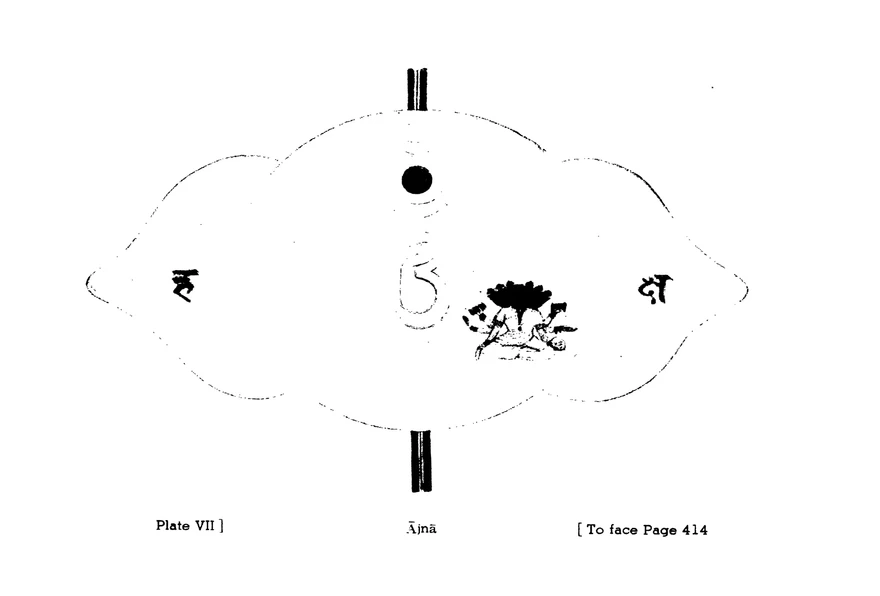
Plate VII shows Ājñā, the two-petalled brow lotus. The accompanying verses and commentary describe the placement of Oṃ, bindu and nāda.
Illustrator unrecorded. The Serpent Power, Plate VII. Library facsimile, compared with the 1924 second edition. · Image source ↗ · Public Domain
The guru meditation in the Pādukā-pañcaka
In the Pādukā-pañcaka, also translated by Avalon, nāda and bindu appear with a jewelled altar within a triangle. Kālīcaraṇa’s commentary explains their relationship in this setting. Here the arrangement serves a meditation on the guru. [8][5]
In the library
The Serpent Power
Reading note
Separately attributed primary Library account, cited on exact verified Reader leaves.
Sources
See references (8)
- The Serpent Power, Plate VII, Reader page 433Illustrator unrecorded. The Serpent Power, Plate VII. Library facsimile, compared with the 1924 second edition.Read this page in The Serpent Power ↗
- The Serpent Power, printed p. 34, Reader page 51Arthur Avalon (Sir John Woodroffe), The Serpent Power, fifth enlarged edition, Ganesh & Co., Madras, 1953. Includes Pūrṇānanda’s Ṣaṭ-cakra-nirūpaṇa, Pādukā-pañcaka and Kālīcaraṇa’s commentary. Exact Library edition IMJ-0608-E001.Read this page in The Serpent Power ↗
- The Serpent Power, printed p. 42, Reader page 59Arthur Avalon (Sir John Woodroffe), The Serpent Power, fifth enlarged edition, Ganesh & Co., Madras, 1953. Includes Pūrṇānanda’s Ṣaṭ-cakra-nirūpaṇa, Pādukā-pañcaka and Kālīcaraṇa’s commentary. Exact Library edition IMJ-0608-E001.Read this page in The Serpent Power ↗
- The Serpent Power, printed p. 403, Reader page 421Arthur Avalon (Sir John Woodroffe), The Serpent Power, fifth enlarged edition, Ganesh & Co., Madras, 1953. Includes Pūrṇānanda’s Ṣaṭ-cakra-nirūpaṇa, Pādukā-pañcaka and Kālīcaraṇa’s commentary. Exact Library edition IMJ-0608-E001.Read this page in The Serpent Power ↗
- The Serpent Power, printed p. 496, Reader page 524Arthur Avalon (Sir John Woodroffe), The Serpent Power, fifth enlarged edition, Ganesh & Co., Madras, 1953. Includes Pūrṇānanda’s Ṣaṭ-cakra-nirūpaṇa, Pādukā-pañcaka and Kālīcaraṇa’s commentary. Exact Library edition IMJ-0608-E001.Read this page in The Serpent Power ↗
- The Serpent Power, printed p. 44, Reader page 61Arthur Avalon (Sir John Woodroffe), The Serpent Power, fifth enlarged edition, Ganesh & Co., Madras, 1953. Includes Pūrṇānanda’s Ṣaṭ-cakra-nirūpaṇa, Pādukā-pañcaka and Kālīcaraṇa’s commentary. Exact Library edition IMJ-0608-E001.Read this page in The Serpent Power ↗
- The Serpent Power, printed p. 427, Reader page 446Arthur Avalon (Sir John Woodroffe), The Serpent Power, fifth enlarged edition, Ganesh & Co., Madras, 1953. Includes Pūrṇānanda’s Ṣaṭ-cakra-nirūpaṇa, Pādukā-pañcaka and Kālīcaraṇa’s commentary. Exact Library edition IMJ-0608-E001.Read this page in The Serpent Power ↗
- The Serpent Power, printed p. 493, Reader page 521Arthur Avalon (Sir John Woodroffe), The Serpent Power, fifth enlarged edition, Ganesh & Co., Madras, 1953. Includes Pūrṇānanda’s Ṣaṭ-cakra-nirūpaṇa, Pādukā-pañcaka and Kālīcaraṇa’s commentary. Exact Library edition IMJ-0608-E001.Read this page in The Serpent Power ↗