Microcosm and macrocosm
Microcosm and macrocosm pair the human “little world” with the wider cosmos. See how Fludd, Bragdon and esoteric authors pictured the relationship.
In this article
What are the microcosm and macrocosm?
A microcosm is a “little world” that reflects something of a larger one, the macrocosm. The human being is a common example. Some writers compare bodily and cosmic structures. Others say the same powers operate at both scales. A diagram can show which features a writer connects and how those connections are meant to work. [2][3][4]
A world within a person
A 1617 engraved title page associated with Robert Fludd places the human figure within concentric rings labelled Microcosmus and Macrocosmus. Celestial signs and bodily terms share the composition. The image gives a visible form to a relationship between the person and a more encompassing order, allowing its two scales to be contemplated together. [5]
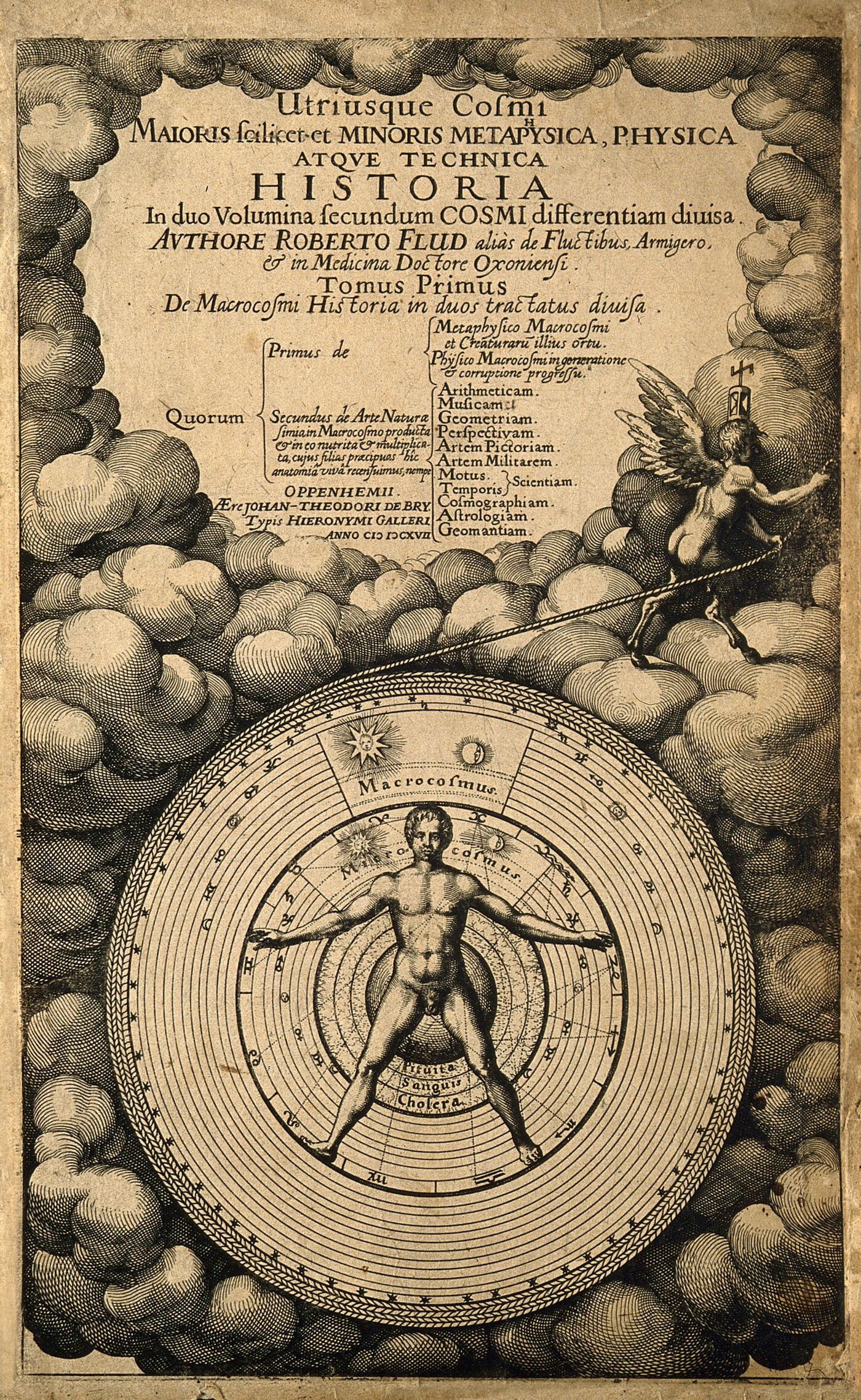
Title page for Robert Fludd’s Utriusque cosmi historia, 1617, credited by Wellcome Collection to T. de Bry. The figure stands within rings labelled Microcosmus and Macrocosmus.
Wellcome Collection, 2989i. Public Domain Mark. · Image source ↗ · Public Domain
Witchcraft Magic & Alchemy by Grillot de Givry
Grillot de Givry explains the microcosm through an analogy between a world and the human being. He reads Robert Fludd’s illustrations as versions of that comparison. One encloses a figure within rings belonging to the planets and elements. Another sets the figure within an invisible celestial order, with the nine ranks of angels taking the place of the planetary rings. [8][9][10]
In a different Fludd plate the argument is about dependence. Nature receives her power from above and holds human Art on a chain. Art appears as an ape measuring a globe. The compass and apparatus have a place in the picture, but they work inside a larger order that the image gives to Nature. [11][12][13]
Fludd’s diagrams can surround a person with celestial rings or put human Art in a relation of dependence on Nature. Each selects a different aspect of the analogy and makes its relations visible with a different arrangement. [11][12][13][9][10]
Rosicruciæ looks for recurring motions in cells, people and worlds, then uses images such as the inward sun to describe the human person. De Givry’s Fludd examples organize the analogy through pictured rings, elements and angelic ranks. Both make the human being intelligible through a larger order, but the pictures and the metaphysical account give the analogy different work to do. [2][3][4][11][12][8][9][10]
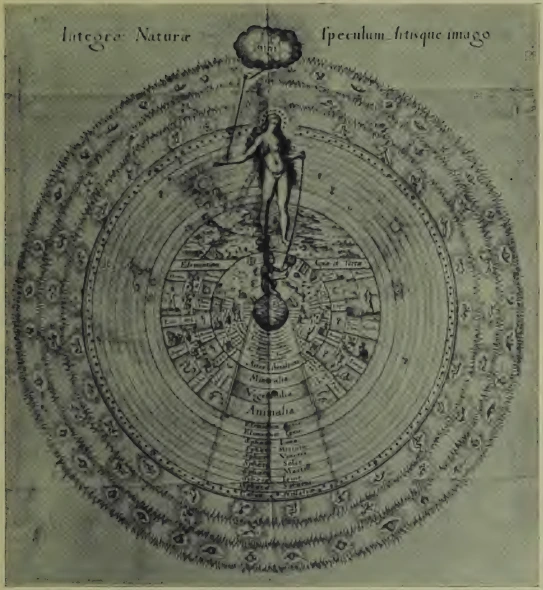
Fludd’s Nature and her Ape, Art, reproduced as figure 179. The chain represents dependence between God, Nature and human Art.
Robert Fludd, Utriusque cosmi historia. Historical plate reproduced by De Givry. · Image source ↗ · Public Domain
See references (9)
- Evolution of Immortality, printed p. 30, Reader page 27
- Evolution of Immortality, printed p. 104, Reader page 101
- Evolution of Immortality, printed p. 137, Reader page 136
- Witchcraft Magic & Alchemy, printed p. 240, Reader page 233
- Witchcraft Magic & Alchemy, printed p. 244, Reader page 237
- Witchcraft Magic & Alchemy, printed p. 245, Reader page 238
- Witchcraft Magic & Alchemy, printed p. 212, Reader page 204
- Witchcraft Magic & Alchemy, printed p. 214, Reader page 206
- Witchcraft Magic & Alchemy, Reader page 207
Man the Grand Symbol of the Mysteries by Manly P. Hall
Manly P. Hall defines the macrocosm as a greater whole and the microcosm as a smaller whole that has a similar organization. He gives the example of a tetrahedron built from smaller pieces of the same form. Each piece is part of the larger solid. Its shape also repeats the shape of that solid, which is why Hall calls it a miniature whole. [30][31]
The pattern can repeat at several scales. A body can be a microcosm of the universe, then become a macrocosm in relation to its cells. Hall uses this repeated organization to explain how a change in a greater whole could be reflected in the smaller worlds within it. [31][32][33][34]
A Primer of Higher Space by Claude Bragdon
Claude Bragdon calls the great crystal cube the macrocosm and the smaller cubes within it microcosms. Each smaller cube can contain smaller cubes of its own. Enlarging or shrinking the model leaves the proportions of corresponding parts unchanged. Bragdon compares this to a cinema image, where the arrangement visible in a film frame persists on a larger screen. [36][37][38]
The little cubes represent archetypal people, while the great cube represents the larger world and the divine whole. As a small cube passes through the film inside the great one, its changing section represents one visible lifetime. The model therefore gives the person two relations to the cosmos: a similarity of form and participation in a world that contains them. [37][38][39]
Manly P. Hall’s example also repeats a shape at different scales, using a tetrahedron made from smaller pieces in the same form. Bragdon adds a moving section to explain why a person may experience only one part of a larger identity at a time. [37][38][30][31]
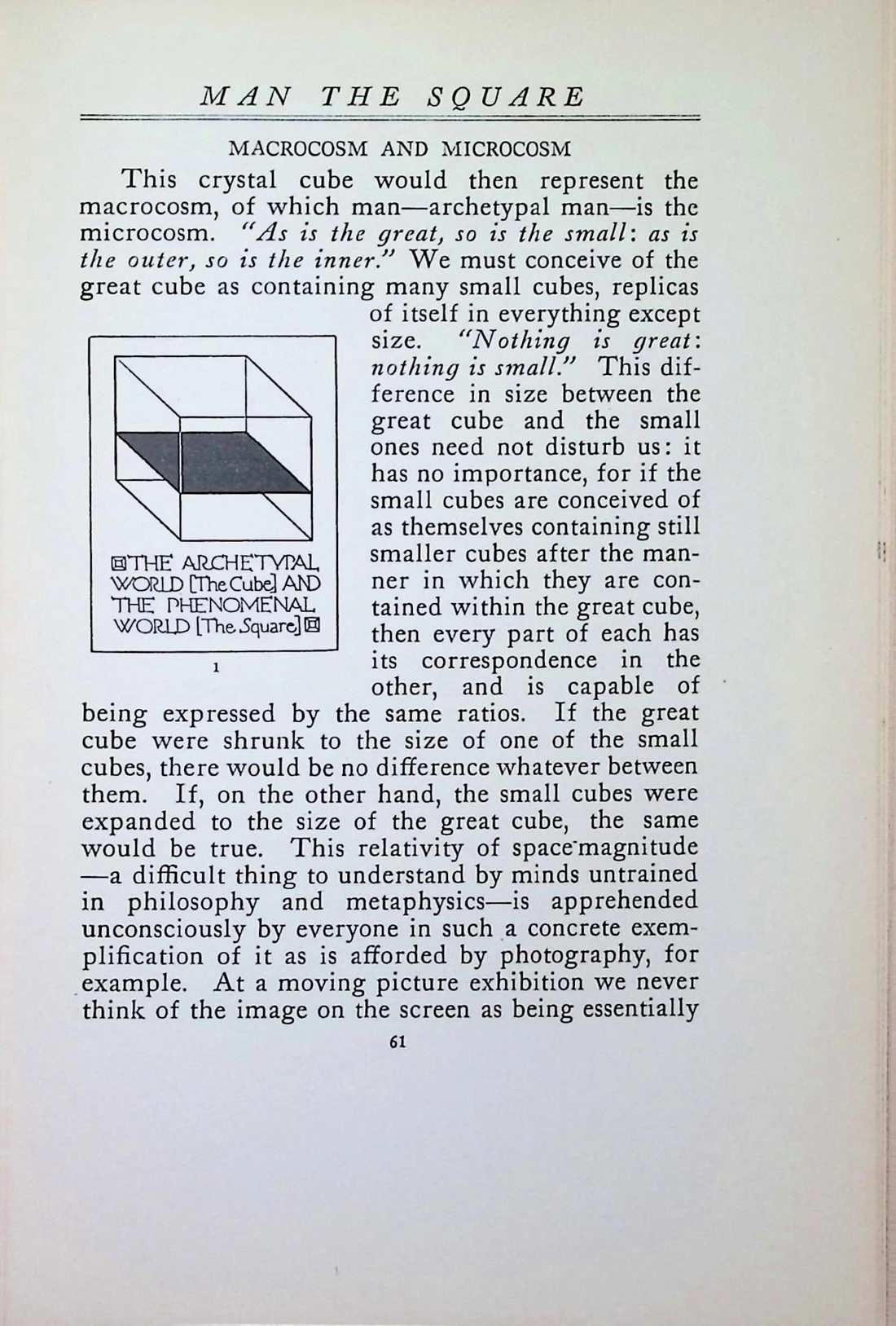
Illustration 1, printed p. 61, Reader page 64. The square intersects the crystal cube, Bragdon’s image of how the visible world relates to an archetypal whole.
Claude Bragdon, A Primer of Higher Space, The Manas Press, 1913. Stickley Museum scan via Internet Archive. · Image source ↗ · Public Domain
Watchers of the Seven Spheres by H. K. Challoner
In H. K. Challoner’s Cosmic Messengers, the human body is a microcosm that responds to the cycles of stars and planets. The poem says each particle recognises its own parent note in a greater harmony. It uses that relation to explain why a human life might express the influences of a world far beyond the body. [24][25][26]
The same structure appears at a collective scale. The Earth Spirit describes organisms as planetary cells, while The International Deva describes nations as limbs. Near the end of the book, awareness of both very small and very large things is presented as part of the human task. These comparisons give the whole and its parts an imagined capacity to affect one another. [27][28][25][29]
Hodson maps correspondences between planetary and human centres and connects them with his account of incarnation. Challoner’s parent note explains a relation through recognition and response. Her image connects processes at several scales without assigning each correspondence a named position on a diagram. [27][28][25][29][16][18][19][22]
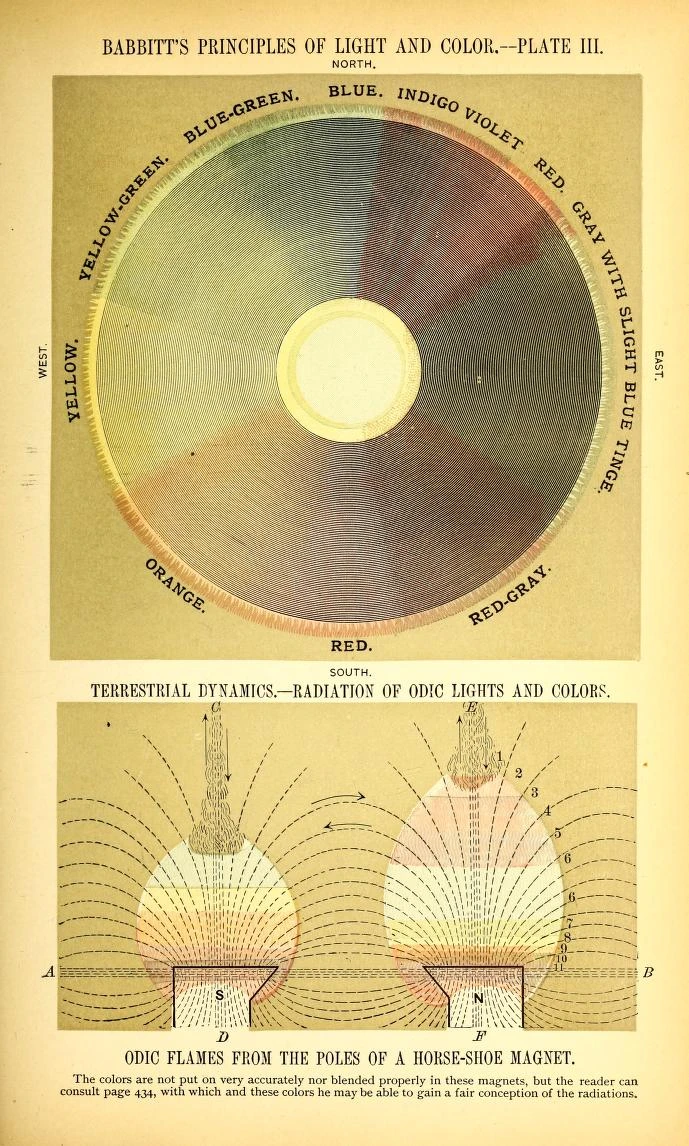
Babbitt’s Plate III places a proposed pattern of colours around Earth beside colours attributed to a magnet. It gives an earlier example of drawing parallels between patterns at different scales.
Edwin D. Babbitt, The Principles of Light and Color, first edition (1878), Plate III. Smithsonian Libraries and Archives. · Image source ↗ · CC0
See references (10)
- The Kingdom of the Gods, Reader page 44
- The Kingdom of the Gods, Reader page 46
- The Kingdom of the Gods, Reader page 49
- The Kingdom of the Gods, Reader page 140
- Watchers of the Seven Spheres, Reader page 81
- Watchers of the Seven Spheres, Reader page 82
- Watchers of the Seven Spheres, Reader page 83
- Watchers of the Seven Spheres, Reader page 33
- Watchers of the Seven Spheres, Reader page 53
- Watchers of the Seven Spheres, Reader page 84
The Kingdom of the Gods by Geoffrey Hodson
Geoffrey Hodson treats the human being as a microcosm of the same creative process he assigns to a solar system. A creative Word begins a new incarnation in his account. He says centres in the different planes relay its influence and draw in the substance suited to each of the person’s bodies. He also proposes that the human chakras correspond to vortices in planetary and solar archetypes. [15][16][17][18][19]
The Auric Tree of Life applies the comparison to the form of the human being. Hodson aligns the middle pillar with the spinal cord and places the pillar of Binah, Geburah and Hod on the right in his description. He relates regions of the aura and body to planetary and zodiacal influences. The diagram expresses his synthesis of sefirot, chakras and astrology. These correspondences are specific to that reading. [20][21][22]
Grillot de Givry presents Robert Fludd’s images of the little world in relation to planetary rings and angelic ranks. The author signing as Rosicruciæ in Evolution of Immortality uses creation imagery to describe powers within the person. Hodson extends the correspondence into a proposed process for building bodies and gives it a map with named points. Fludd’s pictured rings can be compared with that map without assuming that every point corresponds. [16][18][20][22][3][4][8][9][10]
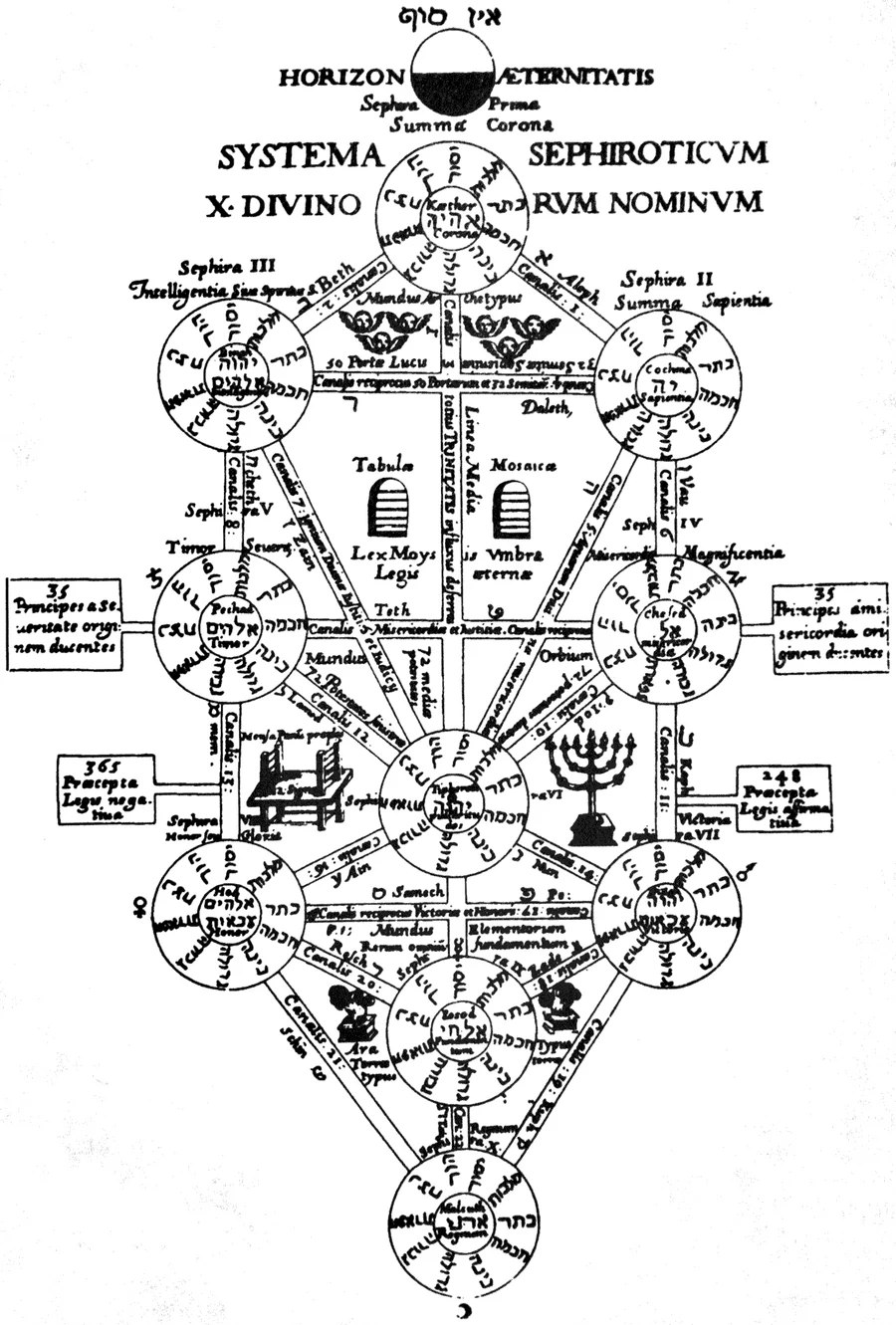
Athanasius Kircher’s seventeenth-century engraving arranges ten sefirot on a tree. Hodson’s later diagram uses a Tree to map regions of the body and aura.
Athanasius Kircher, Oedipus Aegyptiacus. Photograph released into the public domain by Fuzzypeg via Wikimedia Commons. · Image source ↗ · Public Domain
See references (13)
- Evolution of Immortality, printed p. 104, Reader page 101
- Evolution of Immortality, printed p. 137, Reader page 136
- Witchcraft Magic & Alchemy, printed p. 240, Reader page 233
- Witchcraft Magic & Alchemy, printed p. 244, Reader page 237
- Witchcraft Magic & Alchemy, printed p. 245, Reader page 238
- The Kingdom of the Gods, Reader page 43
- The Kingdom of the Gods, Reader page 44
- The Kingdom of the Gods, Reader page 45
- The Kingdom of the Gods, Reader page 46
- The Kingdom of the Gods, Reader page 49
- The Kingdom of the Gods, Reader page 138
- The Kingdom of the Gods, Reader page 139
- The Kingdom of the Gods, Reader page 140
Evolution of Immortality
Freeman Benjamin Dowd, writing as Rosicruciæ in Evolution of Immortality, treats the cell, the world and the human person as related centres of energy. A cell and a world are said to develop through the same fundamental motions. The comparison is part of a metaphysical account in which divine energy differentiates into forms while remaining their common ground. It reaches beyond an observation that two objects happen to look alike. [2]
The human being is then described as an image containing miniature counterparts of the divine whole. The soul becomes the firmament that separates opposing forces, and intelligence becomes an inward sun. Biblical creation language is used to describe relations within the person. These correspondences give the self a place within the author’s larger account of nature. [3]
In the appendix, Intelligence, Will and Love form a human triad understood as a manifestation of divine unity. Rosicruciæ calls the person a microcosmic God. He connects their harmonious activity with an inner flame and the work of transformation. The proposed correspondence therefore carries ethical and spiritual consequences: knowledge, directed action and affection must develop together. [4][1]
The analogy also reaches social life. Rosicruciæ compares a family, a government or an industrial undertaking with a centre that gathers and distributes energy. A factory’s executive is called its soul. The example shows how the correspondence can move between personal, social and cosmic scales. Its central question is how a unifying centre relates the activities of different parts, whether the author is discussing a person, a community or a world. [6][7]
See references (6)
- Evolution of Immortality, printed p. 20, Reader page 17
- Evolution of Immortality, printed p. 30, Reader page 27
- Evolution of Immortality, printed p. 104, Reader page 101
- Evolution of Immortality, printed p. 137, Reader page 136
- Evolution of Immortality, printed p. 15, Reader page 12
- Evolution of Immortality, printed p. 16, Reader page 13
What changes across scales
Fludd’s rings situate the human figure within the cosmos. Hall’s tetrahedron makes the relation repeatable: one piece mirrors the larger solid and can contain pieces of its own. The terms describe a relation that changes with the scale of the example. [30][31][32][34][5]
The scale analogy has different jobs. In Bragdon it explains a lifetime as one section of an archetypal whole. In Hall it explains repeated structures. In Dowd it extends to social organisations as well as to natural bodies. [37][38][39][30][31][6][7]
See references (10)
- The microcosm (man) and the macrocosm (the world), 1617: Wellcome Collection 2989i
- Evolution of Immortality, printed p. 15, Reader page 12
- Evolution of Immortality, printed p. 16, Reader page 13
- Man the Grand Symbol of the Mysteries, Reader page 85
- Man the Grand Symbol of the Mysteries, Reader page 86
- Man the Grand Symbol of the Mysteries, Reader page 87
- Man the Grand Symbol of the Mysteries, Reader page 103
- A Primer of Higher Space, Reader page 64
- A Primer of Higher Space, Reader page 65
- A Primer of Higher Space, Reader page 80
Read further in the library
Evolution of Immortality
Reading note
An esoteric account of worlds, cells and the person as related centres of divine energy.
Witchcraft Magic and Alchemy
Reading note
The separately titled account draws on exact passages in the consulted Library edition.
The Kingdom of the Gods
Reading note
The separately titled account draws on exact passages in the consulted Library edition.
Watchers of the Seven Spheres
Reading note
The separately titled account draws on exact passages in the consulted Library edition.
Man the Grand Symbol of the Mysteries
Reading note
The separately titled account draws on exact passages in the consulted Library edition.
A Primer of Higher Space
Reading note
The separately titled account draws on exact passages in the consulted Library edition.
Sources
See references (39)
- Evolution of Immortality, printed p. 20, Reader page 17Rosicruciæ (catalogued as Freeman Benjamin Dowd), Evolution of Immortality. Eulian Publishing Company, Salem, 1900.Read this page in Evolution of Immortality ↗Return to text ↑
- Evolution of Immortality, printed p. 30, Reader page 27Rosicruciæ (catalogued as Freeman Benjamin Dowd), Evolution of Immortality. Eulian Publishing Company, Salem, 1900.Read this page in Evolution of Immortality ↗Return to text ↑
- Evolution of Immortality, printed p. 104, Reader page 101Rosicruciæ (catalogued as Freeman Benjamin Dowd), Evolution of Immortality. Eulian Publishing Company, Salem, 1900.Read this page in Evolution of Immortality ↗Return to text ↑
- Evolution of Immortality, printed p. 137, Reader page 136Rosicruciæ (catalogued as Freeman Benjamin Dowd), Evolution of Immortality. Eulian Publishing Company, Salem, 1900.Read this page in Evolution of Immortality ↗Return to text ↑
- The microcosm (man) and the macrocosm (the world), 1617: Wellcome Collection 2989i ↗Wellcome Collection, 2989i. Engraving credited to T. de Bry, 1617; associated with Robert Fludd. Public Domain Mark.Return to text ↑
- Evolution of Immortality, printed p. 15, Reader page 12Rosicruciæ (catalogued as Freeman Benjamin Dowd), Evolution of Immortality. Eulian Publishing Company, Salem, 1900.Read this page in Evolution of Immortality ↗Return to text ↑
- Evolution of Immortality, printed p. 16, Reader page 13Rosicruciæ (catalogued as Freeman Benjamin Dowd), Evolution of Immortality. Eulian Publishing Company, Salem, 1900.Read this page in Evolution of Immortality ↗Return to text ↑
- Witchcraft Magic & Alchemy, printed p. 240, Reader page 233Grillot de Givry, Witchcraft Magic & Alchemy, translated by J. Courtenay Locke. Boston and New York, Houghton Mifflin Company, 1931.Read this page in Witchcraft Magic and Alchemy ↗Return to text ↑
- Witchcraft Magic & Alchemy, printed p. 244, Reader page 237Grillot de Givry, Witchcraft Magic & Alchemy, translated by J. Courtenay Locke. Boston and New York, Houghton Mifflin Company, 1931.Read this page in Witchcraft Magic and Alchemy ↗Return to text ↑
- Witchcraft Magic & Alchemy, printed p. 245, Reader page 238Grillot de Givry, Witchcraft Magic & Alchemy, translated by J. Courtenay Locke. Boston and New York, Houghton Mifflin Company, 1931.Read this page in Witchcraft Magic and Alchemy ↗Return to text ↑
- Witchcraft Magic & Alchemy, printed p. 212, Reader page 204Grillot de Givry, Witchcraft Magic & Alchemy, translated by J. Courtenay Locke. Boston and New York, Houghton Mifflin Company, 1931.Read this page in Witchcraft Magic and Alchemy ↗Return to text ↑
- Witchcraft Magic & Alchemy, printed p. 214, Reader page 206Grillot de Givry, Witchcraft Magic & Alchemy, translated by J. Courtenay Locke. Boston and New York, Houghton Mifflin Company, 1931.Read this page in Witchcraft Magic and Alchemy ↗Return to text ↑
- Witchcraft Magic & Alchemy, Reader page 207Grillot de Givry, Witchcraft Magic & Alchemy, translated by J. Courtenay Locke. Boston and New York, Houghton Mifflin Company, 1931.Read this page in Witchcraft Magic and Alchemy ↗Return to text ↑
- Athanasius Kircher, Tree of Sephiroth, Oedipus Aegyptiacus (1652) ↗Athanasius Kircher, Oedipus Aegyptiacus. Photograph released into the public domain by Fuzzypeg via Wikimedia Commons.
- The Kingdom of the Gods, Reader page 43Geoffrey Hodson, The Kingdom of the Gods, Theosophical Publishing House, first published 1952, thirteenth reprint 2007. Lumitheca Library edition IMJ-0606-E001.Read this page in The Kingdom of the Gods ↗Return to text ↑
- The Kingdom of the Gods, Reader page 44Geoffrey Hodson, The Kingdom of the Gods, Theosophical Publishing House, first published 1952, thirteenth reprint 2007. Lumitheca Library edition IMJ-0606-E001.Read this page in The Kingdom of the Gods ↗Return to text ↑
- The Kingdom of the Gods, Reader page 45Geoffrey Hodson, The Kingdom of the Gods, Theosophical Publishing House, first published 1952, thirteenth reprint 2007. Lumitheca Library edition IMJ-0606-E001.Read this page in The Kingdom of the Gods ↗Return to text ↑
- The Kingdom of the Gods, Reader page 46Geoffrey Hodson, The Kingdom of the Gods, Theosophical Publishing House, first published 1952, thirteenth reprint 2007. Lumitheca Library edition IMJ-0606-E001.Read this page in The Kingdom of the Gods ↗Return to text ↑
- The Kingdom of the Gods, Reader page 49Geoffrey Hodson, The Kingdom of the Gods, Theosophical Publishing House, first published 1952, thirteenth reprint 2007. Lumitheca Library edition IMJ-0606-E001.Read this page in The Kingdom of the Gods ↗Return to text ↑
- The Kingdom of the Gods, Reader page 138Geoffrey Hodson, The Kingdom of the Gods, Theosophical Publishing House, first published 1952, thirteenth reprint 2007. Lumitheca Library edition IMJ-0606-E001.Read this page in The Kingdom of the Gods ↗Return to text ↑
- The Kingdom of the Gods, Reader page 139Geoffrey Hodson, The Kingdom of the Gods, Theosophical Publishing House, first published 1952, thirteenth reprint 2007. Lumitheca Library edition IMJ-0606-E001.Read this page in The Kingdom of the Gods ↗Return to text ↑
- The Kingdom of the Gods, Reader page 140Geoffrey Hodson, The Kingdom of the Gods, Theosophical Publishing House, first published 1952, thirteenth reprint 2007. Lumitheca Library edition IMJ-0606-E001.Read this page in The Kingdom of the Gods ↗Return to text ↑
- The Principles of Light and Color, 1878, Plate III ↗Edwin D. Babbitt, The Principles of Light and Color, first edition (1878), Plate III. Smithsonian Libraries and Archives.
- Watchers of the Seven Spheres, Reader page 81H. K. Challoner, Watchers of the Seven Spheres, London, George Routledge & Sons, 1933. Lumitheca Library edition IMJ-0604-E001.Read this page in Watchers of the Seven Spheres ↗Return to text ↑
- Watchers of the Seven Spheres, Reader page 82H. K. Challoner, Watchers of the Seven Spheres, London, George Routledge & Sons, 1933. Lumitheca Library edition IMJ-0604-E001.Read this page in Watchers of the Seven Spheres ↗Return to text ↑
- Watchers of the Seven Spheres, Reader page 83H. K. Challoner, Watchers of the Seven Spheres, London, George Routledge & Sons, 1933. Lumitheca Library edition IMJ-0604-E001.Read this page in Watchers of the Seven Spheres ↗Return to text ↑
- Watchers of the Seven Spheres, Reader page 33H. K. Challoner, Watchers of the Seven Spheres, London, George Routledge & Sons, 1933. Lumitheca Library edition IMJ-0604-E001.Read this page in Watchers of the Seven Spheres ↗Return to text ↑
- Watchers of the Seven Spheres, Reader page 53H. K. Challoner, Watchers of the Seven Spheres, London, George Routledge & Sons, 1933. Lumitheca Library edition IMJ-0604-E001.Read this page in Watchers of the Seven Spheres ↗Return to text ↑
- Watchers of the Seven Spheres, Reader page 84H. K. Challoner, Watchers of the Seven Spheres, London, George Routledge & Sons, 1933. Lumitheca Library edition IMJ-0604-E001.Read this page in Watchers of the Seven Spheres ↗Return to text ↑
- Man the Grand Symbol of the Mysteries, Reader page 85Manly P. Hall, Man the Grand Symbol of the Mysteries, Fourth Edition, The Philosophers Press, Los Angeles, 1937. Lumitheca Library edition IMJ-0603-E001.Read this page in Man the Grand Symbol of the Mysteries ↗Return to text ↑
- Man the Grand Symbol of the Mysteries, Reader page 86Manly P. Hall, Man the Grand Symbol of the Mysteries, Fourth Edition, The Philosophers Press, Los Angeles, 1937. Lumitheca Library edition IMJ-0603-E001.Read this page in Man the Grand Symbol of the Mysteries ↗Return to text ↑
- Man the Grand Symbol of the Mysteries, Reader page 87Manly P. Hall, Man the Grand Symbol of the Mysteries, Fourth Edition, The Philosophers Press, Los Angeles, 1937. Lumitheca Library edition IMJ-0603-E001.Read this page in Man the Grand Symbol of the Mysteries ↗Return to text ↑
- Man the Grand Symbol of the Mysteries, Reader page 88Manly P. Hall, Man the Grand Symbol of the Mysteries, Fourth Edition, The Philosophers Press, Los Angeles, 1937. Lumitheca Library edition IMJ-0603-E001.Read this page in Man the Grand Symbol of the Mysteries ↗Return to text ↑
- Man the Grand Symbol of the Mysteries, Reader page 103Manly P. Hall, Man the Grand Symbol of the Mysteries, Fourth Edition, The Philosophers Press, Los Angeles, 1937. Lumitheca Library edition IMJ-0603-E001.Read this page in Man the Grand Symbol of the Mysteries ↗Return to text ↑
- Man the Square, illustration 1, the cube and the phenomenal world ↗Claude Bragdon, A Primer of Higher Space, The Manas Press, 1913. Stickley Museum scan via Internet Archive.
- A Primer of Higher Space, Reader page 63Claude Bragdon, A Primer of Higher Space (The Fourth Dimension), The Manas Press, Rochester, New York, 1913. Lumitheca Library edition IMJ-0599-E001.Read this page in A Primer of Higher Space ↗Return to text ↑
- A Primer of Higher Space, Reader page 64Claude Bragdon, A Primer of Higher Space (The Fourth Dimension), The Manas Press, Rochester, New York, 1913. Lumitheca Library edition IMJ-0599-E001.Read this page in A Primer of Higher Space ↗Return to text ↑
- A Primer of Higher Space, Reader page 65Claude Bragdon, A Primer of Higher Space (The Fourth Dimension), The Manas Press, Rochester, New York, 1913. Lumitheca Library edition IMJ-0599-E001.Read this page in A Primer of Higher Space ↗Return to text ↑
- A Primer of Higher Space, Reader page 80Claude Bragdon, A Primer of Higher Space (The Fourth Dimension), The Manas Press, Rochester, New York, 1913. Lumitheca Library edition IMJ-0599-E001.Read this page in A Primer of Higher Space ↗Return to text ↑