Miaoshan: The Chinese Buddhist Legend of Princess Guanyin
Miaoshan is a princess in a Chinese Buddhist legend who refuses marriage to pursue religious life. Her trials, acts of compassion and association with Guanyin are told differently in books, religious scrolls and temple paintings.
In this article
Who is Princess Miaoshan?
Miaoshan is the princess whose life is told as a legend of Guanyin’s compassion in Chinese Buddhism. She refuses the marriage her father arranges and chooses a religious life despite his opposition. Her compassion eventually extends to the father who tried to stop her. [3][4][5]
In Alice Getty’s The Gods of Northern Buddhism
Alice Getty sends Miaoshan to the Monastery of the White Sparrows. After her father orders her execution, she visits Yama’s realm and frees the condemned. The Buddha then directs her to Putuo, where she devotes herself to meditation. [3]
At Putuo, Miaoshan sends her disciple Shencai to free the Dragon King’s son, who has been caught as a fish. The king sends a pearl that shines in the dark. His granddaughter Longnü brings it and stays as Miaoshan’s disciple. Getty’s telling gives these attendants and their pearl a place in the story. [1][2][4]
A different retelling in the Xinjin mural
In Rostislav Berezkin’s reading of the Xinjin mural, the later scenes take place at Xiang Mountain. Miaoshan gives her hands and eyes to heal her father, who learns who saved him. Getty’s account develops the rescue of the fish and the gift of the pearl. The mural makes the princess’s compassion personal by bringing it back to her father. [5][3][4]
The princess and Guanyin on a temple wall
The mural places a large Thousand-armed Guanyin at the centre and smaller scenes from Miaoshan’s life around her. Following those scenes lets the viewer read the story alongside the figure of devotion. A 1468 inscription records a woman as the mural’s principal sponsor, together with several of her children. [6][5]
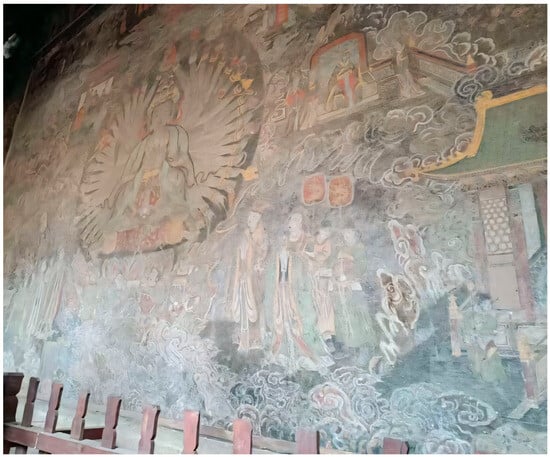
In the Vairochana Hall at Guanyin Monastery, smaller episodes from Miaoshan’s story surround the seated Guanyin. The mural was completed in 1468 and renovated in 1756.
Xiangshan mural, Guanyin Monastery, Xinjin. Figure 1 in Rostislav Berezkin, Religions 17(1), 32, CC BY 4.0. · Image source ↗ · CC BY 4.0
In the library
The Gods of Northern Buddhism
Reading note
Read Alice Getty’s illustrated discussion of Miaoshan.
Sources
See references (6)
- The Gods of Northern Buddhism, printed p. 81, Reader page 131Alice Getty, The Gods of Northern Buddhism, 1928 revised second edition, Munshiram Manoharlal reprint. Lumitheca Library edition IMJ-0597-E001.Read this page in The Gods of Northern Buddhism ↗
- The Gods of Northern Buddhism, printed p. 82, Reader page 132Alice Getty, The Gods of Northern Buddhism, 1928 revised second edition, Munshiram Manoharlal reprint. Lumitheca Library edition IMJ-0597-E001.Read this page in The Gods of Northern Buddhism ↗
- The Gods of Northern Buddhism, printed p. 83, Reader page 133Alice Getty, The Gods of Northern Buddhism, 1928 revised second edition, Munshiram Manoharlal reprint. Lumitheca Library edition IMJ-0597-E001.Read this page in The Gods of Northern Buddhism ↗
- The Gods of Northern Buddhism, printed p. 84, Reader page 134Alice Getty, The Gods of Northern Buddhism, 1928 revised second edition, Munshiram Manoharlal reprint. Lumitheca Library edition IMJ-0597-E001.Read this page in The Gods of Northern Buddhism ↗
- Rostislav Berezkin, Temple Painting and Vernacular Narratives, §2, scenes 10–22, and §3, comparison with the Baojuan of Xiangshan ↗Rostislav Berezkin, Temple Painting and Vernacular Narratives, §2, scenes 10–22, and §3, comparison with the Baojuan of Xiangshan. Source credit: Rostislav Berezkin, Religions 17(1), article 32.
- Mural of Xiangshan at Guanyin temple in Xinjin, Figure 1 ↗Xiangshan mural, Guanyin Monastery, Xinjin. Figure 1 in Rostislav Berezkin, Religions 17(1), 32, CC BY 4.0.