Why Does Avalokiteśvara Have a Thousand Arms?
Why does Avalokiteśvara have a thousand arms and eyes in the palms? Read Getty’s explanation and see how a Qing embroidery portrays seeing and relieving suffering.
In this article
What do the arms and eyes mean?
The many-armed form of Avalokiteśvara pictures the reach of Buddhist compassion. An eye in a palm sees someone in distress, and the hand can reach out to help. Artists may arrange the arms like a halo around the central figure and show eleven heads rising above it. [2][6]
The Gods of Northern Buddhism by Alice Getty
Alice Getty records a story in which Avalokiteśvara’s head breaks apart in grief over the suffering he cannot end. Amitābha restores him with more heads and places his own image above them. In Getty’s account, the many eyes make it possible to see suffering in every direction, and the hands offer the means to respond. [1][2]
Getty also describes Japanese forms in which the features occur separately. Senju Kannon may have many arms and a crown without heads. Another form may have eleven heads and only two arms. [3][4]
The many arms in The Basket’s Display
In Peter Alan Roberts’s translation of the Basket’s Display, Yamarāja praises Avalokiteśvara after seeing him relieve suffering in Avīci. He names eleven heads and a hundred thousand arms. The scale of the praise conveys the reach of the bodhisattva’s care. An eye in a palm makes that idea visible in a single detail. [5][2]
An embroidered Guanyin from 1778
Hands fan out on both sides of Guanyin in this Qing embroidery, and the heads rise above the centre. The Met reads the heads as stages on the way to awakening. Getty’s story gives them another meaning rooted in grief and the desire to help. [6][1]
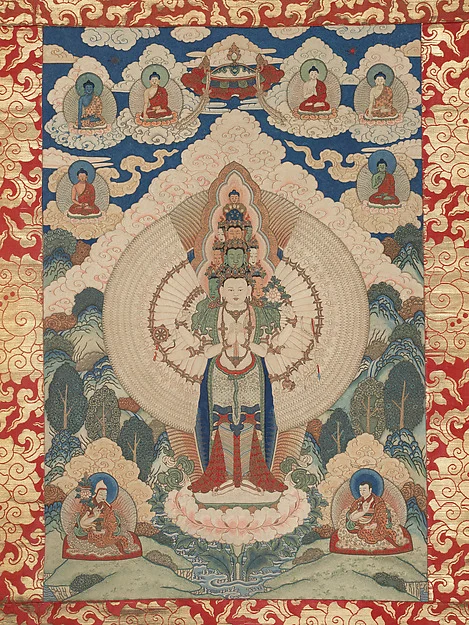
Eleven-headed bodhisattva Guanyin, China, 1778. The outer hands form a halo. The Met identifies an eye in each palm.
The Metropolitan Museum of Art. Qing dynasty, China, 1778. Bequest of William Christian Paul, 1929. Accession 30.75.34a, b. · Image source ↗ · CC0
In the library
The Gods of Northern Buddhism
Reading note
Alice Getty’s separately titled account uses exact pages from the consulted Library edition.
Sources
See references (6)
- The Gods of Northern Buddhism, printed p. 67, Reader page 118Alice Getty, The Gods of Northern Buddhism, 1928 revised second edition, Munshiram Manoharlal reprint. Lumitheca Library edition IMJ-0597-E001.Read this page in The Gods of Northern Buddhism ↗
- The Gods of Northern Buddhism, printed p. 68, Reader page 119Alice Getty, The Gods of Northern Buddhism, 1928 revised second edition, Munshiram Manoharlal reprint. Lumitheca Library edition IMJ-0597-E001.Read this page in The Gods of Northern Buddhism ↗
- The Gods of Northern Buddhism, printed p. 79, Reader page 129Alice Getty, The Gods of Northern Buddhism, 1928 revised second edition, Munshiram Manoharlal reprint. Lumitheca Library edition IMJ-0597-E001.Read this page in The Gods of Northern Buddhism ↗
- The Gods of Northern Buddhism, printed p. 93, Reader page 142Alice Getty, The Gods of Northern Buddhism, 1928 revised second edition, Munshiram Manoharlal reprint. Lumitheca Library edition IMJ-0597-E001.Read this page in The Gods of Northern Buddhism ↗
- The Basket’s Display, Toh 116, § 1.16 ↗Peter Alan Roberts, translated for 84000.
- Eleven-headed bodhisattva Guanyin ↗The Metropolitan Museum of Art. Qing dynasty, China, 1778. Bequest of William Christian Paul, 1929. Accession 30.75.34a, b.