Metoposcopy
Metoposcopy is divination by forehead lines. Cardano’s diagrams show how a Renaissance system assigned planetary names to wrinkles.
In this article
What is metoposcopy?
Metoposcopy is a historical practice of reading forehead lines for signs of a person’s character or future. In Gerolamo Cardano’s system, seven positions across the forehead correspond to planets, from the Moon above the brows to Saturn near the hairline. [3][4][1]
Metoposcopy was closely linked to physiognomy, the practice of judging character from appearance. An English manuscript dated 1648 gives forehead reading its own section alongside physiognomy and palmistry. [3][4][2]
Witchcraft Magic & Alchemy by Grillot de Givry
Grillot de Givry reproduces Cardano’s guide to the seven positions alongside portraits with only some of the lines. One forehead shows lines assigned to Mars, Jupiter and Saturn. A second shows only Mars and Jupiter. [3][4]
In Cardano’s reading, shape also matters. Straight lines can indicate honesty and simplicity, while waviness, interruptions and crossings change the reading. The guide tells readers where to look. The portraits show how Cardano applied it. [3]
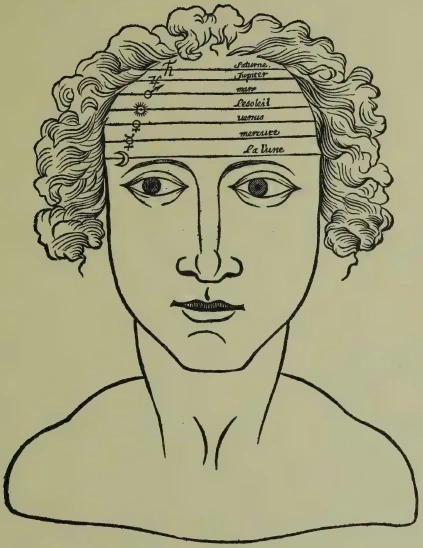
Cardano’s planetary forehead. The figure makes the positions clear before the reader tries to classify an individual wrinkle.
Gerolamo Cardano, Metoposcopia, Paris, 1658. Reproduced by De Givry. · Image source ↗ · Public Domain
Forehead reading and palmistry
Jean d’Indagine’s palm diagram names creases by their shapes and positions. Cardano begins with a planetary order and uses it to place the wrinkles he sees. Both methods treat ordinary bodily marks as signs. [3][4][5][1][2]
In the library
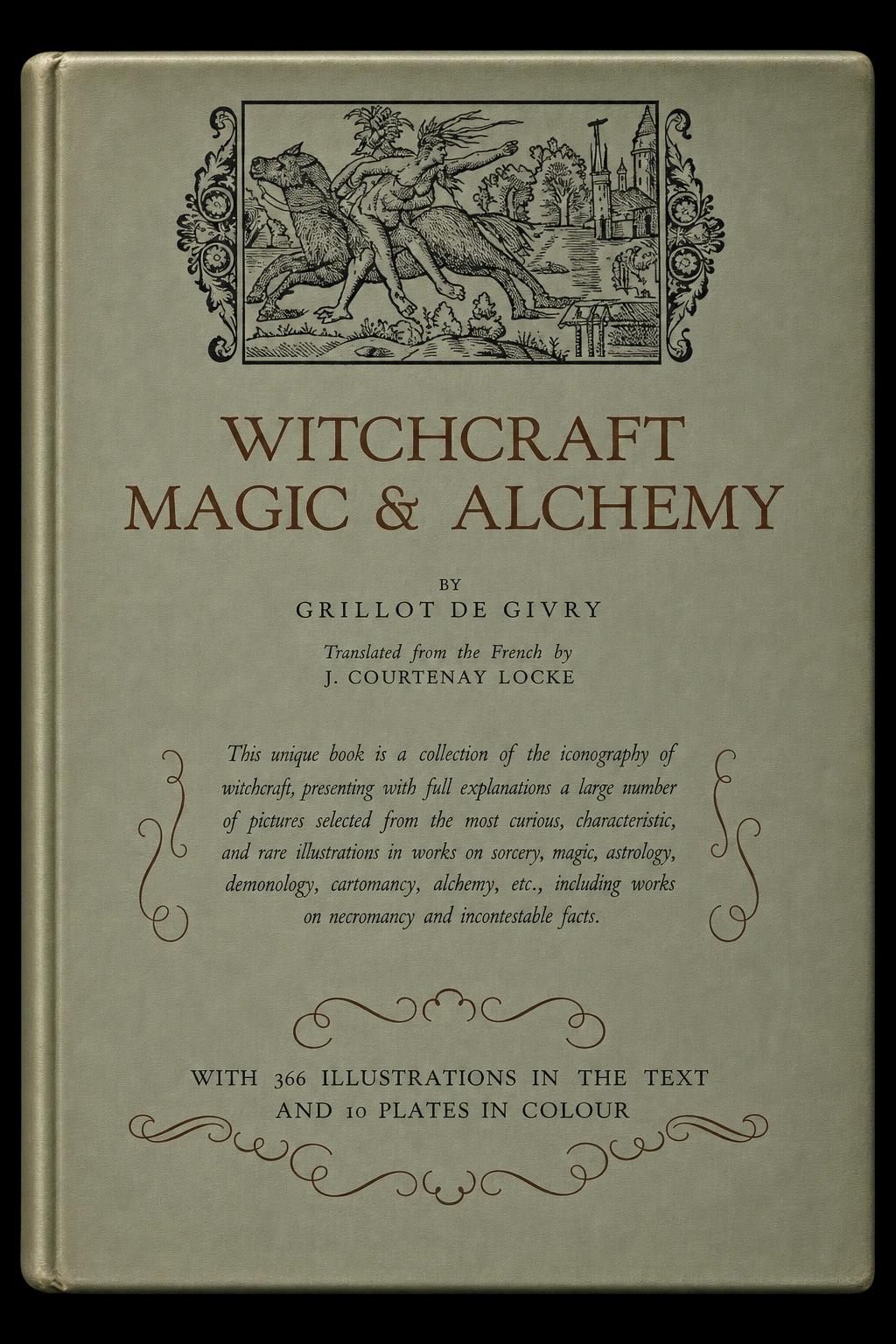
Witchcraft Magic and Alchemy
Reading note
The separately titled account draws on exact passages in the consulted Library edition.
Sources
See references (5)
- Metoposcopia, 1658 edition ↗Gerolamo Cardano, Metoposcopia libris tredecim, Paris, 1658. University of Pennsylvania Libraries, Colenda Digital Repository.
- Chyromancy or Palmestrye. Also Physiognomy and Metoposcopie ↗Seventeenth-century manuscript, dated 1648 in the Wellcome Collection catalogue.
- Witchcraft Magic & Alchemy, printed p. 250, Reader page 243Grillot de Givry, Witchcraft Magic & Alchemy, translated by J. Courtenay Locke. Boston and New York, Houghton Mifflin Company, 1931.Read this page in Witchcraft Magic and Alchemy ↗
- Witchcraft Magic & Alchemy, Reader page 244Grillot de Givry, Witchcraft Magic & Alchemy, translated by J. Courtenay Locke. Boston and New York, Houghton Mifflin Company, 1931.Read this page in Witchcraft Magic and Alchemy ↗
- Witchcraft Magic & Alchemy, printed p. 263, Reader page 256Grillot de Givry, Witchcraft Magic & Alchemy, translated by J. Courtenay Locke. Boston and New York, Houghton Mifflin Company, 1931.Read this page in Witchcraft Magic and Alchemy ↗