Palmistry Lines in Historical Books
Trace the life, head, heart and fate lines on an illustrated palmistry chart and compare how Cheiro and Mrs A. Robinson read them in historical books.
In this article
Trace four lines on Robinson’s palmistry chart
Choose a marker to identify the line in Figure 2. The descriptions use the original drawing’s landmarks and letters.
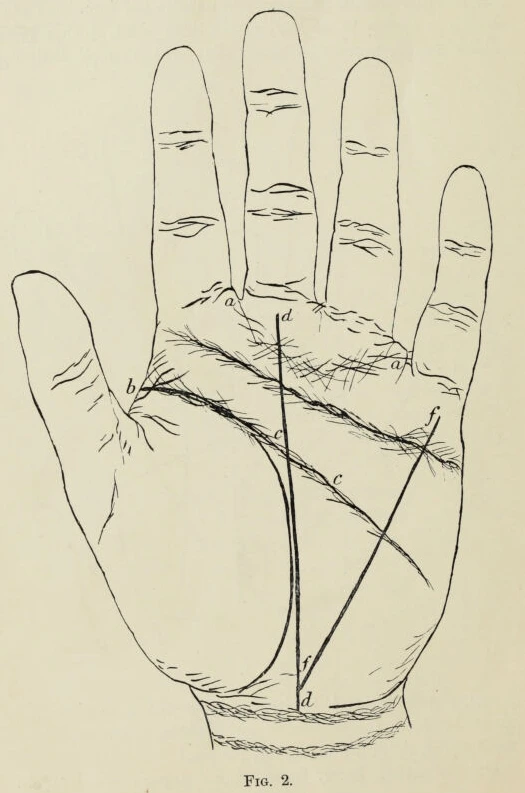
Life line
Start at b beside the thumb. Follow the curve as it rounds the thumb pad and approaches the wrist.
Head line
Follow c diagonally across the centre of the palm, from the thumb side towards the outer edge.
Heart line
Find the long line crossing above the head line, below the broken arc near the fingers.
Fate line
Follow d almost straight up from the wrist towards the middle finger.
What is palmistry?
Palmistry, or chiromancy, interprets features of the hand as signs of character, experience or fortune. The chart below marks four common names in Western manuals. The life line curves around the thumb pad, the head and heart lines run across the palm, and the fate line runs upwards towards the middle finger in these diagrams. The names belong to the books’ systems of divination. [4][8]
A chart is easiest to read in two passes. First find the line by its location and direction. Then open the author’s chapter to see what they associated with it. The two books agree on the location of some marks while assigning different significance to their branches, length or intersections. These historical interpretations do not establish a person’s health, lifespan or future. [4][6][9][11][12]
Life line
Start between the thumb and index finger. In Robinson’s Figure 2, the mark labelled b bends in an arc around the pad at the base of the thumb. Cheiro uses the same landmark and calls that pad the Mount of Venus. Follow the curve around the thumb to distinguish it from the line running across the centre of the palm. [8][9][4]
Robinson says palmists differed about how to assign ages to points on the curve. She considered the width and length of the palm and the shape of the thumb pad in her own readings. Cheiro also assigns meanings to variations along the line, such as a frayed end. The passages show how much interpretation lay between recognising a curve and making a claim about a life. [9][6]
Head line
Find the line crossing the middle of the palm. In Robinson’s figure it is marked c, running diagonally towards the little-finger side. Near the thumb, the head line and life line can meet in a diagram. Follow their routes away from that junction. The life line bends back around the thumb pad, while the head line continues across the palm. [8][11][5]
Both authors discuss the head line in relation to thought. Robinson opens her chapter by comparing a separated beginning with one joined to the life line, then asks the reader to consider other features of the hand. Cheiro’s discussion of branches gives different readings to similar small marks depending on which major line they touch. The name gives a reader a way to find the line before the prose adds an interpretation. [11][6]
Heart line
Of the two main lines across the palm, the heart line is the one nearer the fingers in Cheiro’s map. Robinson describes several starting points below or between the fingers while discussing the line’s different courses. On her diagram, the broken arc still nearer the fingers is a separate feature. Compare the full page before treating that arc as part of the heart line. [5][4][8][10]
Cheiro links rising branches at the commencement of the heart line to warmth of affection. The same page attaches a different significance to branches on the head and fate lines. Read the prose next to the chart, since it often refers to a smaller mark whose position matters more to the author than the length of the line as a whole. [6]
Fate line
The fate line is the upright line labelled d on Robinson’s diagram, rising towards the middle finger. Her chapter introduces it as a line that may run up the palm from near the wrist. Cheiro also draws it towards the middle finger, which he associates with Saturn. His text allows several starting points, including the wrist and the life, head or heart lines. [8][12][5][7]
The books read the same straight line differently. Cheiro interprets a line running straight from the wrist to Saturn as a sign of great success. Robinson discusses that same shape in Figure 2 and explicitly rejects the equation with an ideally successful life. She associates it instead with continuity and few changes. Here the authors agree on the shape and disagree on its meaning. [7][12]
Why the lists disagree
Cheiro counts seven important lines and includes the Girdle of Venus. Robinson counts six principal lines. Her list includes a line of fortune, and she gives the line of fame its own treatment alongside it. She mentions the girdle as a feature others place in the principal list and explains why she leaves it out. Compare the two opening lists before equating their labels. [4][9]
Cheiro makes another distinction by giving small marks their own plate. An island is drawn as an enclosed shape along a line, while a cross consists of intersecting strokes. The plate teaches a visual vocabulary that his prose then uses in context. Keep the plate date and page reference when comparing his terminology with words drawn from a different manual. [14][6][16]
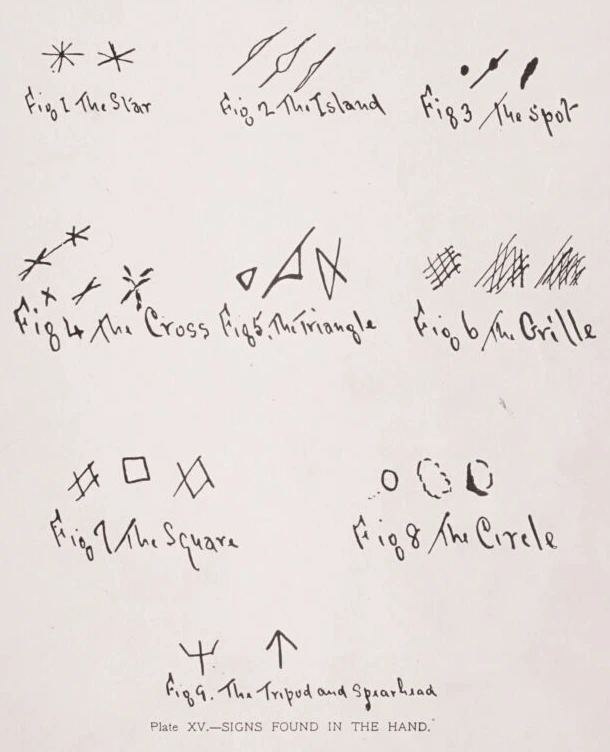
Cheiro’s Plate XV groups small marks separately from the major lines. The star and island occupy the first two places.
Cheiro, Cheiro’s Language of the Hand, Library of Congress copy, 1898, Plate XV. Library of Congress via Internet Archive. Public domain in the US. Cropped. · Image source ↗ · Public Domain
Witchcraft Magic & Alchemy by Grillot de Givry
Grillot de Givry reproduces a hand from Jean d’Indagine’s Chiromance, then compares it with Robert Fludd’s version. Fludd adds a line associated with Saturn and gives new names to the positions d’Indagine calls the middle and liver lines. The position of the life line stays the same. [3]
Authors also disagreed about which hand to read. In one account the left hand preserves marks more clearly. In another it shows the fate a person was born with, while the right shows what they have made of it. De Givry asks how a future can count as destiny if it can be altered. [2][3]
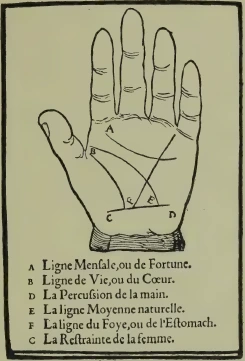
The hand in Jean d’Indagine’s Chiromance, reproduced as figure 240. Its key gives the names used in that source.
Jean d’Indagine, Chiromance, Lyon, 1549. Reproduced by De Givry. · Image source ↗ · Public Domain
How the hand maps differ
An English manuscript from 1648 puts palmistry alongside physiognomy and forehead reading. Even within the same art, readers had to know which scheme a writer used. Fludd’s brain line, for example, sits where d’Indagine places the liver line. [2][3][1]
Read further in the library
Witchcraft Magic and Alchemy
Reading note
The separately titled account draws on exact passages in the consulted Library edition.
Cheiro’s Language of the Hand
Reading note
See Plate XIII and the passages naming and interpreting the principal lines.
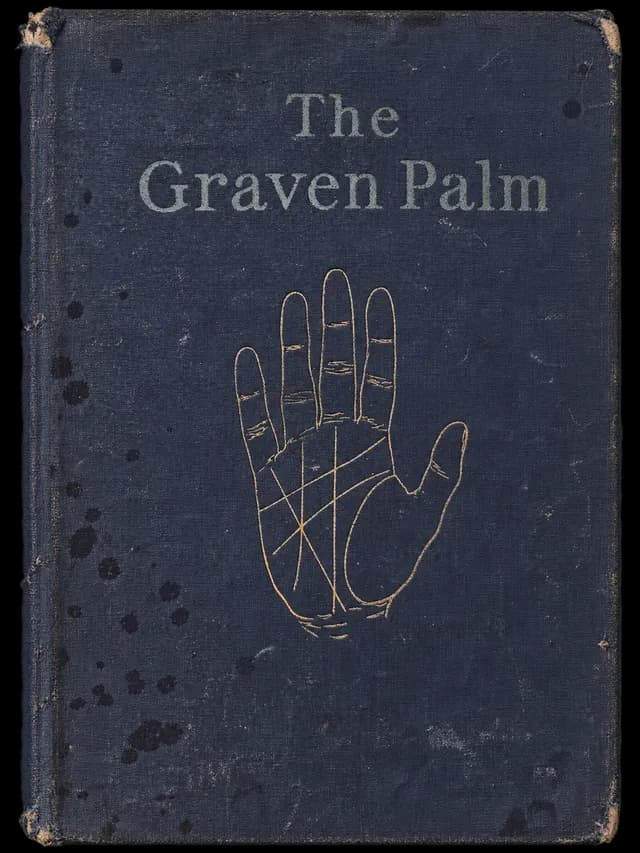
The Graven Palm: A Manual of the Science of Palmistry
Reading note
Compare Figure 2 with the chapters naming the life, heart, head and fate lines.
Sources
See references (16)
- Chyromancy or Palmestrye. Also Physiognomy and Metoposcopie ↗Seventeenth-century manuscript, dated 1648 in the Wellcome Collection catalogue.Return to text ↑
- Witchcraft Magic & Alchemy, printed p. 262, Reader page 255Grillot de Givry, Witchcraft Magic & Alchemy, translated by J. Courtenay Locke. Boston and New York, Houghton Mifflin Company, 1931.Read this page in Witchcraft Magic and Alchemy ↗Return to text ↑
- Witchcraft Magic & Alchemy, printed p. 263, Reader page 256Grillot de Givry, Witchcraft Magic & Alchemy, translated by J. Courtenay Locke. Boston and New York, Houghton Mifflin Company, 1931.Read this page in Witchcraft Magic and Alchemy ↗Return to text ↑
- The Lines of the Hand · printed p. 72Cheiro, Cheiro’s Language of the Hand. Undated fifteenth edition in the Lumitheca Library.Read this page in Cheiro’s Language of the Hand ↗Return to text ↑
- Plate XIII · The Map of the HandCheiro, Cheiro’s Language of the Hand. Undated fifteenth edition in the Lumitheca Library.Read this page in Cheiro’s Language of the Hand ↗Return to text ↑
- Branches and line formations · printed p. 76Cheiro, Cheiro’s Language of the Hand. Undated fifteenth edition in the Lumitheca Library.Read this page in Cheiro’s Language of the Hand ↗Return to text ↑
- The Line of Fate · printed p. 103Cheiro, Cheiro’s Language of the Hand. Undated fifteenth edition in the Lumitheca Library.Read this page in Cheiro’s Language of the Hand ↗Return to text ↑
- Figure 2 · printed p. 36Mrs A. Robinson, The Graven Palm. Edward Arnold, 1911. Lumitheca Library facsimile.Read this page in The Graven Palm: A Manual of the Science of Palmistry ↗Return to text ↑
- Six principal lines and the life line · printed p. 73Mrs A. Robinson, The Graven Palm. Edward Arnold, 1911. Lumitheca Library facsimile.Read this page in The Graven Palm: A Manual of the Science of Palmistry ↗Return to text ↑
- The Line of Heart · printed p. 95Mrs A. Robinson, The Graven Palm. Edward Arnold, 1911. Lumitheca Library facsimile.Read this page in The Graven Palm: A Manual of the Science of Palmistry ↗Return to text ↑
- The Line of Head · printed p. 103Mrs A. Robinson, The Graven Palm. Edward Arnold, 1911. Lumitheca Library facsimile.Read this page in The Graven Palm: A Manual of the Science of Palmistry ↗Return to text ↑
- The Line of Fate · printed p. 116Mrs A. Robinson, The Graven Palm. Edward Arnold, 1911. Lumitheca Library facsimile.Read this page in The Graven Palm: A Manual of the Science of Palmistry ↗Return to text ↑
- The Graven Palm · Figure 2 ↗Mrs A. Robinson, The Graven Palm, 1911, p. 36, figure 2. Harold B. Lee Library via Internet Archive. Public domain in the US. Cropped.
- Cheiro · Signs Found in the Hand, Plate XV ↗Cheiro, Cheiro’s Language of the Hand, Library of Congress copy, 1898, Plate XV. Library of Congress via Internet Archive. Public domain in the US. Cropped.Return to text ↑
- Jean d’Indagine palm print and notes ↗Museum of Witchcraft and Magic, object R/7/1048.
- Cheiro’s Language of the Hand, 1898 ↗Library of Congress.Return to text ↑