Materialism in the afterlife
In Gone West, factories, shops and games repeat in the afterlife without satisfying anyone. Ward uses these scenes to ask what makes an occupation worth continuing.
In this article
Understanding materialism in the afterlife
Materialism in the afterlife is J. S. M. Ward’s picture of earthly attachments carried beyond death. His characters still make things, sell goods and pursue status. They find it harder to imagine what they could do with the rest of their lives. [1][2]
The workplaces and shops look familiar. What changes is what their actions can accomplish. A sale sends the same goods back to the shelf, and a match ends without a goal. [1][2]
Gone West by J. S. M. Ward
In J. S. M. Ward’s Gone West, the Officer visits a city in the division called the blatant materialists. Factories produce goods that return after sale, filling warehouses that cannot be permanently emptied. A worker says he thought only of work during earthly life and now feels compelled to repeat it endlessly. [1]
A shopkeeper gives the attachment a personal form. The goods are those present in his shop when he died, and each sale is undone as the goods return. Asked why he does not stop, he cannot imagine what he would do without the shop: selling has organised his whole life. Possession and occupation have become an identity he cannot easily relinquish. [2]
Churches in the same division compete for standing and press for subscriptions. A council debates and gets nowhere. A football match yields neither a goal nor pleasure. The scenes extend Ward’s criticism from owning things to repeating activities whose point the participants have lost. [1][2]
One player walks away because the game gives him no pleasure. The Officer sees a bright stranger approach him and takes it as a sign that he may leave the division. The change starts when he can see a reason to stop doing what everyone else is doing. [2]
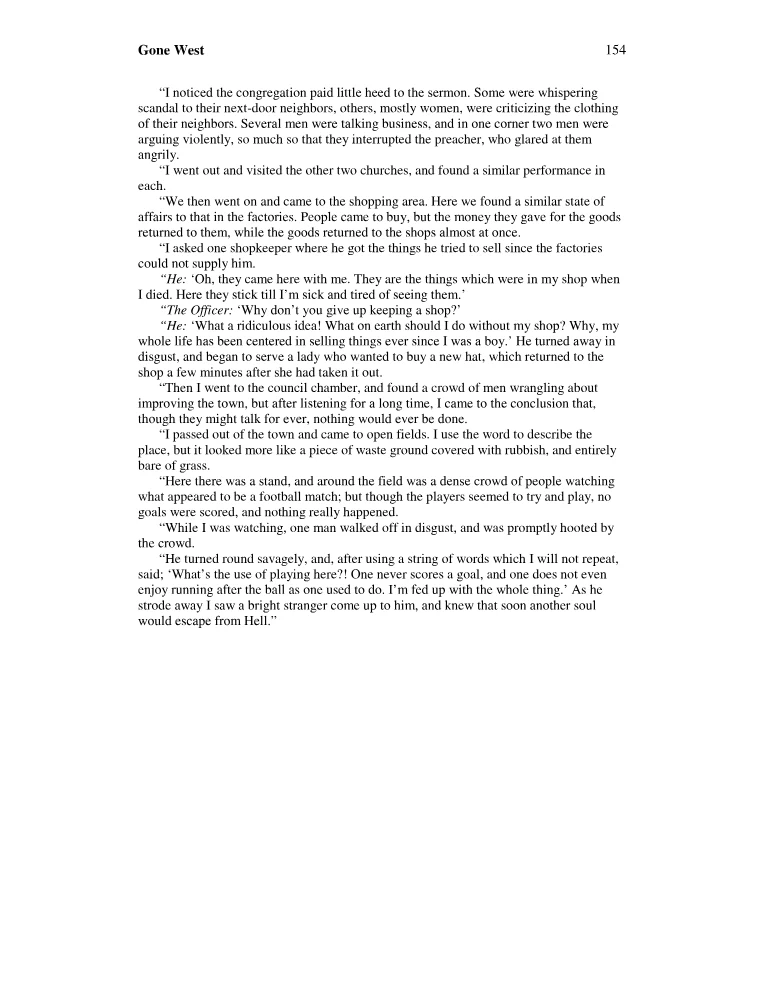
Gone West, printed p. 154, Library Reader page 167. Goods return after each sale in the Officer’s account. Geoff Cutler’s digital transcription.
J. S. M. Ward, Gone West, historical text in the public domain. Geoff Cutler’s 2009 transcription expressly permits reuse for any purpose on source leaf2. This image shows the digital transcription, not an original printed facsimile. · Image source ↗ · Public Domain
What makes work worth continuing?
Art and craft continue in Ward’s galleries too. The difference is what the makers hope to give other people. The galleries show why Ward can value an object or occupation while making the shopkeeper’s attachment a source of distress. [3][4][1][2]
The shopkeeper lives in a community described as part of Hell. His case therefore raises a different question from stories of earthbound spirits: what makes him feel that selling is the only way his life can go on? [1][2][5]
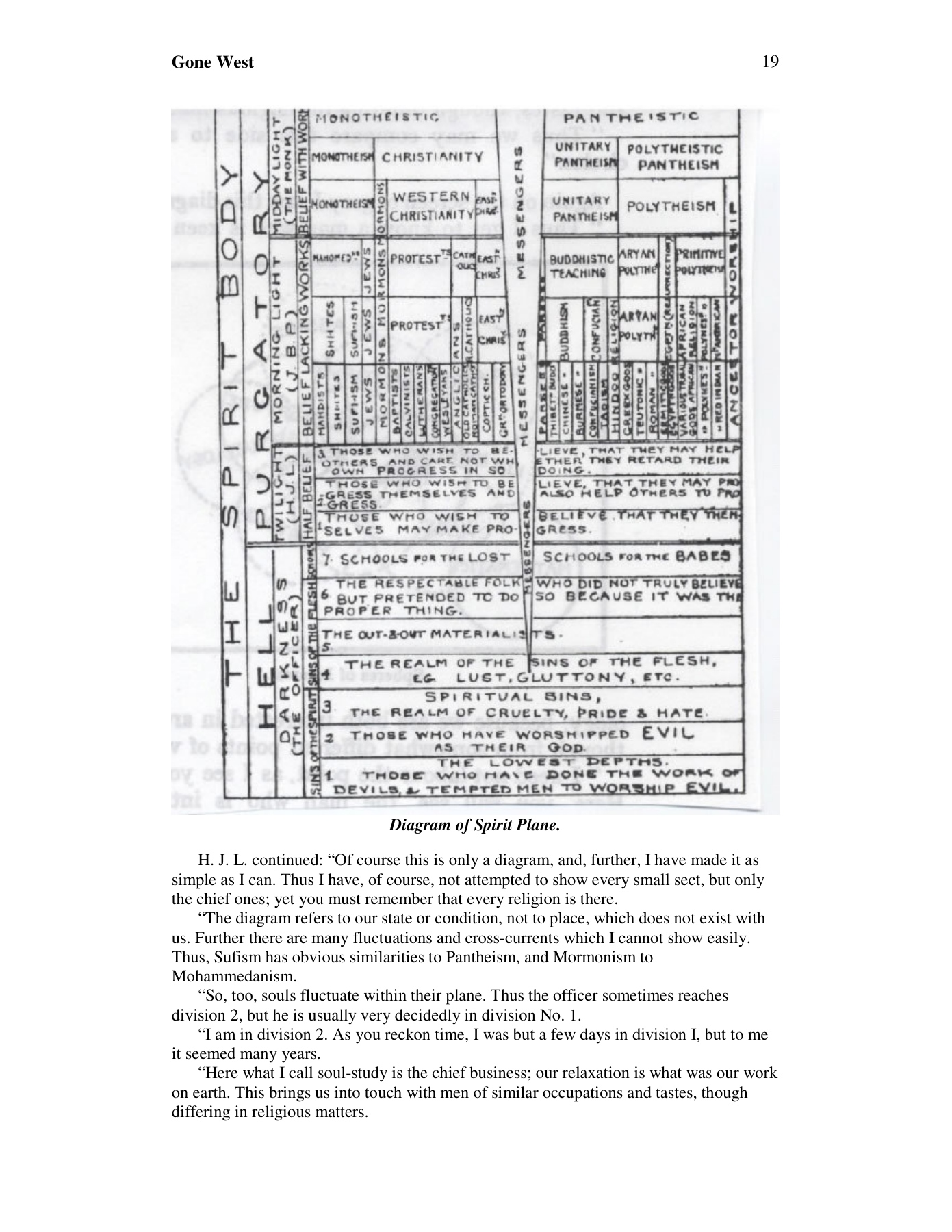
Diagram of the Spirit Plane in Gone West, printed p. 19, Library Reader page 32. The fifth division of Hell is the one Ward assigns to people absorbed in material life.
J. S. M. Ward, Gone West. Historical diagram in the public domain. Digital transcription by Geoff Cutler, whose notice on source leaf 2 permits reuse for any purpose. · Image source ↗ · Public Domain
Read further in the library

Gone West
Reading note
The separately titled account draws on exact passages in the consulted Library edition.
Sources
See references (7)
- Gone West, printed p. 153, Reader page 166J. S. M. Ward, Gone West: Three Narratives of After-Death Experiences, third impression, William Rider & Son, London, 1920, as reproduced in Geoff Cutler’s December 2009 digital transcription. Ward’s introduction is distinct from the supplied 1974 foreword.Read this page in Gone West ↗Return to text ↑
- Gone West, printed p. 154, Reader page 167J. S. M. Ward, Gone West: Three Narratives of After-Death Experiences, third impression, William Rider & Son, London, 1920, as reproduced in Geoff Cutler’s December 2009 digital transcription. Ward’s introduction is distinct from the supplied 1974 foreword.Read this page in Gone West ↗Return to text ↑
- Gone West, printed p. 56, Reader page 69J. S. M. Ward, Gone West: Three Narratives of After-Death Experiences, third impression, William Rider & Son, London, 1920, as reproduced in Geoff Cutler’s December 2009 digital transcription. Ward’s introduction is distinct from the supplied 1974 foreword.Read this page in Gone West ↗Return to text ↑
- Gone West, printed p. 57, Reader page 70J. S. M. Ward, Gone West: Three Narratives of After-Death Experiences, third impression, William Rider & Son, London, 1920, as reproduced in Geoff Cutler’s December 2009 digital transcription. Ward’s introduction is distinct from the supplied 1974 foreword.Read this page in Gone West ↗Return to text ↑
- Gone West, printed p. 19, Reader page 32J. S. M. Ward, Gone West, 1920 third impression as reproduced in the 2009 Geoff Cutler digital transcription.Read this page in Gone West ↗Return to text ↑
- Gone West, printed p. v, Reader page 9J. S. M. Ward, Gone West: Three Narratives of After-Death Experiences, third impression, William Rider & Son, London, 1920, as reproduced in Geoff Cutler’s December 2009 digital transcription. Ward’s introduction is distinct from the supplied 1974 foreword.Read this page in Gone West ↗
- Gone West, printed p. vi, Reader page 10J. S. M. Ward, Gone West: Three Narratives of After-Death Experiences, third impression, William Rider & Son, London, 1920, as reproduced in Geoff Cutler’s December 2009 digital transcription. Ward’s introduction is distinct from the supplied 1974 foreword.Read this page in Gone West ↗