Earthbound Spirits
Earthbound spirits are the dead said to remain close to earthly life. Compare accounts of familiar places, unrecognised death and unfinished concerns.
In this article
What is an earthbound spirit?
Earthbound spirits are departed people said to remain close to earthly life. They may return to a familiar house, try to finish a task or be unable to understand why ordinary things no longer respond to them. [1][2][3]
Different stories give a person different reasons to remain. Ward’s Officer first has to recognise that he has died. Other figures know they are dead and remain attached to a place or a concern. [4][3][5][6]
Remaining near earthly life
The Other World, edited by Frederick George Lee
Frederick George Lee’s The Other World gathers several explanations for spirits remaining near earthly places. In a passage he quotes from the Marquis de Marsay, location can be connected with wrongdoing, resistance to purification or an assigned period of punishment. The account distinguishes these conditions instead of making every returning soul equally malicious or equally unaware of death. [42][43]
Marsay’s first group haunts places associated with its evil deeds. Another seeks release while resisting the divine order to which it should submit. A third must remain in a particular place because pleasures pursued there are made into an occasion of correction. The imagined relation between a person and a location is therefore moral as well as geographical. [42][43]
The Barby narrative supplies a concrete story of unfinished obligations. After a woman’s death, noises and appearances are said to trouble the house. Money and documents are discovered, but the disturbance reportedly continues. The story says it ends only when outstanding debts are paid. Finding a hidden possession and putting an obligation right are different moments in the account. [44][45][46][47]
Lee treats such stories as evidence of an unseen order, while the proposed explanations come through particular witnesses and writers. The account of Barby does not supply a rule for every haunting, and Marsay’s divisions are not a universal classification of the dead. They show different ways of connecting a remembered life, a troubled condition and a place. [42][43][44][46][47]
Gone West by J. S. M. Ward
In J. S. M. Ward’s Gone West, the Officer initially carries on as though his life has not ended. He goes to an office to sign an agreement and becomes angry when the people there ignore him. Only after finding that his hand passes through a door and meeting a former acquaintance does he begin to recognise his situation. [7][2]
W. A. remains concerned with his family, former friends and financial affairs. He watches people taking advantage of a poorly prepared will and discovers that some relationships meant less to others than he had imagined. His continuing presence brings new knowledge of those relationships, alongside the frustration of being unable to intervene as he once could. [4][8][9][10]
W. A. also describes fleeing back to familiar earthly surroundings when the astral forests frighten him. He offers this as one explanation for why a ghost might revisit an old place. A return can express distress or uncertainty, rather than a clear intention to deliver a message. [11][3]
The same contributor explains why contact may fail. Someone absorbed in difficult experiences has little attention for others; later, new interests may take their place. He also describes messages reaching a medium in a distorted form. Within this account, the absence of a communication cannot settle what the relationship means to the departed person. [3]
His guide eventually directs his attention towards helping others. The tasks move from someone he loves to a stranger and then a former enemy. Completing them precedes his departure from the astral body. The story makes a widening concern for other people part of the movement beyond being earthbound. [5][6][12]
See references (11)
- Gone West, printed p. 87, Reader page 100
- Gone West, printed p. 169, Reader page 182
- Gone West, printed p. 164, Reader page 177
- Gone West, printed p. 171, Reader page 184
- Gone West, printed p. 172, Reader page 185
- Gone West, printed p. 86, Reader page 99
- Gone West, printed p. 165, Reader page 178
- Gone West, printed p. 166, Reader page 179
- Gone West, printed p. 167, Reader page 180
- Gone West, printed p. 168, Reader page 181
- Gone West, printed p. 176, Reader page 189
Picturing a ghost
A stereoscopic photograph stages an apparition beside an ordinary figure. Its photographic effect gives the idea of a return from death a visual form. The stories in this entry go further by asking why a figure would return. [13]
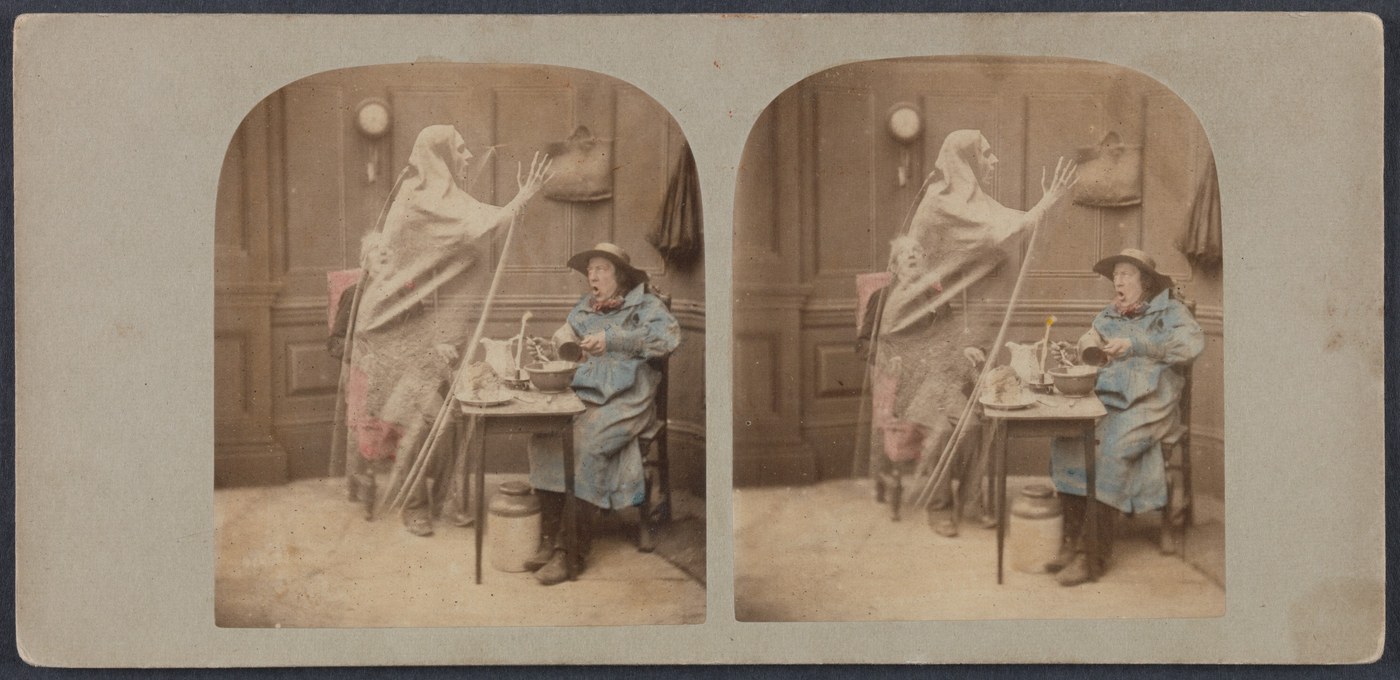
The Ghost in the Stereoscope, London Stereoscopic Company, ca. 1856. Albumen silver prints with applied colour. A staged ghostlike appearance illustrates nineteenth-century interest in making spirits visible through photographic effects.
The Metropolitan Museum of Art. Gift of Weston J. Naef, in memory of Kathleen W. Naef and Weston J. Naef Sr., 1982. Accession 1982.1182.1284. Public Domain (CC0). · Image source ↗ · CC0
A Subaltern in Spirit Land by J. S. M. Ward
J. S. M. Ward’s A Subaltern in Spirit Land describes people remaining in familiar conditions long after their earthly era. H. J. L., one of Ward’s reported spirit contributors, says some neither attempt to progress nor take the course that would carry them towards hell. Others continue to visit former homes. He offers these as possibilities within a larger and varied population of the astral plane. [14][15]
The guide cautions that a recurring ghost need not be the person whose shape it bears. An empty astral shell can persist after the spirit has moved on. He connects some repeated appearances with the habits of a former life. The book distinguishes the continuing attachment of a person from the persistence of a residual form. [15][16]
Earthly interests also remain important to people who recognise their new state. An adjutant asks Ward eagerly for news of the war and his regiment. Ward agrees to bring news while warning him against making it his sole concern. Attachment is represented as a matter of attention and purpose as well as location. [17][18]
Rex, Ward’s deceased brother, is instead encouraged to take up work helping people in both worlds. Within the guide’s explanation, doing good can prepare the spiritual form to leave the astral body. The relationship with earth can become a field of service while the person learns to move beyond former habits. [19][16]
In Part II, Rex says attachment to earth can arise from an unfinished task, an undelivered message, love or simple lack of knowledge. His own account begins with continuing the battle in which he died, then moves through confusion towards accepting help. The book gives earthly attachment several motives; the term does not by itself tell the reader whether a particular figure is malicious, bewildered or trying to reach someone. [20][21][22]
See references (9)
- A Subaltern in Spirit Land, printed p. 11, Reader page 26
- A Subaltern in Spirit Land, printed p. 12, Reader page 27
- A Subaltern in Spirit Land, printed p. 44, Reader page 59
- A Subaltern in Spirit Land, printed p. 53, Reader page 68
- A Subaltern in Spirit Land, printed p. 54, Reader page 69
- A Subaltern in Spirit Land, printed p. 42, Reader page 57
- A Subaltern in Spirit Land, printed p. 168, Reader page 183
- A Subaltern in Spirit Land, printed p. 182, Reader page 197
- A Subaltern in Spirit Land, printed p. 183, Reader page 198
The Encyclopaedia of Death and Life in Spirit-World, Volume I
J. R. Francis’s The Encyclopaedia of Death and Life in Spirit-World, Volume I, includes a report by the medium D. C. Densmore from Voice of Angels. A man brought to him cannot accept that he has died: his continuing strength, bodily appearance and ability to speak seem to contradict the news. Densmore’s deceased daughter is said to arrange the meeting without the visitor perceiving her. [23][24]
The visitor gradually hears a voice discussing private events from his marriage. Recognition begins before sight: he first hears his wife, then becomes able to see the spirits around him and finally recognises his wife and children. The story presents a change in awareness as the opening out of a restricted condition. Its explanation is mediumistic and belongs to Densmore’s published account. [25][26][27]
Elsewhere, the dialogue attributed to a spirit called Lucretus describes continuing earthly attachments through a person’s dominant concerns. A parent turns towards children, a miser towards money, and a resentful person towards revenge. These examples distinguish affection, preoccupation and hostility rather than treating every return to earth as the same kind of bondage. The anthology offers several reasons for lingering near familiar life, without independently verifying the experiences it reports. [28][29]
See references (7)
- The Encyclopaedia of Death and Life in Spirit-World, Volume I, printed p. 165, Reader page 164
- The Encyclopaedia of Death and Life in Spirit-World, Volume I, printed p. 166, Reader page 165
- The Encyclopaedia of Death and Life in Spirit-World, Volume I, printed p. 167, Reader page 166
- The Encyclopaedia of Death and Life in Spirit-World, Volume I, printed p. 168, Reader page 167
- The Encyclopaedia of Death and Life in Spirit-World, Volume I, printed p. 169, Reader page 168
- The Encyclopaedia of Death and Life in Spirit-World, Volume I, printed p. 97, Reader page 96
- The Encyclopaedia of Death and Life in Spirit-World, Volume I, printed p. 98, Reader page 97
A Wanderer in the Spirit Lands
Franchezzo’s A Wanderer in the Spirit Lands, transcribed by A. Farnese, gives earthly attachment several forms. At the beginning, a dark elastic thread binds the narrator to his dead body. Later, astral clothing can retain a person close to earthly conditions. Hassein, the narrator’s guide, also describes spirits becoming temporarily trapped by putting on an astral envelope in order to make themselves perceptible. [30][31][33][34][35]
Attachment is not always explained by vice. Some departed people wait near loved ones whom they cannot reach. Franchezzo himself fears becoming earthbound again when his desire to watch his living beloved turns possessive. The book distinguishes caring about someone from trying to remain constantly involved in that person’s earthly life. [32][36][37]
The conclusion supplies a precise example of unfinished restitution. A spirit who forged property deeds reveals the true documents through a medium. Confession frees him from attachment to that particular house, but he must still help those injured by his act before leaving the earth plane. Release from a place and release from a broader condition are separate stages. [40][41]
A later vision portrays bereavement as binding some spirits near the living. This is part of the book’s case for spirit communication. It should not be turned into a claim that ordinary grief harms the dead or makes mourners responsible for another person’s suffering. [38][39]
See references (12)
- A Wanderer in the Spirit Lands, Reader page 18
- A Wanderer in the Spirit Lands, Reader page 19
- A Wanderer in the Spirit Lands, Reader page 81
- A Wanderer in the Spirit Lands, Reader page 125
- A Wanderer in the Spirit Lands, Reader page 127
- A Wanderer in the Spirit Lands, Reader page 128
- A Wanderer in the Spirit Lands, Reader page 240
- A Wanderer in the Spirit Lands, Reader page 241
- A Wanderer in the Spirit Lands, Reader page 299
- A Wanderer in the Spirit Lands, Reader page 300
- A Wanderer in the Spirit Lands, Reader page 308
- A Wanderer in the Spirit Lands, Reader page 309
Several reasons for remaining near earth
Ward’s Officer and Densmore’s visitor fail to recognise their deaths. Other figures remain near earth through affection, revenge or attachment to an unfinished concern. Proximity can look alike while arising from very different motives. [7][2][23][24][20][21][22][28][29]
Ward gives helping other people a role in moving on. Franchezzo also explains some cases through an astral covering that can keep someone near earth. One account follows a change in conduct and the other describes a temporary form. [5][6][12][30][31][33][34][35][38][39]
Marsay’s figures, as quoted by Lee, remain tied to places through punishment or resistance to spiritual purification. In Ward and Densmore, someone first has to understand that death has occurred. Their starting points make different kinds of change possible. [7][2][23][24][25][26][27][42][43][46][47]
See references (26)
- Gone West, printed p. 87, Reader page 100
- Gone West, printed p. 171, Reader page 184
- Gone West, printed p. 172, Reader page 185
- Gone West, printed p. 86, Reader page 99
- Gone West, printed p. 176, Reader page 189
- A Subaltern in Spirit Land, printed p. 168, Reader page 183
- A Subaltern in Spirit Land, printed p. 182, Reader page 197
- A Subaltern in Spirit Land, printed p. 183, Reader page 198
- The Encyclopaedia of Death and Life in Spirit-World, Volume I, printed p. 165, Reader page 164
- The Encyclopaedia of Death and Life in Spirit-World, Volume I, printed p. 166, Reader page 165
- The Encyclopaedia of Death and Life in Spirit-World, Volume I, printed p. 167, Reader page 166
- The Encyclopaedia of Death and Life in Spirit-World, Volume I, printed p. 168, Reader page 167
- The Encyclopaedia of Death and Life in Spirit-World, Volume I, printed p. 169, Reader page 168
- The Encyclopaedia of Death and Life in Spirit-World, Volume I, printed p. 97, Reader page 96
- The Encyclopaedia of Death and Life in Spirit-World, Volume I, printed p. 98, Reader page 97
- A Wanderer in the Spirit Lands, Reader page 18
- A Wanderer in the Spirit Lands, Reader page 19
- A Wanderer in the Spirit Lands, Reader page 125
- A Wanderer in the Spirit Lands, Reader page 127
- A Wanderer in the Spirit Lands, Reader page 128
- A Wanderer in the Spirit Lands, Reader page 299
- A Wanderer in the Spirit Lands, Reader page 300
- The Other World, Reader page 388
- The Other World, Reader page 389
- The Other World, Reader page 412
- The Other World, Reader page 413
Read further in the library

Gone West
Reading note
Ward’s account supplies the exact examples discussed below.
A Subaltern in Spirit Land: A Sequel to Gone West
Reading note
Ward’s sequel adds the separately cited account of this subject.
The Encyclopaedia of Death and Life in the Spirit-World, Volume I
Reading note
Distinct attributed accounts in the 1903 fourth edition, cited to exact printed pages and retained Reader leaves.

A Wanderer in the Spirit Lands
Reading note
Attachment to places, unfinished restitution, affection and possessive watching lead to different forms of earthly attachment.
The Other World
Reading note
The separately titled account draws on exact passages in the consulted Library edition.
Sources
See references (47)
- Gone West, printed p. 42, Reader page 55J. S. M. Ward, Gone West, 1920 third impression in the 2009 Geoff Cutler digital transcription.Read this page in Gone West ↗Return to text ↑
- Gone West, printed p. 87, Reader page 100J. S. M. Ward, Gone West, 1920 third impression in the 2009 Geoff Cutler digital transcription.Read this page in Gone West ↗Return to text ↑
- Gone West, printed p. 169, Reader page 182J. S. M. Ward, Gone West, 1920 third impression in the 2009 Geoff Cutler digital transcription.Read this page in Gone West ↗Return to text ↑
- Gone West, printed p. 164, Reader page 177J. S. M. Ward, Gone West, 1920 third impression in the 2009 Geoff Cutler digital transcription.Read this page in Gone West ↗Return to text ↑
- Gone West, printed p. 171, Reader page 184J. S. M. Ward, Gone West, 1920 third impression in the 2009 Geoff Cutler digital transcription.Read this page in Gone West ↗Return to text ↑
- Gone West, printed p. 172, Reader page 185J. S. M. Ward, Gone West, 1920 third impression in the 2009 Geoff Cutler digital transcription.Read this page in Gone West ↗Return to text ↑
- Gone West, printed p. 86, Reader page 99J. S. M. Ward, Gone West, 1920 third impression in the 2009 Geoff Cutler digital transcription.Read this page in Gone West ↗Return to text ↑
- Gone West, printed p. 165, Reader page 178J. S. M. Ward, Gone West, 1920 third impression in the 2009 Geoff Cutler digital transcription.Read this page in Gone West ↗Return to text ↑
- Gone West, printed p. 166, Reader page 179J. S. M. Ward, Gone West, 1920 third impression in the 2009 Geoff Cutler digital transcription.Read this page in Gone West ↗Return to text ↑
- Gone West, printed p. 167, Reader page 180J. S. M. Ward, Gone West, 1920 third impression in the 2009 Geoff Cutler digital transcription.Read this page in Gone West ↗Return to text ↑
- Gone West, printed p. 168, Reader page 181J. S. M. Ward, Gone West, 1920 third impression in the 2009 Geoff Cutler digital transcription.Read this page in Gone West ↗Return to text ↑
- Gone West, printed p. 176, Reader page 189J. S. M. Ward, Gone West, 1920 third impression in the 2009 Geoff Cutler digital transcription.Read this page in Gone West ↗Return to text ↑
- The Ghost in the Stereoscope, ca. 1856 ↗The Metropolitan Museum of Art. Gift of Weston J. Naef, in memory of Kathleen W. Naef and Weston J. Naef Sr., 1982. Accession 1982.1182.1284. Public Domain (CC0).Return to text ↑
- A Subaltern in Spirit Land, printed p. 11, Reader page 26J. S. M. Ward, A Subaltern in Spirit Land: A Sequel to Gone West, William Rider & Son, 1920.Read this page in A Subaltern in Spirit Land: A Sequel to Gone West ↗Return to text ↑
- A Subaltern in Spirit Land, printed p. 12, Reader page 27J. S. M. Ward, A Subaltern in Spirit Land: A Sequel to Gone West, William Rider & Son, 1920.Read this page in A Subaltern in Spirit Land: A Sequel to Gone West ↗Return to text ↑
- A Subaltern in Spirit Land, printed p. 44, Reader page 59J. S. M. Ward, A Subaltern in Spirit Land: A Sequel to Gone West, William Rider & Son, 1920.Read this page in A Subaltern in Spirit Land: A Sequel to Gone West ↗Return to text ↑
- A Subaltern in Spirit Land, printed p. 53, Reader page 68J. S. M. Ward, A Subaltern in Spirit Land: A Sequel to Gone West, William Rider & Son, 1920.Read this page in A Subaltern in Spirit Land: A Sequel to Gone West ↗Return to text ↑
- A Subaltern in Spirit Land, printed p. 54, Reader page 69J. S. M. Ward, A Subaltern in Spirit Land: A Sequel to Gone West, William Rider & Son, 1920.Read this page in A Subaltern in Spirit Land: A Sequel to Gone West ↗Return to text ↑
- A Subaltern in Spirit Land, printed p. 42, Reader page 57J. S. M. Ward, A Subaltern in Spirit Land: A Sequel to Gone West, William Rider & Son, 1920.Read this page in A Subaltern in Spirit Land: A Sequel to Gone West ↗Return to text ↑
- A Subaltern in Spirit Land, printed p. 168, Reader page 183J. S. M. Ward, A Subaltern in Spirit Land: A Sequel to Gone West, William Rider & Son, 1920.Read this page in A Subaltern in Spirit Land: A Sequel to Gone West ↗Return to text ↑
- A Subaltern in Spirit Land, printed p. 182, Reader page 197J. S. M. Ward, A Subaltern in Spirit Land: A Sequel to Gone West, William Rider & Son, 1920.Read this page in A Subaltern in Spirit Land: A Sequel to Gone West ↗Return to text ↑
- A Subaltern in Spirit Land, printed p. 183, Reader page 198J. S. M. Ward, A Subaltern in Spirit Land: A Sequel to Gone West, William Rider & Son, 1920.Read this page in A Subaltern in Spirit Land: A Sequel to Gone West ↗Return to text ↑
- The Encyclopaedia of Death and Life in Spirit-World, Volume I, printed p. 165, Reader page 164J. R. Francis (compiler), The Encyclopaedia of Death and Life in Spirit-World, Volume I, fourth edition, Progressive Thinker Publishing House, Chicago, 1903. Individual contributors identified in the text.Read this page in The Encyclopaedia of Death and Life in the Spirit-World, Volume I ↗Return to text ↑
- The Encyclopaedia of Death and Life in Spirit-World, Volume I, printed p. 166, Reader page 165J. R. Francis (compiler), The Encyclopaedia of Death and Life in Spirit-World, Volume I, fourth edition, Progressive Thinker Publishing House, Chicago, 1903. Individual contributors identified in the text.Read this page in The Encyclopaedia of Death and Life in the Spirit-World, Volume I ↗Return to text ↑
- The Encyclopaedia of Death and Life in Spirit-World, Volume I, printed p. 167, Reader page 166J. R. Francis (compiler), The Encyclopaedia of Death and Life in Spirit-World, Volume I, fourth edition, Progressive Thinker Publishing House, Chicago, 1903. Individual contributors identified in the text.Read this page in The Encyclopaedia of Death and Life in the Spirit-World, Volume I ↗Return to text ↑
- The Encyclopaedia of Death and Life in Spirit-World, Volume I, printed p. 168, Reader page 167J. R. Francis (compiler), The Encyclopaedia of Death and Life in Spirit-World, Volume I, fourth edition, Progressive Thinker Publishing House, Chicago, 1903. Individual contributors identified in the text.Read this page in The Encyclopaedia of Death and Life in the Spirit-World, Volume I ↗Return to text ↑
- The Encyclopaedia of Death and Life in Spirit-World, Volume I, printed p. 169, Reader page 168J. R. Francis (compiler), The Encyclopaedia of Death and Life in Spirit-World, Volume I, fourth edition, Progressive Thinker Publishing House, Chicago, 1903. Individual contributors identified in the text.Read this page in The Encyclopaedia of Death and Life in the Spirit-World, Volume I ↗Return to text ↑
- The Encyclopaedia of Death and Life in Spirit-World, Volume I, printed p. 97, Reader page 96J. R. Francis (compiler), The Encyclopaedia of Death and Life in Spirit-World, Volume I, fourth edition, Progressive Thinker Publishing House, Chicago, 1903. Individual contributors identified in the text.Read this page in The Encyclopaedia of Death and Life in the Spirit-World, Volume I ↗Return to text ↑
- The Encyclopaedia of Death and Life in Spirit-World, Volume I, printed p. 98, Reader page 97J. R. Francis (compiler), The Encyclopaedia of Death and Life in Spirit-World, Volume I, fourth edition, Progressive Thinker Publishing House, Chicago, 1903. Individual contributors identified in the text.Read this page in The Encyclopaedia of Death and Life in the Spirit-World, Volume I ↗Return to text ↑
- A Wanderer in the Spirit Lands, Reader page 18Franchezzo (source attribution), A Wanderer in the Spirit Lands, transcribed by A. Farnese. W. J. Sinkins, London, 1896. Date confirmed on the consulted title-page facsimile.Read this page in A Wanderer in the Spirit Lands ↗Return to text ↑
- A Wanderer in the Spirit Lands, Reader page 19Franchezzo (source attribution), A Wanderer in the Spirit Lands, transcribed by A. Farnese. W. J. Sinkins, London, 1896. Date confirmed on the consulted title-page facsimile.Read this page in A Wanderer in the Spirit Lands ↗Return to text ↑
- A Wanderer in the Spirit Lands, Reader page 81Franchezzo (source attribution), A Wanderer in the Spirit Lands, transcribed by A. Farnese. W. J. Sinkins, London, 1896. Date confirmed on the consulted title-page facsimile.Read this page in A Wanderer in the Spirit Lands ↗Return to text ↑
- A Wanderer in the Spirit Lands, Reader page 125Franchezzo (source attribution), A Wanderer in the Spirit Lands, transcribed by A. Farnese. W. J. Sinkins, London, 1896. Date confirmed on the consulted title-page facsimile.Read this page in A Wanderer in the Spirit Lands ↗Return to text ↑
- A Wanderer in the Spirit Lands, Reader page 127Franchezzo (source attribution), A Wanderer in the Spirit Lands, transcribed by A. Farnese. W. J. Sinkins, London, 1896. Date confirmed on the consulted title-page facsimile.Read this page in A Wanderer in the Spirit Lands ↗Return to text ↑
- A Wanderer in the Spirit Lands, Reader page 128Franchezzo (source attribution), A Wanderer in the Spirit Lands, transcribed by A. Farnese. W. J. Sinkins, London, 1896. Date confirmed on the consulted title-page facsimile.Read this page in A Wanderer in the Spirit Lands ↗Return to text ↑
- A Wanderer in the Spirit Lands, Reader page 240Franchezzo (source attribution), A Wanderer in the Spirit Lands, transcribed by A. Farnese. W. J. Sinkins, London, 1896. Date confirmed on the consulted title-page facsimile.Read this page in A Wanderer in the Spirit Lands ↗Return to text ↑
- A Wanderer in the Spirit Lands, Reader page 241Franchezzo (source attribution), A Wanderer in the Spirit Lands, transcribed by A. Farnese. W. J. Sinkins, London, 1896. Date confirmed on the consulted title-page facsimile.Read this page in A Wanderer in the Spirit Lands ↗Return to text ↑
- A Wanderer in the Spirit Lands, Reader page 299Franchezzo (source attribution), A Wanderer in the Spirit Lands, transcribed by A. Farnese. W. J. Sinkins, London, 1896. Date confirmed on the consulted title-page facsimile.Read this page in A Wanderer in the Spirit Lands ↗Return to text ↑
- A Wanderer in the Spirit Lands, Reader page 300Franchezzo (source attribution), A Wanderer in the Spirit Lands, transcribed by A. Farnese. W. J. Sinkins, London, 1896. Date confirmed on the consulted title-page facsimile.Read this page in A Wanderer in the Spirit Lands ↗Return to text ↑
- A Wanderer in the Spirit Lands, Reader page 308Franchezzo (source attribution), A Wanderer in the Spirit Lands, transcribed by A. Farnese. W. J. Sinkins, London, 1896. Date confirmed on the consulted title-page facsimile.Read this page in A Wanderer in the Spirit Lands ↗Return to text ↑
- A Wanderer in the Spirit Lands, Reader page 309Franchezzo (source attribution), A Wanderer in the Spirit Lands, transcribed by A. Farnese. W. J. Sinkins, London, 1896. Date confirmed on the consulted title-page facsimile.Read this page in A Wanderer in the Spirit Lands ↗Return to text ↑
- The Other World, Reader page 388Frederick George Lee, editor, The Other World; or, Glimpses of the Supernatural, two volumes, Henry S. King and Co., London, 1875. Exact consulted Library edition IMJ-0657-E001. Narratives and embedded quotations are attributed to this compilation; an original author is not represented as independently consulted merely because Lee quotes them. Reader positions are verified separately from printed pagination.Read this page in The Other World ↗Return to text ↑
- The Other World, Reader page 389Frederick George Lee, editor, The Other World; or, Glimpses of the Supernatural, two volumes, Henry S. King and Co., London, 1875. Exact consulted Library edition IMJ-0657-E001. Narratives and embedded quotations are attributed to this compilation; an original author is not represented as independently consulted merely because Lee quotes them. Reader positions are verified separately from printed pagination.Read this page in The Other World ↗Return to text ↑
- The Other World, Reader page 410Frederick George Lee, editor, The Other World; or, Glimpses of the Supernatural, two volumes, Henry S. King and Co., London, 1875. Exact consulted Library edition IMJ-0657-E001. Narratives and embedded quotations are attributed to this compilation; an original author is not represented as independently consulted merely because Lee quotes them. Reader positions are verified separately from printed pagination.Read this page in The Other World ↗Return to text ↑
- The Other World, Reader page 411Frederick George Lee, editor, The Other World; or, Glimpses of the Supernatural, two volumes, Henry S. King and Co., London, 1875. Exact consulted Library edition IMJ-0657-E001. Narratives and embedded quotations are attributed to this compilation; an original author is not represented as independently consulted merely because Lee quotes them. Reader positions are verified separately from printed pagination.Read this page in The Other World ↗Return to text ↑
- The Other World, Reader page 412Frederick George Lee, editor, The Other World; or, Glimpses of the Supernatural, two volumes, Henry S. King and Co., London, 1875. Exact consulted Library edition IMJ-0657-E001. Narratives and embedded quotations are attributed to this compilation; an original author is not represented as independently consulted merely because Lee quotes them. Reader positions are verified separately from printed pagination.Read this page in The Other World ↗Return to text ↑
- The Other World, Reader page 413Frederick George Lee, editor, The Other World; or, Glimpses of the Supernatural, two volumes, Henry S. King and Co., London, 1875. Exact consulted Library edition IMJ-0657-E001. Narratives and embedded quotations are attributed to this compilation; an original author is not represented as independently consulted merely because Lee quotes them. Reader positions are verified separately from printed pagination.Read this page in The Other World ↗Return to text ↑