Mary Magdalene, Mary of Bethany and the Unnamed Woman
Compare Mary Magdalene, Mary of Bethany and Luke’s unnamed woman. Find who anoints Jesus in each Gospel scene and how later traditions connected them.
In this article
Compare the women and the anointings
Start with a scene you remember. The table shows how each Gospel identifies the woman, describes her action and records the response.
Find the scene in the Gospels
| Scene | Woman named | What happens | Who speaks |
|---|---|---|---|
| Luke 7:36–50 | Unnamed | Anoints Jesus’ feet | Jesus answers Simon |
| Luke 8:1–3 | Mary Magdalene | Travels with Jesus’ group | Luke names the women |
| Mark 14:3–9 | Unnamed | Anoints Jesus’ head | Some guests object |
| Matthew 26:6–13 | Unnamed | Anoints Jesus’ head | The disciples object |
| John 12:1–8 | Mary of Bethany | Anoints Jesus’ feet | Judas objects |
| John 20:11–18 | Mary Magdalene | Meets Jesus in the garden | Mary and Jesus speak |
Are Mary Magdalene and Mary of Bethany the same person?
The Gospels introduce them differently. Luke names Mary Magdalene among Jesus’ followers, and John names her at the tomb. John identifies the woman who anoints Jesus’ feet at Bethany as Mary, the sister of Martha and Lazarus. The woman who anoints his feet at Simon the Pharisee’s dinner in Luke 7 remains unnamed. Later Western Christian tradition often brought these figures together. [1][2][4][5][9][10]
When finding a scene, check who hosts the meal, which part of Jesus is anointed, and what Jesus says about the act. In Luke the discussion turns to forgiveness and hospitality. In the Bethany accounts, Jesus speaks about his burial. A woman, an ointment vessel and a meal are shared features, which is why a scene can be hard to identify from a picture alone. [1][5][6][7]
See references (8)
- Luke 7:36–50 · The unnamed woman at Simon’s dinner
- Luke 8:1–3 · Mary Magdalene named among the followers
- John 11:1–5 and 28–35 · Mary, Martha and Lazarus
- John 12:1–8 · Mary anoints Jesus in Bethany
- Mark 14:3–9 · An unnamed woman anoints Jesus’ head
- Matthew 26:6–13 · The supper at Simon the leper’s house
- John 20:1–18 · Mary Magdalene at the tomb and in the garden
- The new preface of Saint Mary Magdalene · Historical explanation
The unnamed woman at Simon the Pharisee’s dinner
In Luke 7, Simon invites Jesus to eat. A woman known in the town as a sinner brings ointment, wets Jesus’ feet with her tears and dries them with her hair. Simon questions in his own mind what Jesus would know about her. Jesus responds with the story of two debtors, then asks Simon to compare the woman’s welcome with his own. The narrative describes her conduct and gives her no personal name or named offence. [1]
Mary Magdalene is introduced by name near the beginning of the next chapter, along with other women who travel with Jesus and support the group. Luke describes her as someone from whom seven demons had gone out. The adjacent passages make a later association easy to see. Luke’s description of the former affliction supplies no occupation and makes no explicit link to Simon’s dinner. [1][2][10]
Look at Raimondi’s engraving. The diners form a line across the middle, and the woman bends over Jesus’ foot in front of them. The composition recalls Luke’s dinner. The name Magdalene in the Met’s catalogue reflects the later reading of that scene. It helps to read the image’s title alongside the Gospel before using it to identify anyone in the story. [15][1][10]
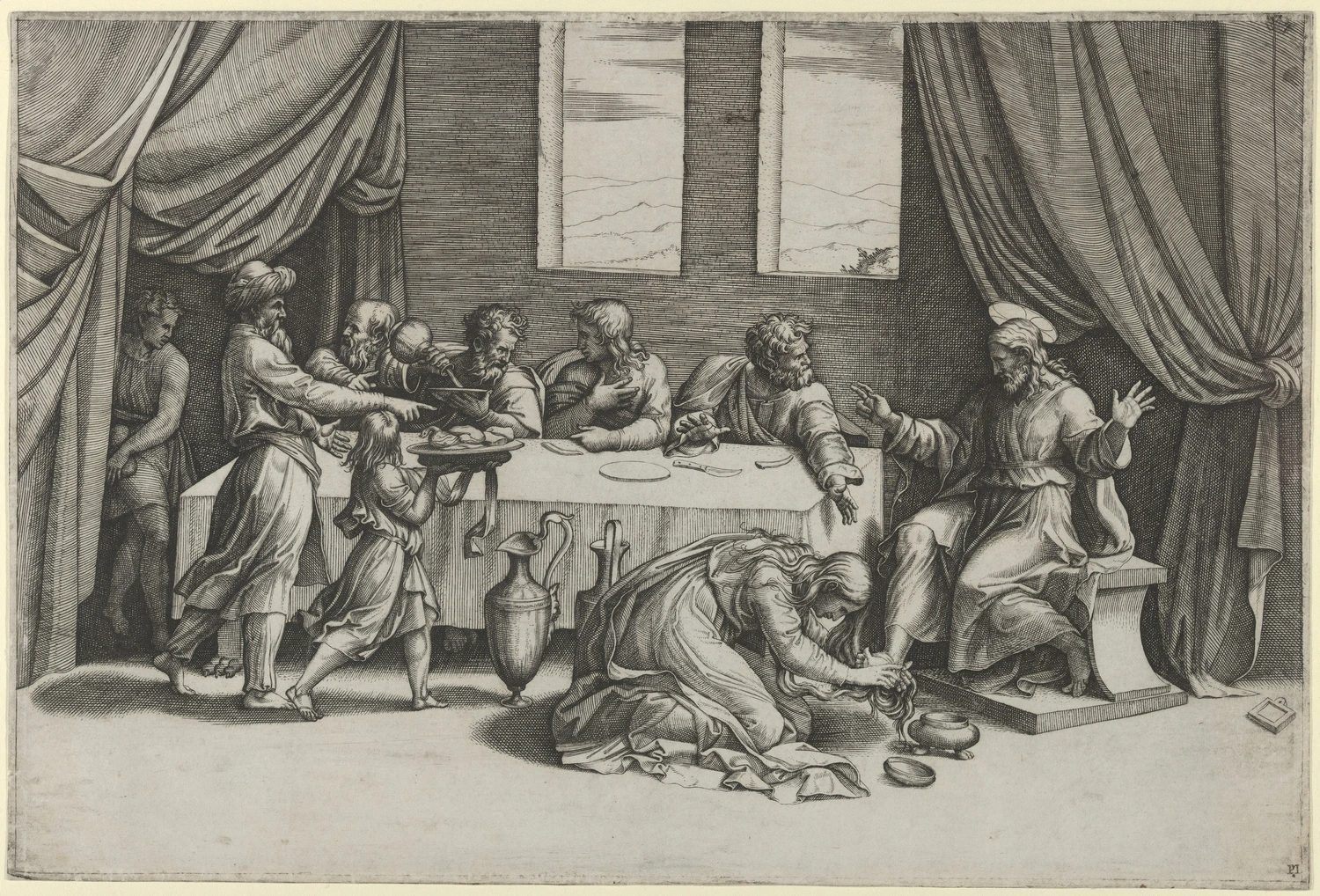
Raimondi shows the scene at Simon the Pharisee’s table. The Met’s catalogue title calls the kneeling woman Mary Magdalene, following the later identification.
Marcantonio Raimondi, Christ at the table of Simon the Pharisee, ca. 1520–25. The Metropolitan Museum of Art, Purchase, Joseph Pulitzer Bequest, 1917. · Image source ↗ · CC0
Mary of Bethany at the feet of Jesus
John introduces Mary’s family in chapter 11 and anticipates the anointing. Chapter 12 puts Jesus at a dinner in Bethany before Passover. Martha serves and Lazarus reclines at table. Mary anoints Jesus’ feet with nard and wipes them with her hair. Judas questions the cost and Jesus relates the act to his burial. Names and family relationships make this scene identifiable in John’s account. [4][5]
In Luke 10, another scene worth checking, Martha receives Jesus and Mary listens at his feet. This time Luke names Mary. The act is listening, and the conversation turns on Martha’s concern about the work of serving. Read it alongside John for the sisters’ roles and watch what changes when the anointing becomes the subject. [3][5][12]
The unnamed woman in Mark and Matthew
Mark and Matthew place an anointing at Bethany in the house of Simon the leper. An unnamed woman pours the ointment on Jesus’ head. In Mark some present object to the expense, and in Matthew the disciples object. Jesus relates the act to his burial and says it will be remembered. The NABRE note on John 12 treats these as likely versions of the same Bethany scene. Its text gives readers room to compare what each Gospel chooses to name and describe. [6][7][5]
Mary Magdalene at the cross and the tomb
John names Mary Magdalene among those at the cross. In chapter 20 she comes to the tomb, reports the missing body, and later speaks with a figure she takes for the gardener. The recognition comes when Jesus calls her by name. She then carries the news to the disciples. John’s sequence gives her a role as a witness and messenger. [8][9]
Raimondi’s garden engraving puts a spade over the standing figure’s shoulder and a vessel in the foreground. The garden and the tool point to the episode in John. The vessel can recall the association of Magdalene with spices or ointment in art. John’s account identifies her through the scene and her name, and the engraving illustrates the gardener’s role in her first impression. [16][9][13]
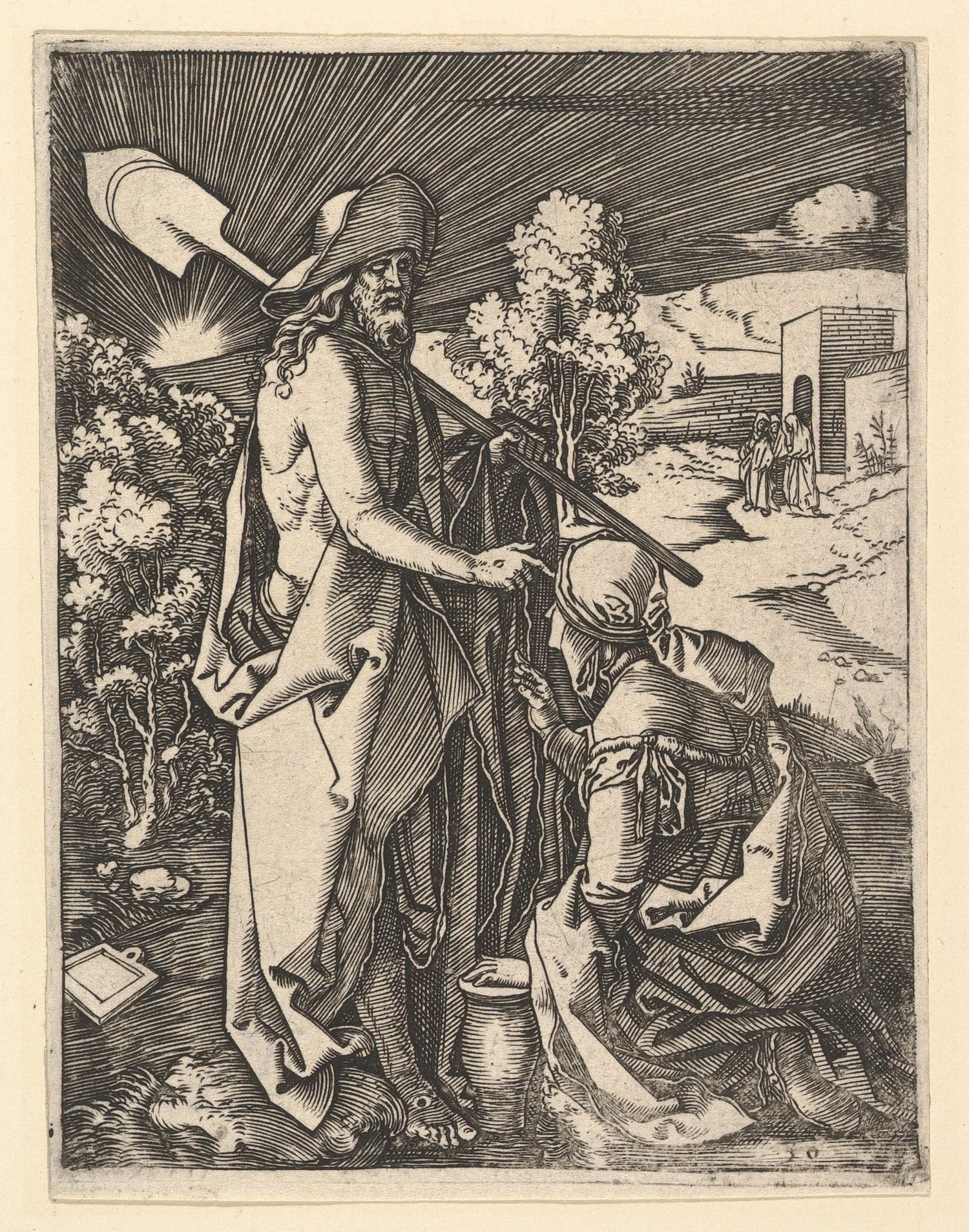
In the garden scene, the spade gives visible form to Mary’s first impression in John 20. John calls her Mary Magdalene.
Marcantonio Raimondi, after Dürer, Christ Appearing to the Magdalen as a gardener, ca. 1500–34. The Metropolitan Museum of Art, Gift of Henry Walters, 1917. · Image source ↗ · CC0
How Christian traditions identified the women
A 2016 Roman commentary attributes the identification of the three figures in much Western tradition to the interpretation associated with Gregory the Great. It also describes changes after the Second Vatican Council that focused the July 22 observance on Mary of Magdala. In 2016 her observance was elevated to a feast. The 2021 decree records the July 29 memorial for Martha, Mary and Lazarus, the Bethany siblings. These documents state how the Roman calendar distinguishes the two named women. [10][11][12]
The Orthodox Church in America commemorates Magdalene as a myrrhbearer and Equal of the Apostles on July 22. Its list of the myrrhbearing women gives Martha and Mary, sisters of Lazarus, their own commemoration on June 4. These practices preserve a distinction. They also explain why a title like myrrhbearer describes a role within a tradition and gives little help in identifying the woman at Simon’s dinner. [13][14][1]
See references (6)
- Luke 7:36–50 · The unnamed woman at Simon’s dinner
- The new preface of Saint Mary Magdalene · Historical explanation
- 2016 decree · Saint Mary Magdalene’s feast
- 2021 decree · Saints Martha, Mary and Lazarus
- Mary Magdalene, Myrrhbearer and Equal of the Apostles
- Holy Myrrhbearing Women · Magdalene and the sisters of Lazarus
Read Doré and Chambers together in the Library
Open the commentary in The Bible Gallery, then turn to Doré’s plate. Chambers interprets the kneeling woman as a penitent and presents that reading as Mary Magdalene’s story. The plate places her alone against a rock in a dark landscape. Compare the historical interpretation with Luke’s introduction of Magdalene in chapter 8 and John’s account at the tomb. The exact pages show how an illustrator and a commentator gave the inherited reading a visual form. [18][19][17][2][9]
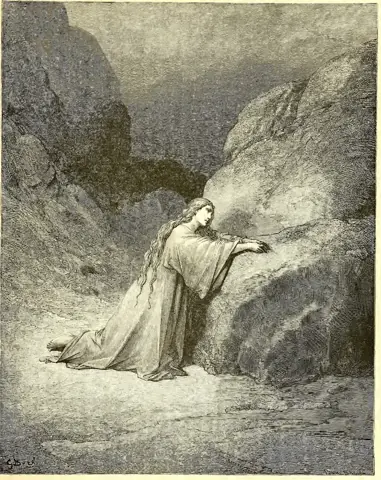
Read further in the library
The Bible Gallery
Reading note
See Doré’s illustration and Chambers’s commentary as a historical example of how the figures were identified.
Sources
See references (19)
- Luke 7:36–50 · The unnamed woman at Simon’s dinner ↗New American Bible, Revised Edition, United States Conference of Catholic Bishops.Return to text ↑
- Luke 8:1–3 · Mary Magdalene named among the followers ↗New American Bible, Revised Edition, United States Conference of Catholic Bishops.Return to text ↑
- Luke 10:38–42 · Martha hosts Jesus and Mary listens ↗New American Bible, Revised Edition, United States Conference of Catholic Bishops.Return to text ↑
- John 11:1–5 and 28–35 · Mary, Martha and Lazarus ↗New American Bible, Revised Edition, United States Conference of Catholic Bishops.Return to text ↑
- John 12:1–8 · Mary anoints Jesus in Bethany ↗New American Bible, Revised Edition, United States Conference of Catholic Bishops.Return to text ↑
- Mark 14:3–9 · An unnamed woman anoints Jesus’ head ↗New American Bible, Revised Edition, United States Conference of Catholic Bishops.Return to text ↑
- Matthew 26:6–13 · The supper at Simon the leper’s house ↗New American Bible, Revised Edition, United States Conference of Catholic Bishops.Return to text ↑
- John 19:25 · Women at the cross ↗New American Bible, Revised Edition, United States Conference of Catholic Bishops.Return to text ↑
- John 20:1–18 · Mary Magdalene at the tomb and in the garden ↗New American Bible, Revised Edition, United States Conference of Catholic Bishops.Return to text ↑
- The new preface of Saint Mary Magdalene · Historical explanation ↗Congregation for Divine Worship and the Discipline of the Sacraments, Roman liturgical commentary, 2016.Return to text ↑
- 2016 decree · Saint Mary Magdalene’s feast ↗Congregation for Divine Worship and the Discipline of the Sacraments, 3 June 2016.Return to text ↑
- 2021 decree · Saints Martha, Mary and Lazarus ↗Congregation for Divine Worship and the Discipline of the Sacraments, 26 January 2021.Return to text ↑
- Mary Magdalene, Myrrhbearer and Equal of the Apostles ↗Orthodox Church in America, liturgical account for 22 July.Return to text ↑
- Holy Myrrhbearing Women · Magdalene and the sisters of Lazarus ↗Orthodox Church in America, calendar and commemoration list.Return to text ↑
- Raimondi · Christ at the table of Simon the Pharisee ↗The Metropolitan Museum of Art, Purchase, Joseph Pulitzer Bequest, 1917. Open Access.Return to text ↑
- Raimondi after Dürer · Christ appearing to Mary Magdalene as a gardener ↗The Metropolitan Museum of Art, Gift of Henry Walters, 1917. Open Access.Return to text ↑
- Doré · Mary Magdalene at Prayer ↗Lumitheca Gallery, source leaf 337 of The Bible Gallery.Return to text ↑
- Chambers’s commentary on Mary MagdaleneThe Bible Gallery, Gustave Doré designs with descriptive text by Talbot W. Chambers, Cassell & Company. Lumitheca reading edition.Read this page in The Bible Gallery ↗Return to text ↑
- Doré’s Mary Magdalene plate in The Bible GalleryThe Bible Gallery, Gustave Doré designs with descriptive text by Talbot W. Chambers, Cassell & Company. Lumitheca reading edition.Read this page in The Bible Gallery ↗Return to text ↑