The Gospel of Mary: The Story, the Missing Pages and Mary’s Role
Read the Gospel of Mary in manuscript order. See which pages are missing, what the Greek fragments preserve, and why Peter challenges Mary’s vision.
In this article
Follow the surviving pages
Four ranges show where the surviving Gospel can be read and where pages are missing. Follow the links to see what the text says before and after each break.
Map of the Berlin Codex pages
- Pages 1–6 · Missing opening
The first surviving page opens inside a conversation.
- Pages 7–10 · Dialogue and vision
The Saviour departs. Mary comforts the disciples and begins her account.
- Pages 11–14 · Missing middle
The text breaks off during the explanation of how a vision is seen.
- Pages 15–19 · Ascent and dispute
The soul answers the powers. The disciples debate Mary’s report.
What is the Gospel of Mary?
The Gospel of Mary is an early Christian dialogue in which the Saviour commissions his followers, Mary recounts a vision, and the disciples disagree about whether to trust her account. Its longest surviving copy is in Coptic in the Berlin Codex. Two earlier Greek fragments overlap passages still present in that copy. The ancient title names Mary and the surviving text gives her the central role. The author is unknown. [14][3][4]
The text has three layers of speech. First the Saviour speaks to the gathered disciples. Mary then tells the disciples what she saw and heard in private. Inside her report, a soul answers the powers that try to hold or judge it. Watch for changes in who is addressing whom, especially across the gap between pages 10 and 15. [9][10][11][12]
See references (7)
- Christopher Tuckett · Manuscripts of the Gospel of Mary
- Christopher Tuckett · Attestation, manuscripts, language and date
- Berlin Codex 8502, pp. 8–9 · Farewell and commission
- Berlin Codex 8502, pp. 9–10 · Mary addresses the disciples and recounts her vision
- Berlin Codex 8502, pp. 11–14 · Missing pages
- Berlin Codex 8502, pp. 15–17 · The soul answers the powers
- Berlin Codex 8502, p. 19 · Closing title
Which pages are missing?
Of the nineteen numbered pages assigned to this tractate in the Berlin Codex, nine remain: pages 7–10 and 15–19. Pages 1–6 and 11–14 are absent. Page 7 opens in the middle of a question about matter. The title at the end identifies the text even though the opening pages are gone. [8][14][2][3]
Page 10 breaks off as the Saviour explains how visions are perceived. Page 15 resumes with Desire addressing the soul on its way upward. The original transition between those moments is unknown. Brackets on surviving pages often indicate much smaller losses or editorial additions. Read the translation’s legend before treating bracketed words as certain. [10][11][12][1]
See references (8)
- Mark M. Mattison · The Gospel of Mary
- Manuscript inventory · Berlin Codex and the two Greek fragments
- Christopher Tuckett · Manuscripts of the Gospel of Mary
- Berlin Codex 8502, pp. 7–8 · Matter and sin
- Berlin Codex 8502, pp. 9–10 · Mary addresses the disciples and recounts her vision
- Berlin Codex 8502, pp. 11–14 · Missing pages
- Berlin Codex 8502, pp. 15–17 · The soul answers the powers
- Berlin Codex 8502, p. 19 · Closing title
Pages 7–10 · The Saviour departs and Mary reports a vision
The first dialogue asks what happens to matter and what makes sin possible. The Saviour speaks of things dissolving into their roots. In his farewell he commissions the disciples to preach and warns them against laying down new rules. They fear meeting the same hostility he faced. Mary’s first contribution is to encourage them, and the group returns to discussing his words. [8][9][10]
Peter asks Mary to tell them words that they were unable to hear. She recalls seeing the Lord and asking whether the soul or spirit sees a vision. The reply locates perception in the mind between them. Read that exchange before the missing pages. It provides the ground for Andrew’s later question about the teaching and for Peter’s challenge to the circumstances in which she heard it. [10][11][13]
Pages 15–19 · The soul answers the powers
The first surviving challenge comes from Desire, which claims the soul belongs to it. The soul answers that Desire failed to recognise it. Ignorance then raises a charge against it, and the soul questions the power’s right to judge. The fourth power appears in seven forms and is associated with wrath. The soul’s reply turns from what once bound it to the rest it expects to receive. The missing pages make the complete sequence of encounters uncertain. [12][11]
The story returns to Mary’s audience as she finishes and falls silent. Andrew doubts the unfamiliar teaching. Peter asks whether the Saviour would have spoken privately to a woman and whether the group should listen to her. Levi rebukes Peter and recalls the Saviour’s authority to judge who is worthy. His appeal to the commission echoes the farewell. The disciples go out to teach after the scene. [9][13]
Who speaks in the Gospel of Mary?
The Saviour teaches the group on pages 7–9 and answers Mary within her account on page 10. Mary addresses the grieving group on page 9, reports the vision from page 10 and responds to Peter on page 18. The soul, Desire, Ignorance and the voices associated with wrath belong to the ascent scene on pages 15–17. [8][10][12][13]
Watch Peter’s two turns. On page 10 he asks Mary for a teaching the group lacks. On pages 17–18 he challenges the authority of that private exchange. Andrew addresses the content of the teaching. Mary answers the accusation, and Levi defends her and urges the group to return to its task. The speech order shows how the initial invitation becomes a dispute. [10][13]
What do the Greek fragments preserve?
Oxyrhynchus Papyrus 3525 is a Greek roll fragment. Its surviving lines overlap the transition from Mary’s encouragement to her account of the vision, approximately Berlin Codex pages 9–10. Rylands Papyrus 463 preserves Greek writing on both sides of a damaged leaf. Its text overlaps the final dispute, approximately pages 17–19. [5][6][3]
Both Greek fragments are assigned to around the third century and predate the later Coptic manuscript. The fragments help establish that the work circulated in Greek. The dates of the papyri establish when particular copies were made within a range, while the work itself could have been composed earlier. Neither fragment supplies the missing opening or the missing middle. [5][6][4][2]
Is this Mary Magdalene?
Mary Magdalene is a common identification for the Gospel’s central figure. The surviving text and title call her Mary without giving her the name Magdalene. John 20 gives a reason for the comparison: Mary Magdalene meets Jesus and reports what she has seen to the disciples. Here too Mary reports an encounter with the Lord. The details differ, and the lost opening leaves open how this account first introduced her. [14][10][15][4]
Schongauer’s engraving belongs to the later visual tradition of John’s garden scene. Luke 8 identifies Mary by the name Magdalene in a list of Jesus’s followers. Reading those named scenes alongside the Coptic dialogue helps explain why readers make the connection while keeping the evidence for each identification visible. [17][15][16][10]
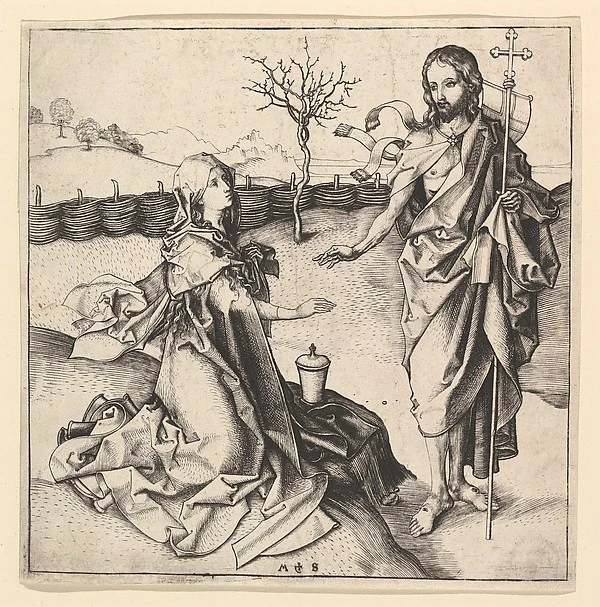
Schongauer’s engraving depicts the garden encounter in John 20. Compare Mary’s report to the disciples in John with the account she gives to Peter in the Gospel of Mary.
Martin Schongauer, Noli me Tangere, ca. 1470–74. The Metropolitan Museum of Art, Harris Brisbane Dick Fund, 1932, 32.64.2. Open Access. · Image source ↗ · Public Domain
See references (6)
- Christopher Tuckett · Attestation, manuscripts, language and date
- Berlin Codex 8502, pp. 9–10 · Mary addresses the disciples and recounts her vision
- Berlin Codex 8502, p. 19 · Closing title
- John 20:11–18 · Mary Magdalene in the garden
- Luke 8:1–3 · Mary called Magdalene
- Martin Schongauer · Noli me Tangere
Sources
See references (17)
- Mark M. Mattison · The Gospel of Mary ↗Public-domain translation of Berlin Codex 8502, tractate 1.Return to text ↑
- Manuscript inventory · Berlin Codex and the two Greek fragments ↗Mark M. Mattison, manuscript inventory and links to photographs.Return to text ↑
- Christopher Tuckett · Manuscripts of the Gospel of Mary ↗The Gospel of Mary, Oxford Early Christian Gospel Texts, 2007.Return to text ↑
- Christopher Tuckett · Attestation, manuscripts, language and date ↗The Gospel of Mary, Oxford Early Christian Gospel Texts, 2007.Return to text ↑
- P.Oxy. L 3525 · Catalogue and manuscript image ↗Egypt Exploration Society and University of Oxford. See the repository for photograph rights.Return to text ↑
- P.Ryl. 463 · Catalogue and manuscript image links ↗Links to the University of Manchester photographs, collected by Mark M. Mattison.Return to text ↑
- Berlin Codex 8502 · Photograph of the cover ↗Manuscript photograph reproduced on Gospels.net.
- Berlin Codex 8502, pp. 7–8 · Matter and sin ↗Mark M. Mattison’s public-domain translation from the Coptic.Return to text ↑
- Berlin Codex 8502, pp. 8–9 · Farewell and commission ↗Mark M. Mattison’s public-domain translation from the Coptic.Return to text ↑
- Berlin Codex 8502, pp. 9–10 · Mary addresses the disciples and recounts her vision ↗Mark M. Mattison’s public-domain translation from the Coptic.Return to text ↑
- Berlin Codex 8502, pp. 11–14 · Missing pages ↗Mark M. Mattison’s public-domain translation from the Coptic.Return to text ↑
- Berlin Codex 8502, pp. 15–17 · The soul answers the powers ↗Mark M. Mattison’s public-domain translation from the Coptic.Return to text ↑
- Berlin Codex 8502, pp. 17–19 · Andrew, Peter, Mary and Levi ↗Mark M. Mattison’s public-domain translation from the Coptic.Return to text ↑
- Berlin Codex 8502, p. 19 · Closing title ↗Mark M. Mattison’s public-domain translation from the Coptic.Return to text ↑
- John 20:11–18 · Mary Magdalene in the garden ↗New American Bible, Revised Edition, United States Conference of Catholic Bishops.Return to text ↑
- Luke 8:1–3 · Mary called Magdalene ↗New American Bible, Revised Edition, United States Conference of Catholic Bishops.Return to text ↑
- Martin Schongauer · Noli me Tangere ↗Martin Schongauer, Noli me Tangere, ca. 1470–74. The Metropolitan Museum of Art, Harris Brisbane Dick Fund, 1932, 32.64.2. Open Access.Return to text ↑