Michael Maier, Atalanta Fugiens (1618)
The Two Fountains in Maier
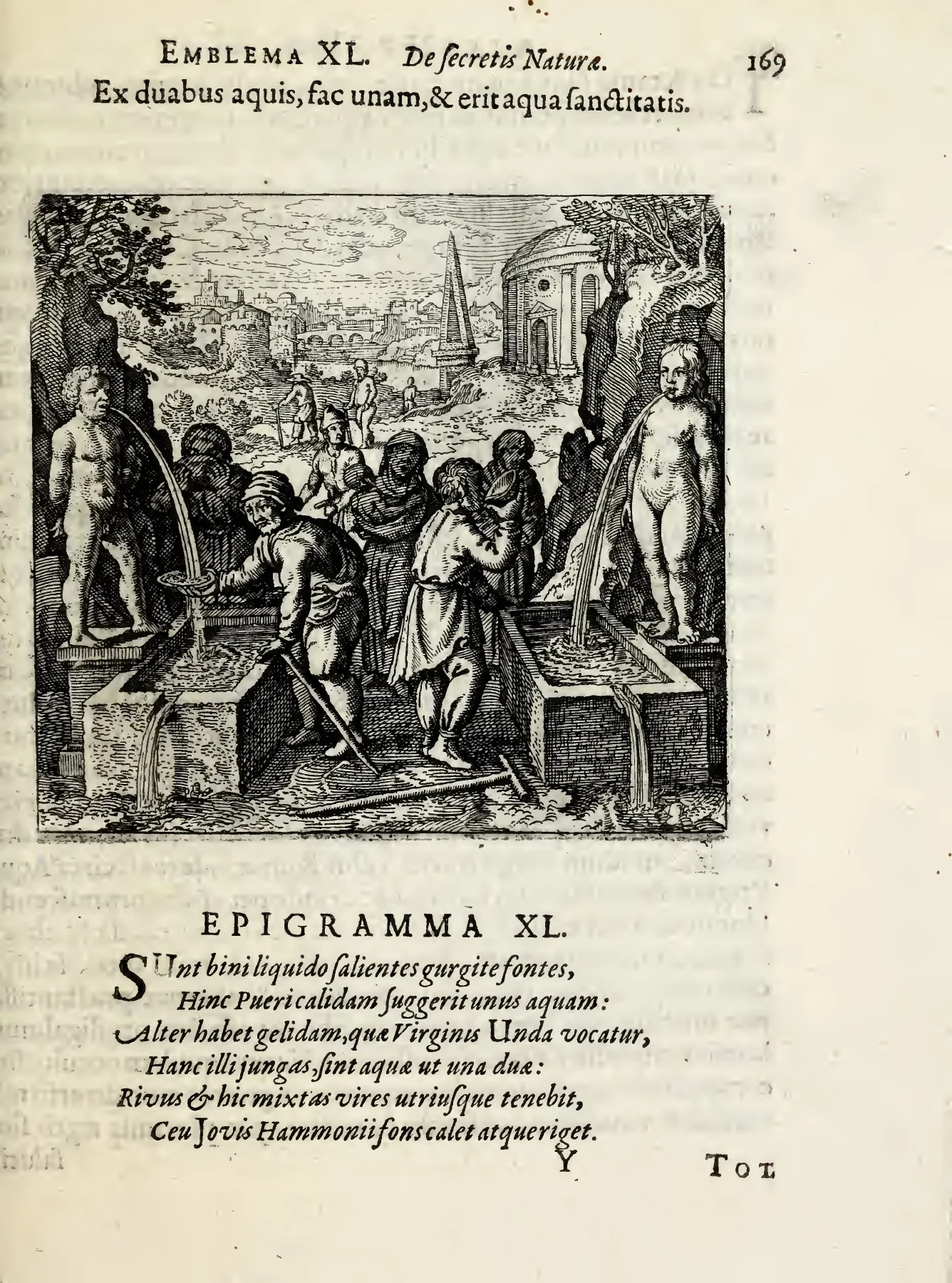
Two streams issue from figures set on opposite sides of Maier’s fortieth engraving, while people gather at their basins. The motto calls for two waters to become one. The epigram identifies a boy’s warm spring and a virgin’s cold spring; the prose carries the opposition into fixing and volatile qualities. Maier’s discussion also distinguishes a mixture made by art from the natural union he seeks. The fountains therefore give a concrete setting to an abstract question: how different qualities might retain their powers while becoming a single subject.
Loading your archive…
In the sources
Warm and cold springs
DocumentedThe epigram contrasts the boy’s warm water with the virgin’s cold water and describes their union.
Mixture and natural union
DocumentedThe discourse pairs fixing and volatile liquors, then distinguishes artificial mixture from union aided by nature.
Context & interpretation
The waters are explained within Maier’s historical account of alchemical composition. Their claimed qualities are attributed to this emblem and its discourse.
Original passages
Source 1
Atalanta Fugiens
Ex duabus aquis, fac unamOpen this page in the book
Passage & edition details
Location recorded at citation review: Atalanta Fugiens (1618), Emblem 40, motto, engraving and epigram, printed p. 169
Original scan and printed heading inspected; short Latin quotation normalizes spacing and ligatures. Historical English text consulted in Furnace and Fugue.
- Edition
- IMJ-0287-E001
- Reader page
- IMJ-0287-E001-P0170
- Original scan leaf
- 177
- Recorded leaf number
- 177
- Current Reader position
- 170
- Reader verification
- Source-preserving update confirmed
Source 2
Atalanta Fugiens
unus lapis congelatus fixus & induratusOpen this page in the book
Passage & edition details
Location recorded at citation review: Atalanta Fugiens (1618), Emblem 40, Latin discourse, printed p. 170
Original scan and printed heading inspected; short Latin quotation normalizes spacing and ligatures. Historical English text consulted in Furnace and Fugue.
- Edition
- IMJ-0287-E001
- Reader page
- IMJ-0287-E001-P0171
- Original scan leaf
- 178
- Recorded leaf number
- 178
- Current Reader position
- 171
- Reader verification
- Source-preserving update confirmed
Source 3
Atalanta Fugiens
absque naturae ope non vera & naturalis unioOpen this page in the book
Passage & edition details
Location recorded at citation review: Atalanta Fugiens (1618), Emblem 40, Latin discourse, printed p. 155 [sic; continuation of Discursus XL]
Original scan and printed heading inspected; short Latin quotation normalizes spacing and ligatures. Historical English text consulted in Furnace and Fugue.
- Edition
- IMJ-0287-E001
- Reader page
- IMJ-0287-E001-P0172
- Original scan leaf
- 179
- Recorded leaf number
- 179
- Current Reader position
- 172
- Reader verification
- Source-preserving update confirmed
Illustrations
Continue exploring
Ceres, Thetis and Alchemical Nurture
Maier pairs the nurture of Triptolemus and Achilles with the gradual strengthening of his philosophical stone.
Same subject and traditionFour Guides to Alchemy in Maier
Nature, reason, experience and reading become a guide, staff, spectacles and lamp in Maier’s image of inquiry.
Same subject and traditionMercury and Vulcan at the Hearth
Two Mercuries and a furnace introduce Maier’s distinction between the subject’s inward qualities and the heat applied from outside.
Same subject and traditionNaaman’s Washing in Maier
The biblical washing in Jordan becomes Maier’s analogy for the purification of the philosophers’ brass.