Michael Maier, Atalanta Fugiens (1618)
The Sun and Its Shadow in Maier
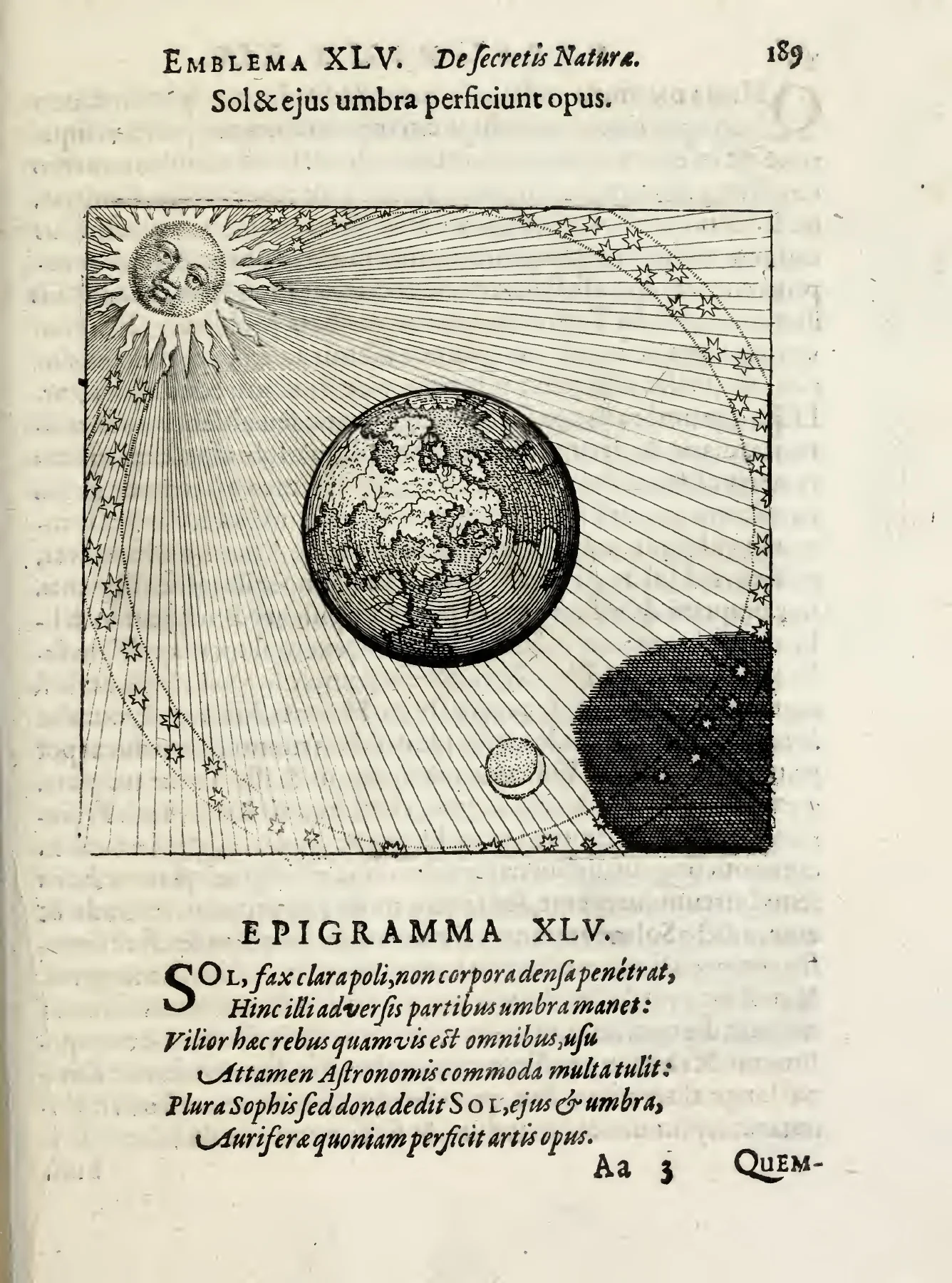
Emblem XLV depicts sunlight reaching a spherical earth while a cone of darkness extends behind it. Maier begins the discourse with an analogy: a fire lights a round hall, but an object placed in the way creates shadow. He develops the comparison through a historical account of celestial motions and then applies it to the philosophers’ sun and its black shadow. The later passage insists on the usefulness of both, comparing a sun without shadow with a clapper lacking its bell. What appears worthless can have a necessary part in the work. The image therefore invites attention to a relation between light, obstruction and darkness. Maier’s astronomical model and alchemical applications remain the arguments of this seventeenth-century text.
Loading your archive…
In the sources
An optical comparison
DocumentedThe plate and opening discourse describe illumination and the shadow cast when a dense body obstructs light.
The pair is necessary
DocumentedMaier argues that the philosophical sun and its shadow must cooperate, using the clapper and bell as a comparison.
Reconsidering apparent worthlessness
InterpretationThe account assigns a necessary role to the black shadow instead of dismissing it as an absence without value.
Context & interpretation
The entry distinguishes Maier’s historical astronomical and alchemical explanations from present-day scientific models. It makes no practical promise of transmutation.
Original passages
Source 1
Atalanta Fugiens
Sol & ejus umbraOpen this page in the book
Passage & edition details
Location recorded at citation review: Atalanta Fugiens (1618), Emblem 45, printed p. 189
Actual original Latin plate and complete two-page discourse inspected; short Latin identifiers use normalized spacing/ligatures. Historical English translation consulted.
- Edition
- IMJ-0287-E001
- Reader page
- IMJ-0287-E001-P0190
- Original scan leaf
- 197
- Recorded leaf number
- 197
- Current Reader position
- 190
- Reader verification
- Source-preserving update confirmed
Source 2
Atalanta Fugiens
Palatio rotundoOpen this page in the book
Passage & edition details
Location recorded at citation review: Atalanta Fugiens (1618), Emblem 45, printed p. 190
Actual original Latin plate and complete two-page discourse inspected; short Latin identifiers use normalized spacing/ligatures. Historical English translation consulted.
- Edition
- IMJ-0287-E001
- Reader page
- IMJ-0287-E001-P0191
- Original scan leaf
- 198
- Recorded leaf number
- 198
- Current Reader position
- 191
- Reader verification
- Source-preserving update confirmed
Source 3
Atalanta Fugiens
Quid enim Sol hic sine umbraOpen this page in the book
Passage & edition details
Location recorded at citation review: Atalanta Fugiens (1618), Emblem 45, printed p. 191
Actual original Latin plate and complete two-page discourse inspected; short Latin identifiers use normalized spacing/ligatures. Historical English translation consulted.
- Edition
- IMJ-0287-E001
- Reader page
- IMJ-0287-E001-P0192
- Original scan leaf
- 199
- Recorded leaf number
- 199
- Current Reader position
- 192
- Reader verification
- Source-preserving update confirmed
Illustrations
Continue exploring
Ceres, Thetis and Alchemical Nurture
Maier pairs the nurture of Triptolemus and Achilles with the gradual strengthening of his philosophical stone.
Same subject and traditionFour Guides to Alchemy in Maier
Nature, reason, experience and reading become a guide, staff, spectacles and lamp in Maier’s image of inquiry.
Same subject and traditionMercury and Vulcan at the Hearth
Two Mercuries and a furnace introduce Maier’s distinction between the subject’s inward qualities and the heat applied from outside.
Same subject and traditionNaaman’s Washing in Maier
The biblical washing in Jordan becomes Maier’s analogy for the purification of the philosophers’ brass.