Michael Maier, Atalanta Fugiens (1618)
Saturn and the Colours of Transformation
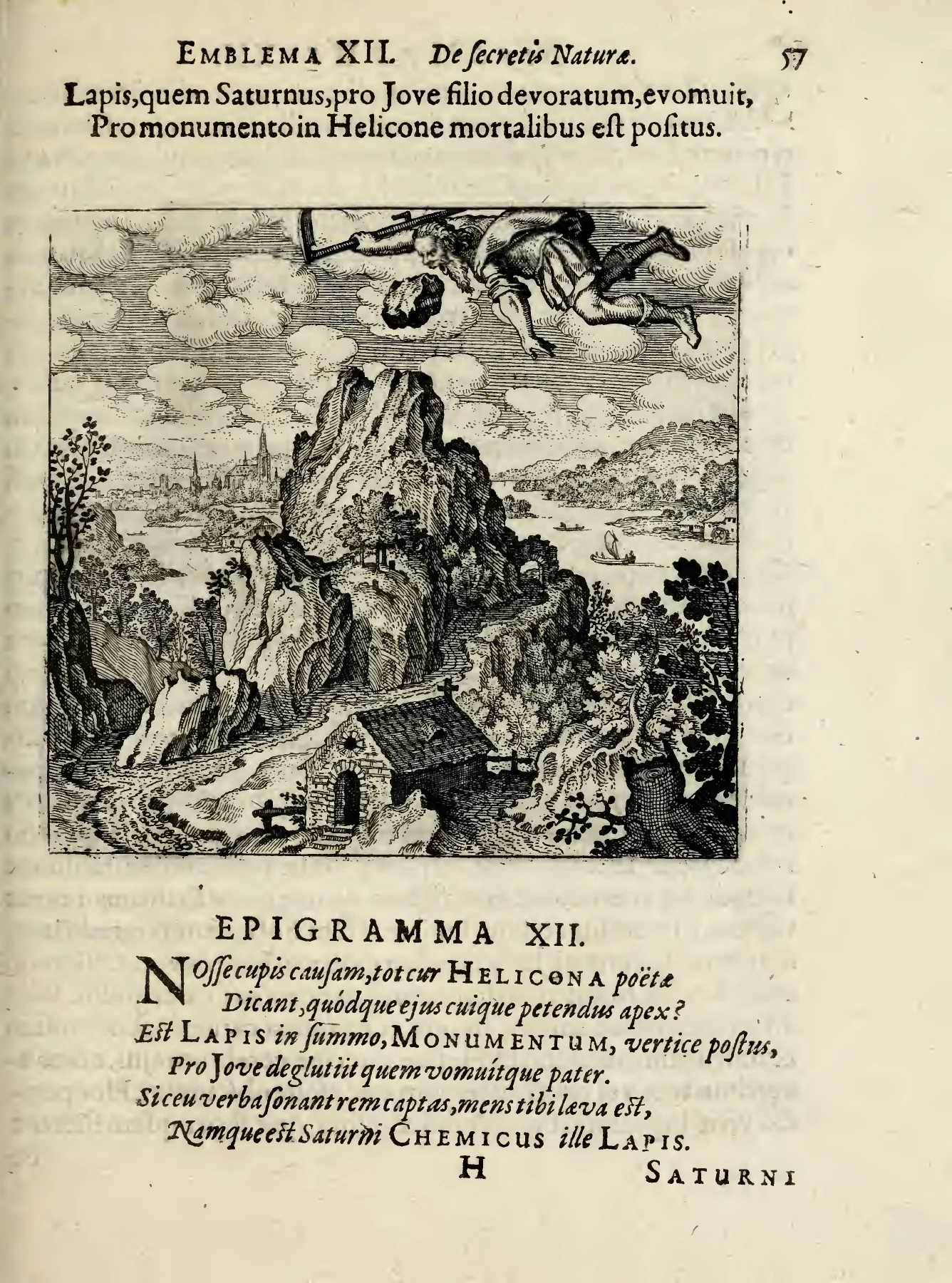
Maier’s twelfth emblem shows Saturn expelling a stone above Helicon. Its discourse first surveys competing meanings of Saturn: a planet, lead, the mythological father of Jupiter, and time. Maier argues that these readings do not fully explain the details of the story for his purpose. He instead turns to the alchemical work, identifying Saturn with the blackness that initially hides the stone. The emergence of whiteness becomes the stone’s release. In the closing passage he links Saturn, Jupiter, Diana and Apollo with stages in a progression of colours. This is a deliberate reinterpretation of inherited mythology inside an alchemical argument. The entry records that local explanation, rather than treating every representation of Saturn as a diagram of the same process.
Loading your archive…
In the sources
More than one Saturn
DocumentedMaier distinguishes planetary, metallic, mythological and temporal readings before proposing his alchemical account.
An ordered colour sequence
DocumentedThe discourse links Saturn with blackness and describes the emergence of whiteness and the subsequent red stage through mythological figures.
Context & interpretation
This is Maier’s interpretation of one emblem, not a general account of classical religion or a claim that his stated transformations have been experimentally verified.
Original passages
Source 1
Atalanta Fugiens
Lapis, quem SaturnusOpen this page in the book
Passage & edition details
Location recorded at citation review: Atalanta Fugiens (1618), Emblem 12, printed p. 57
Original Latin plate or discourse and printed pagination actually inspected; historical English translation consulted for interpretation.
- Edition
- IMJ-0287-E001
- Reader page
- IMJ-0287-E001-P0058
- Original scan leaf
- 65
- Recorded leaf number
- 65
- Current Reader position
- 58
- Reader verification
- Source-preserving update confirmed
Source 2
Atalanta Fugiens
Nigredo itaque Saturnus estOpen this page in the book
Passage & edition details
Location recorded at citation review: Atalanta Fugiens (1618), Emblem 12, printed p. 58
Original Latin plate or discourse and printed pagination actually inspected; historical English translation consulted for interpretation.
- Edition
- IMJ-0287-E001
- Reader page
- IMJ-0287-E001-P0059
- Original scan leaf
- 66
- Recorded leaf number
- 66
- Current Reader position
- 59
- Reader verification
- Source-preserving update confirmed
Source 3
Atalanta Fugiens
Dianam, id est, perfectam albedinemOpen this page in the book
Passage & edition details
Location recorded at citation review: Atalanta Fugiens (1618), Emblem 12, printed p. 59
Original Latin plate or discourse and printed pagination actually inspected; historical English translation consulted for interpretation.
- Edition
- IMJ-0287-E001
- Reader page
- IMJ-0287-E001-P0060
- Original scan leaf
- 67
- Recorded leaf number
- 67
- Current Reader position
- 60
- Reader verification
- Source-preserving update confirmed
Illustrations
Continue exploring
Ceres, Thetis and Alchemical Nurture
Maier pairs the nurture of Triptolemus and Achilles with the gradual strengthening of his philosophical stone.
Same subject and traditionFour Guides to Alchemy in Maier
Nature, reason, experience and reading become a guide, staff, spectacles and lamp in Maier’s image of inquiry.
Same subject and traditionMercury and Vulcan at the Hearth
Two Mercuries and a furnace introduce Maier’s distinction between the subject’s inward qualities and the heat applied from outside.
Same subject and traditionNaaman’s Washing in Maier
The biblical washing in Jordan becomes Maier’s analogy for the purification of the philosophers’ brass.