Michael Maier, Atalanta Fugiens (1618)
The Salamander and Fixation in Maier
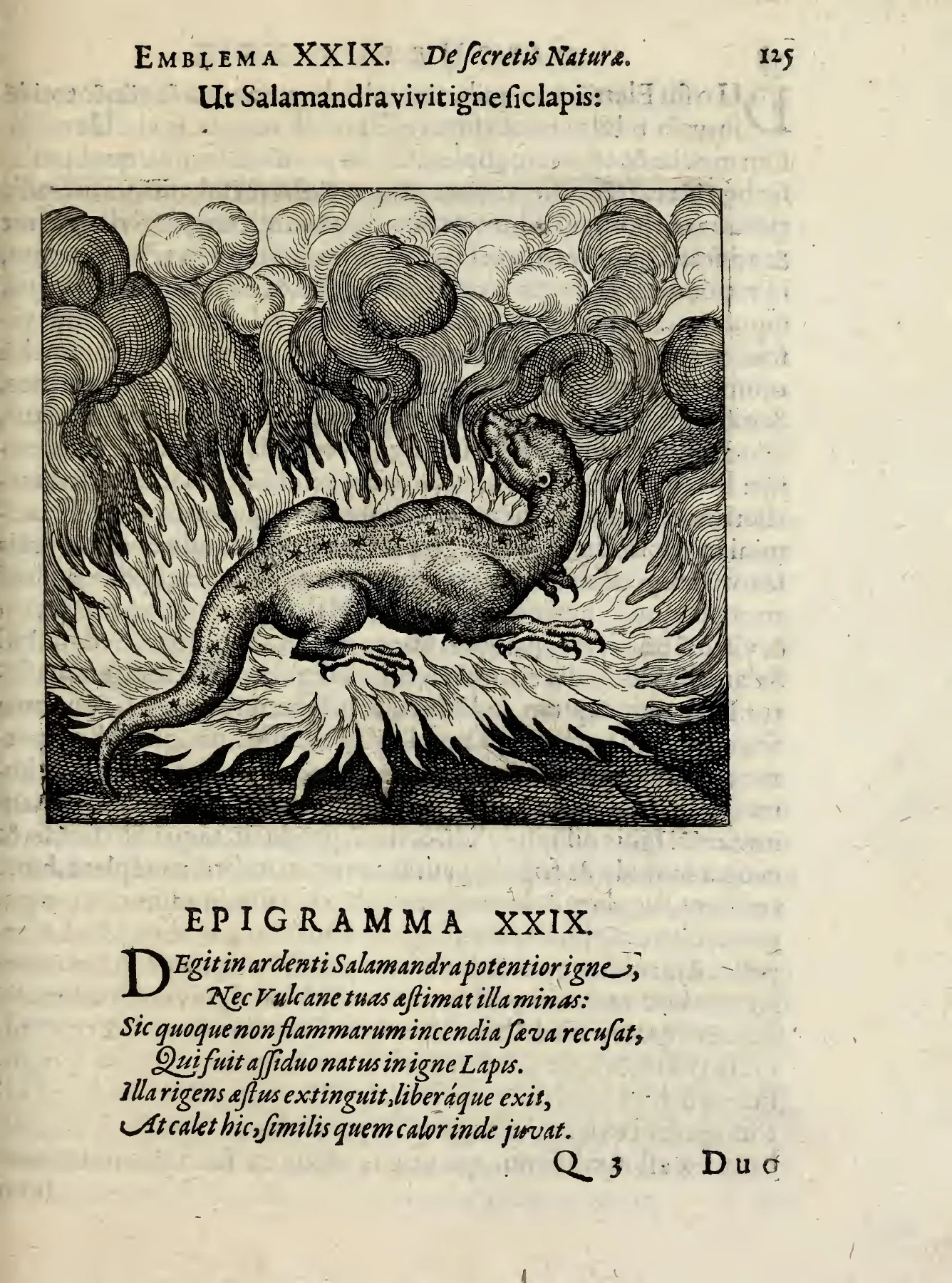
Maier’s twenty-ninth emblem compares the stone with a salamander living in fire. The discourse distinguishes the animal he says he observed in the Alps from the philosophers’ salamander. One is described through coldness and moisture; the other is imagined as born in fire and at home in it. The later passage connects this second salamander with fixation: the stone must acquire a lasting capacity to endure heat. Maier develops the contrast through the four elements and the imagined examination of compounds by Vulcan. The engraving thus presents fire resistance as a defining quality within his alchemical argument. It should be read alongside his explicit distinction between the natural creature and the philosophical figure, rather than taken as proof that an animal can live in a flame.
Loading your archive…
In the sources
Two salamanders distinguished
DocumentedMaier separates a natural animal from the philosophical salamander that his argument places in fire.
An emblem of fixation
DocumentedThe later discourse explicitly connects the stone’s resistance to fire with fixation.
Context & interpretation
This entry describes Maier’s historical symbolism of fixation and distinguishes the philosophical salamander from the animal in his reported observation. His chemical and biological claims remain attributed, not established scientific facts.
Original passages
Source 1
Atalanta Fugiens
SalamandraOpen this page in the book
Passage & edition details
Location recorded at citation review: Atalanta Fugiens (1618), Emblem 29, printed p. 125
Actual original Latin plate and complete two-page discourse inspected; short Latin identifiers use normalized spacing/ligatures. Historical English translation consulted.
- Edition
- IMJ-0287-E001
- Reader page
- IMJ-0287-E001-P0126
- Original scan leaf
- 133
- Recorded leaf number
- 133
- Current Reader position
- 126
- Reader verification
- Source-preserving update confirmed
Source 2
Atalanta Fugiens
SalamandraOpen this page in the book
Passage & edition details
Location recorded at citation review: Atalanta Fugiens (1618), Emblem 29, printed p. 126
Actual original Latin plate and complete two-page discourse inspected; short Latin identifiers use normalized spacing/ligatures. Historical English translation consulted.
- Edition
- IMJ-0287-E001
- Reader page
- IMJ-0287-E001-P0127
- Original scan leaf
- 134
- Recorded leaf number
- 134
- Current Reader position
- 127
- Reader verification
- Source-preserving update confirmed
Source 3
Atalanta Fugiens
fixationemOpen this page in the book
Passage & edition details
Location recorded at citation review: Atalanta Fugiens (1618), Emblem 29, printed p. 127
Actual original Latin plate and complete two-page discourse inspected; short Latin identifiers use normalized spacing/ligatures. Historical English translation consulted.
- Edition
- IMJ-0287-E001
- Reader page
- IMJ-0287-E001-P0128
- Original scan leaf
- 135
- Recorded leaf number
- 135
- Current Reader position
- 128
- Reader verification
- Source-preserving update confirmed
Illustrations
Continue exploring
Ceres, Thetis and Alchemical Nurture
Maier pairs the nurture of Triptolemus and Achilles with the gradual strengthening of his philosophical stone.
Same subject and traditionFour Guides to Alchemy in Maier
Nature, reason, experience and reading become a guide, staff, spectacles and lamp in Maier’s image of inquiry.
Same subject and traditionMercury and Vulcan at the Hearth
Two Mercuries and a furnace introduce Maier’s distinction between the subject’s inward qualities and the heat applied from outside.
Same subject and traditionNaaman’s Washing in Maier
The biblical washing in Jordan becomes Maier’s analogy for the purification of the philosophers’ brass.