Michael Maier, Atalanta Fugiens (1618)
Rebis and the Two Mountains in Maier
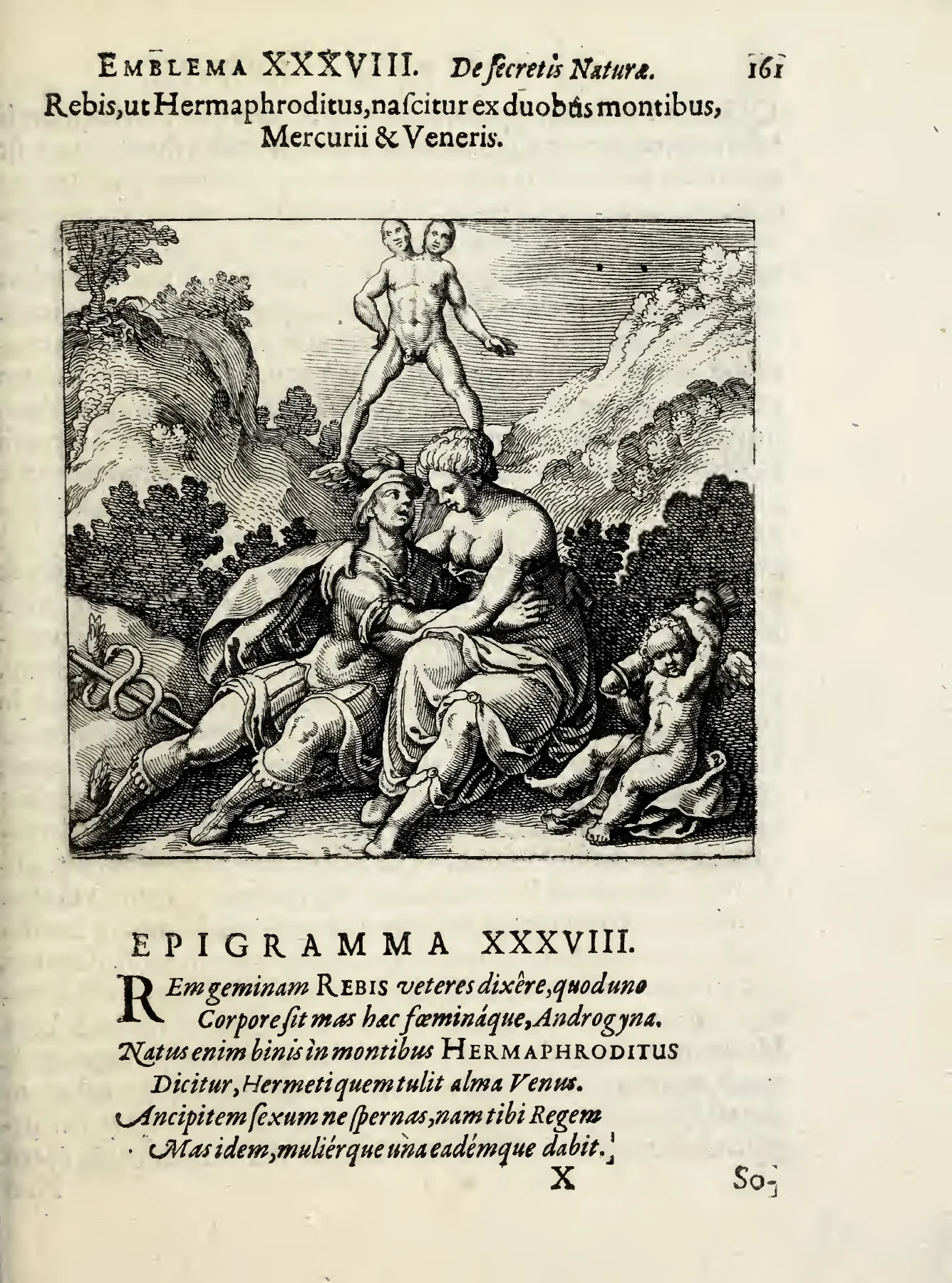
Maier’s thirty-eighth emblem places Mercury and Venus beneath a joined two-headed figure. The discourse asks where this figure belongs, comparing the question with Socrates’ reported identity as a citizen of the world. Rebis is then assigned a more particular origin in two mountains associated with Mercury and Venus. In the concluding passage, Maier identifies a Parnassus with two summits: one mountain in name but double in reality, like the figure with two heads in one body. The difficult ascent also becomes a comparison for the perseverance demanded of the reader. This account concerns Maier’s own treatment of Rebis and the image’s classical names; it does not establish one universal meaning for every historical double figure.
Loading your archive…
In the sources
A double parentage
DocumentedMaier associates the named figure with Mercury and Venus and calls it an inhabitant of two mountains.
One mountain, two summits
DocumentedThe closing discourse compares a double-peaked Parnassus with two heads in a single body.
Context & interpretation
The entry uses historical terms for an emblematic figure, not a description or diagnosis of people. The first prose page misprints163, and the next also prints163; stable Reader page links distinguish them.
Original passages
Source 1
Atalanta Fugiens
RebisOpen this page in the book
Passage & edition details
Location recorded at citation review: Atalanta Fugiens (1618), Emblem 38, printed p. 161
Actual original Latin plate and complete two-page discourse inspected; short Latin identifiers use normalized spacing/ligatures. Historical English translation consulted.
- Edition
- IMJ-0287-E001
- Reader page
- IMJ-0287-E001-P0162
- Original scan leaf
- 169
- Recorded leaf number
- 169
- Current Reader position
- 162
- Reader verification
- Source-preserving update confirmed
Source 2
Atalanta Fugiens
duorum montiumOpen this page in the book
Passage & edition details
Location recorded at citation review: Atalanta Fugiens (1618), Emblem 38, printed p. 163 (first discourse page; misprinted pagination)
Actual original Latin plate and complete two-page discourse inspected; short Latin identifiers use normalized spacing/ligatures. Historical English translation consulted.
- Edition
- IMJ-0287-E001
- Reader page
- IMJ-0287-E001-P0163
- Original scan leaf
- 170
- Recorded leaf number
- 170
- Current Reader position
- 163
- Reader verification
- Source-preserving update confirmed
Source 3
Atalanta Fugiens
Unus est mons nomineOpen this page in the book
Passage & edition details
Location recorded at citation review: Atalanta Fugiens (1618), Emblem 38, printed p. 163 (second discourse page)
Actual original Latin plate and complete two-page discourse inspected; short Latin identifiers use normalized spacing/ligatures. Historical English translation consulted.
- Edition
- IMJ-0287-E001
- Reader page
- IMJ-0287-E001-P0164
- Original scan leaf
- 171
- Recorded leaf number
- 171
- Current Reader position
- 164
- Reader verification
- Source-preserving update confirmed
Illustrations
Continue exploring
Ceres, Thetis and Alchemical Nurture
Maier pairs the nurture of Triptolemus and Achilles with the gradual strengthening of his philosophical stone.
Same subject and traditionFour Guides to Alchemy in Maier
Nature, reason, experience and reading become a guide, staff, spectacles and lamp in Maier’s image of inquiry.
Same subject and traditionMercury and Vulcan at the Hearth
Two Mercuries and a furnace introduce Maier’s distinction between the subject’s inward qualities and the heat applied from outside.
Same subject and traditionNaaman’s Washing in Maier
The biblical washing in Jordan becomes Maier’s analogy for the purification of the philosophers’ brass.