Michael Maier, Atalanta Fugiens (1618)
The Lion and Winged Lioness in Maier
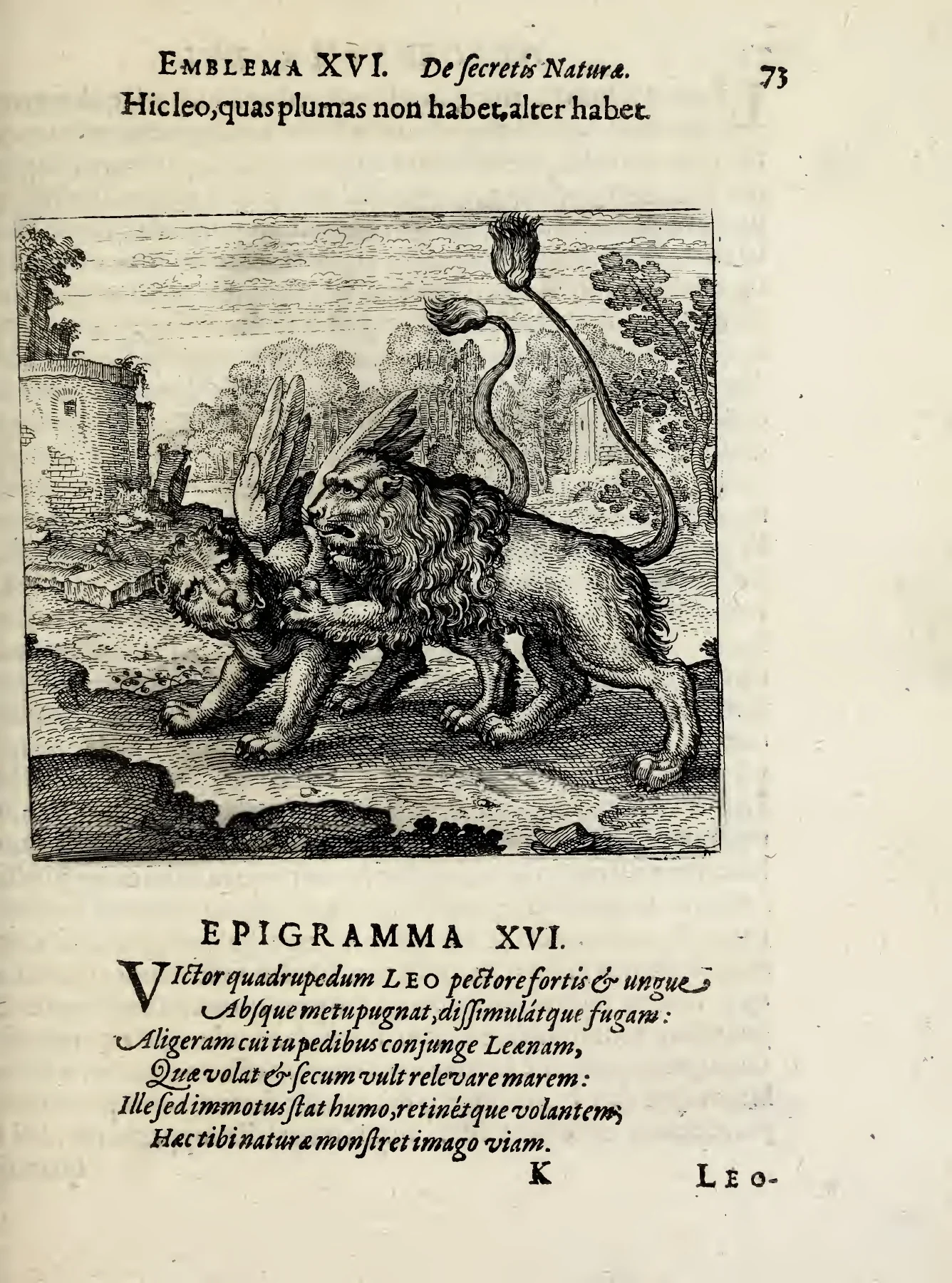
The lion and winged lioness of Emblem XVI are a pair whose differences matter. Maier draws on inherited stories about lions to compare the male with the firmer part of a philosophical composition. The lioness, associated in the discourse with Luna or Mercury, must have wings so that she can contend with the lion rather than simply be overwhelmed. The later passage places flying lionesses in a valley and a red lion on a mountain, then describes bringing the pair together and raising them to the summit. Their lasting union follows earlier discord. This is Maier’s allegorical account of combining and reconciling different qualities. His animal lore belongs to that argument and is not a reliable zoological description of lions.
Loading your archive…
In the sources
Different qualities in a pair
DocumentedThe discourse associates the lion with firmness and the winged lioness with a counterpart described through Luna or Mercury.
From valley to summit
DocumentedMaier describes joining the pair and raising them from a valley to a mountain summit, where they remain united.
Context & interpretation
A source-specific reading of Emblem XVI. The lioness is an alchemical figure, and the inherited animal stories are attributed to Maier rather than presented as modern biology.
Original passages
Source 1
Atalanta Fugiens
LeoOpen this page in the book
Passage & edition details
Location recorded at citation review: Atalanta Fugiens (1618), Emblem 16, printed p. 73
Actual original Latin plate and complete two-page discourse inspected; short Latin identifiers use normalized spacing/ligatures. Historical English translation consulted.
- Edition
- IMJ-0287-E001
- Reader page
- IMJ-0287-E001-P0074
- Original scan leaf
- 81
- Recorded leaf number
- 81
- Current Reader position
- 74
- Reader verification
- Source-preserving update confirmed
Source 2
Atalanta Fugiens
Luna seu MercuriusOpen this page in the book
Passage & edition details
Location recorded at citation review: Atalanta Fugiens (1618), Emblem 16, printed p. 74
Actual original Latin plate and complete two-page discourse inspected; short Latin identifiers use normalized spacing/ligatures. Historical English translation consulted.
- Edition
- IMJ-0287-E001
- Reader page
- IMJ-0287-E001-P0075
- Original scan leaf
- 82
- Recorded leaf number
- 82
- Current Reader position
- 75
- Reader verification
- Source-preserving update confirmed
Source 3
Atalanta Fugiens
inviolato foedereOpen this page in the book
Passage & edition details
Location recorded at citation review: Atalanta Fugiens (1618), Emblem 16, printed p. 75
Actual original Latin plate and complete two-page discourse inspected; short Latin identifiers use normalized spacing/ligatures. Historical English translation consulted.
- Edition
- IMJ-0287-E001
- Reader page
- IMJ-0287-E001-P0076
- Original scan leaf
- 83
- Recorded leaf number
- 83
- Current Reader position
- 76
- Reader verification
- Source-preserving update confirmed
Illustrations
Continue exploring
Ceres, Thetis and Alchemical Nurture
Maier pairs the nurture of Triptolemus and Achilles with the gradual strengthening of his philosophical stone.
Same subject and traditionFour Guides to Alchemy in Maier
Nature, reason, experience and reading become a guide, staff, spectacles and lamp in Maier’s image of inquiry.
Same subject and traditionMercury and Vulcan at the Hearth
Two Mercuries and a furnace introduce Maier’s distinction between the subject’s inward qualities and the heat applied from outside.
Same subject and traditionNaaman’s Washing in Maier
The biblical washing in Jordan becomes Maier’s analogy for the purification of the philosophers’ brass.