Michael Maier, Atalanta Fugiens (1618)
The King’s Vapour Bath in Maier
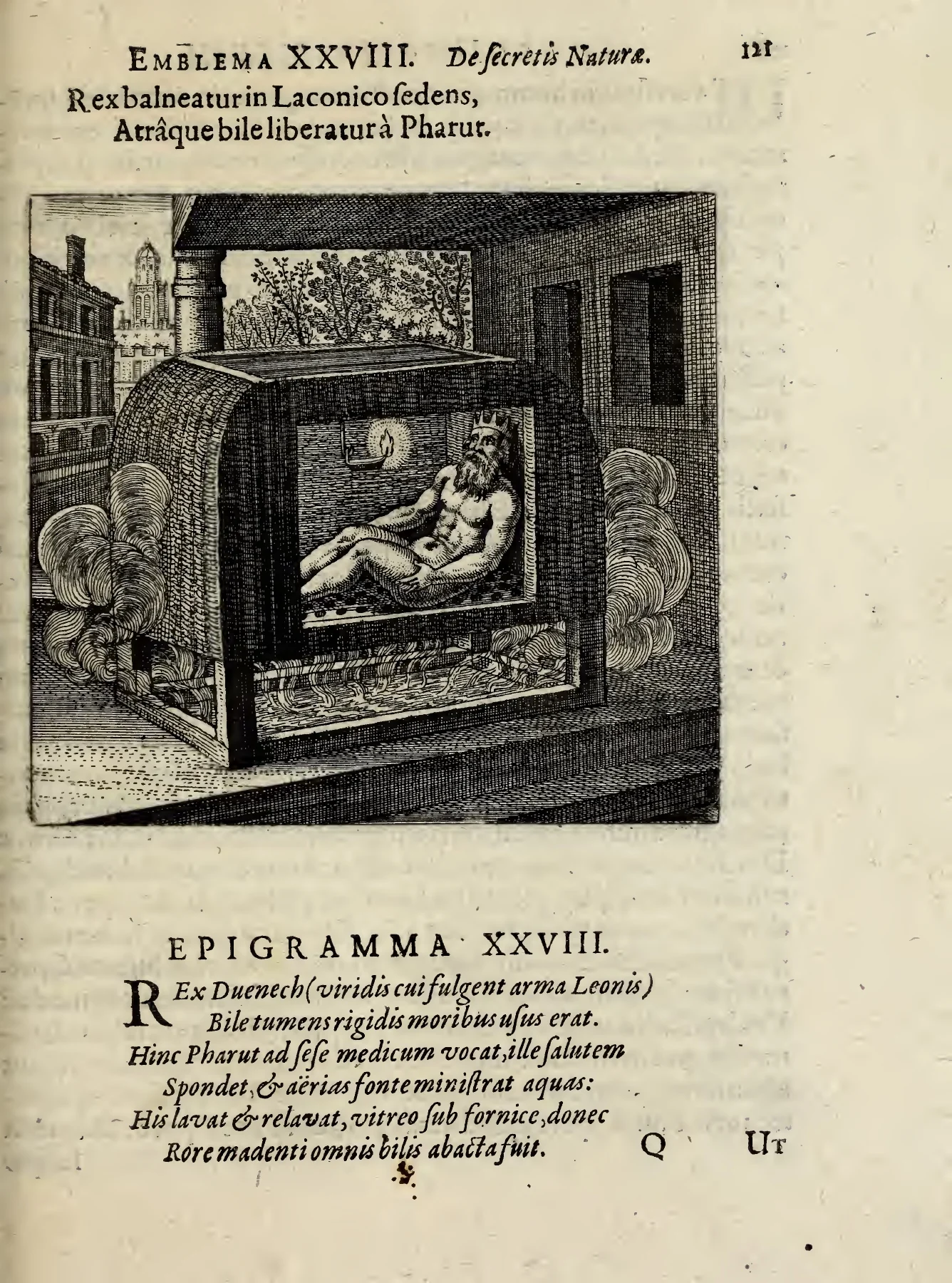
A crowned king sits within a heated enclosure in Maier’s twenty-eighth emblem. The discourse identifies the royal patient as Duenech and relates his condition to a historical theory of bodily concoctions and their corresponding evacuations. Maier compares ways of purifying metals with methods attributed to physicians, making the king’s sweating bath an allegory of the work. Near the end he specifies a vapour bath rather than an immersion that might injure the patient. He also warns that the royal nature of the chosen subject should not be judged by its poor outward appearance. These details explain how the image participates in the book’s language of concealed value and purification. Its physiology and proposed cure belong to early modern medicine.
Loading your archive…
In the sources
A royal patient
DocumentedThe plate presents a king inside an enclosure heated from below, while the discourse names Duenech.
The bath is specified
DocumentedMaier explicitly distinguishes the vapour-and-sweat bath from an unsuitable use of water.
Hidden value beneath poor appearance
InterpretationThe king’s outward condition and intended recovery extend Maier’s account of a valuable subject requiring purification.
Context & interpretation
This entry explains Maier’s historical medical-alchemical allegory of King Duenech. Its theory of concoctions and purification is attributed to the text; it provides neither treatment instructions nor a modern physiological explanation.
Original passages
Source 1
Atalanta Fugiens
RexOpen this page in the book
Passage & edition details
Location recorded at citation review: Atalanta Fugiens (1618), Emblem 28, printed p. 121
Actual original Latin plate and complete two-page discourse inspected; short Latin identifiers use normalized spacing/ligatures. Historical English translation consulted.
- Edition
- IMJ-0287-E001
- Reader page
- IMJ-0287-E001-P0122
- Original scan leaf
- 129
- Recorded leaf number
- 129
- Current Reader position
- 122
- Reader verification
- Source-preserving update confirmed
Source 2
Atalanta Fugiens
tres sunt in homine concoctionesOpen this page in the book
Passage & edition details
Location recorded at citation review: Atalanta Fugiens (1618), Emblem 28, printed p. 122
Actual original Latin plate and complete two-page discourse inspected; short Latin identifiers use normalized spacing/ligatures. Historical English translation consulted.
- Edition
- IMJ-0287-E001
- Reader page
- IMJ-0287-E001-P0123
- Original scan leaf
- 130
- Recorded leaf number
- 130
- Current Reader position
- 123
- Reader verification
- Source-preserving update confirmed
Source 3
Atalanta Fugiens
vaporosumOpen this page in the book
Passage & edition details
Location recorded at citation review: Atalanta Fugiens (1618), Emblem 28, printed p. 123
Actual original Latin plate and complete two-page discourse inspected; short Latin identifiers use normalized spacing/ligatures. Historical English translation consulted.
- Edition
- IMJ-0287-E001
- Reader page
- IMJ-0287-E001-P0124
- Original scan leaf
- 131
- Recorded leaf number
- 131
- Current Reader position
- 124
- Reader verification
- Source-preserving update confirmed
Illustrations
Continue exploring
Ceres, Thetis and Alchemical Nurture
Maier pairs the nurture of Triptolemus and Achilles with the gradual strengthening of his philosophical stone.
Same subject and traditionFour Guides to Alchemy in Maier
Nature, reason, experience and reading become a guide, staff, spectacles and lamp in Maier’s image of inquiry.
Same subject and traditionMercury and Vulcan at the Hearth
Two Mercuries and a furnace introduce Maier’s distinction between the subject’s inward qualities and the heat applied from outside.
Same subject and traditionNaaman’s Washing in Maier
The biblical washing in Jordan becomes Maier’s analogy for the purification of the philosophers’ brass.