Magic Mirrors in Spiritualist Literature
Magic mirrors in A Wanderer in the Spirit Lands offer a vision of power and replay an expedition. Compare them with Celestion Study of Man’s Hall of Memory.
In this article
Understanding the concept
A magic mirror is a surface in an occult story that makes otherwise hidden scenes visible. In A Wanderer in the Spirit Lands, one mirror shows Franchezzo the power he could have. Another shows a hall full of people what happened on an expedition. [1][2][3][4][5]
The polished surface tells the viewer little about the image’s purpose. Franchezzo has to decide whether he is being invited to want something or shown something he can learn from. [1][2][4]
See references (5)
- A Wanderer in the Spirit Lands, printed p. 195, Reader page 204
- A Wanderer in the Spirit Lands, printed p. 196, Reader page 205
- A Wanderer in the Spirit Lands, printed p. 228, Reader page 237
- A Wanderer in the Spirit Lands, printed p. 229, Reader page 238
- A Wanderer in the Spirit Lands, printed p. 230, Reader page 239
A Wanderer in the Spirit Lands: Franchezzo, transcribed by A. Farnese
In Franchezzo’s account, transcribed by A. Farnese, an ancestral tempter uses a black mirror to display influence over earthly life. Music, literature and political power become means of controlling other people. The scenes show what Franchezzo might obtain by joining him, not events the narrator says have already taken place. [1][2]
The remembered presence of his beloved interrupts the attraction. The narrator connects the dissolving images with disturbed waves of magnetic ether. His escape is not immediate: fear and attachment still bind him until assistance arrives. Refusing the display and being free of its maker are separate moments. [2][6][7]
Later, a gathering of the Brotherhood watches a huge mirror of polished black marble. Accompanying music changes with scenes from the rescue expedition. The experiences of different members, including their leader, are shown in sequence. This public review differs from the ancestor’s private offer. [3][4]
Franchezzo’s father says sheets of spiritual metal preserve the travellers’ experiences much as a phonograph preserves sound. The analogy borrows a familiar machine of the period to explain the story’s imagined recording medium. [4][5]
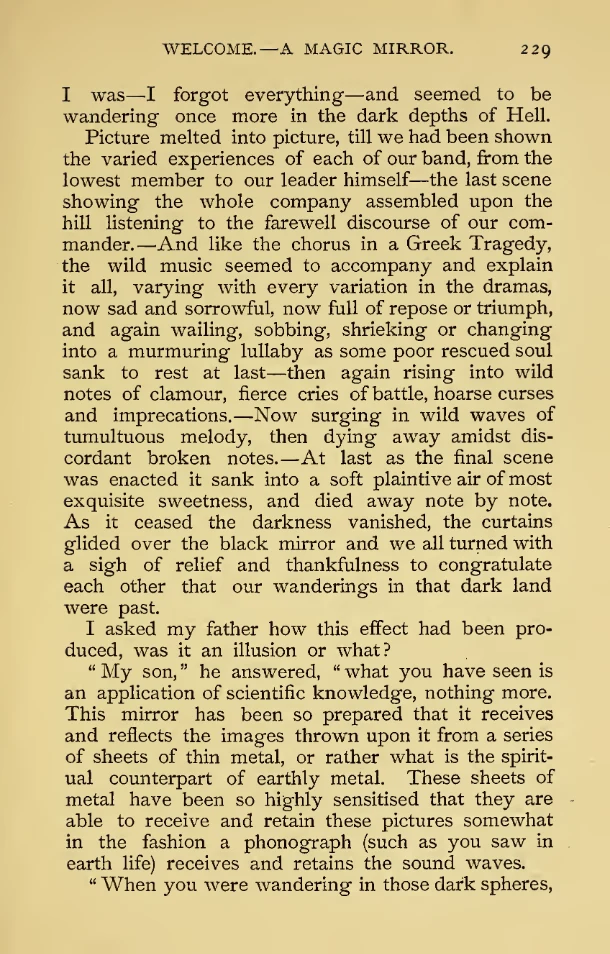
A Wanderer in the Spirit Lands (1896), printed p. 229, Library Reader page 238. The company sees the expedition replayed, and Franchezzo asks how the images were kept.
A Wanderer in the Spirit Lands, W. J. Sinkins, London, preface dated 1896. Public-domain historical page from the checksum-verified Library PDF. · Image source ↗ · Public Domain
See references (7)
- A Wanderer in the Spirit Lands, printed p. 195, Reader page 204
- A Wanderer in the Spirit Lands, printed p. 196, Reader page 205
- A Wanderer in the Spirit Lands, printed p. 228, Reader page 237
- A Wanderer in the Spirit Lands, printed p. 229, Reader page 238
- A Wanderer in the Spirit Lands, printed p. 230, Reader page 239
- A Wanderer in the Spirit Lands, printed p. 197, Reader page 206
- A Wanderer in the Spirit Lands, printed p. 198, Reader page 207
The Angels’ Diary and Celestion Study of Man
Celestion Study of Man, published under the names of Effie M. Shirey and Charles Samson, imagines an inward Hall of Memory. Pictures cover its rooms, preserving experiences which the owner cannot simply remove at will. Adjacent machinery makes the mental interior a place of continued activity as well as storage. [10][11][12]
Who sees the image, and why?
The ancestral mirror advertises a future and the Brotherhood’s mirror replays the past. The small responsive picture in Franchezzo’s room serves a third purpose: it lets him remain in contact with his beloved. What an image does for its viewer matters as much as what appears on the surface. [1][2][3][4][5][8][9]
Celestion Study of Man locates the Hall of Memory inside a person’s mental life. The Brotherhood’s screen presents several people’s experiences to a room full of witnesses. Each gives memory a visible form and a different audience. [10][11][12][1][2][4][5]
See references (10)
- A Wanderer in the Spirit Lands, printed p. 195, Reader page 204
- A Wanderer in the Spirit Lands, printed p. 196, Reader page 205
- A Wanderer in the Spirit Lands, printed p. 228, Reader page 237
- A Wanderer in the Spirit Lands, printed p. 229, Reader page 238
- A Wanderer in the Spirit Lands, printed p. 230, Reader page 239
- A Wanderer in the Spirit Lands, printed p. 41, Reader page 50
- A Wanderer in the Spirit Lands, printed p. 42, Reader page 51
- The Angels’ Diary and Celestion Study of Man, Reader page 119
- The Angels’ Diary and Celestion Study of Man, Reader page 120
- The Angels’ Diary and Celestion Study of Man, Reader page 121
Read further in the library

A Wanderer in the Spirit Lands
Reading note
The separately titled account draws on exact passages in the consulted Library edition.
The Angels’ Diary and Celestion Study of Man
Reading note
Separately attributed comparison with exact previously researched Library passages.
Sources
See references (12)
- A Wanderer in the Spirit Lands, printed p. 195, Reader page 204A Wanderer in the Spirit Lands, attributed to the spirit Franchezzo and transcribed by A. Farnese. W. J. Sinkins, London. Title page undated; preface dated 1896. The narrator’s experiences and the guides’ explanations are reported claims, not independently established observations.Read this page in A Wanderer in the Spirit Lands ↗Return to text ↑
- A Wanderer in the Spirit Lands, printed p. 196, Reader page 205A Wanderer in the Spirit Lands, attributed to the spirit Franchezzo and transcribed by A. Farnese. W. J. Sinkins, London. Title page undated; preface dated 1896. The narrator’s experiences and the guides’ explanations are reported claims, not independently established observations.Read this page in A Wanderer in the Spirit Lands ↗Return to text ↑
- A Wanderer in the Spirit Lands, printed p. 228, Reader page 237A Wanderer in the Spirit Lands, attributed to the spirit Franchezzo and transcribed by A. Farnese. W. J. Sinkins, London. Title page undated; preface dated 1896. The narrator’s experiences and the guides’ explanations are reported claims, not independently established observations.Read this page in A Wanderer in the Spirit Lands ↗Return to text ↑
- A Wanderer in the Spirit Lands, printed p. 229, Reader page 238A Wanderer in the Spirit Lands, attributed to the spirit Franchezzo and transcribed by A. Farnese. W. J. Sinkins, London. Title page undated; preface dated 1896. The narrator’s experiences and the guides’ explanations are reported claims, not independently established observations.Read this page in A Wanderer in the Spirit Lands ↗Return to text ↑
- A Wanderer in the Spirit Lands, printed p. 230, Reader page 239A Wanderer in the Spirit Lands, attributed to the spirit Franchezzo and transcribed by A. Farnese. W. J. Sinkins, London. Title page undated; preface dated 1896. The narrator’s experiences and the guides’ explanations are reported claims, not independently established observations.Read this page in A Wanderer in the Spirit Lands ↗Return to text ↑
- A Wanderer in the Spirit Lands, printed p. 197, Reader page 206A Wanderer in the Spirit Lands, attributed to the spirit Franchezzo and transcribed by A. Farnese. W. J. Sinkins, London. Title page undated; preface dated 1896. The narrator’s experiences and the guides’ explanations are reported claims, not independently established observations.Read this page in A Wanderer in the Spirit Lands ↗Return to text ↑
- A Wanderer in the Spirit Lands, printed p. 198, Reader page 207A Wanderer in the Spirit Lands, attributed to the spirit Franchezzo and transcribed by A. Farnese. W. J. Sinkins, London. Title page undated; preface dated 1896. The narrator’s experiences and the guides’ explanations are reported claims, not independently established observations.Read this page in A Wanderer in the Spirit Lands ↗Return to text ↑
- A Wanderer in the Spirit Lands, printed p. 41, Reader page 50A Wanderer in the Spirit Lands, attributed to the spirit Franchezzo and transcribed by A. Farnese. W. J. Sinkins, London. Title page undated; preface dated 1896. The narrator’s experiences and the guides’ explanations are reported claims, not independently established observations.Read this page in A Wanderer in the Spirit Lands ↗Return to text ↑
- A Wanderer in the Spirit Lands, printed p. 42, Reader page 51A Wanderer in the Spirit Lands, attributed to the spirit Franchezzo and transcribed by A. Farnese. W. J. Sinkins, London. Title page undated; preface dated 1896. The narrator’s experiences and the guides’ explanations are reported claims, not independently established observations.Read this page in A Wanderer in the Spirit Lands ↗Return to text ↑
- The Angels’ Diary and Celestion Study of Man, Reader page 119Effie M. Shirey and Charles Samson, The Angels’ Diary and Celestion Study of Man (1903), communicated through Elizabeth Maud Weatherhead according to the volume’s acknowledgment. Accounts below refer to the exact retained Library edition IMJ-0055-E001.Read this page in The Angels’ Diary and Celestion Study of Man ↗Return to text ↑
- The Angels’ Diary and Celestion Study of Man, Reader page 120Effie M. Shirey and Charles Samson, The Angels’ Diary and Celestion Study of Man (1903), communicated through Elizabeth Maud Weatherhead according to the volume’s acknowledgment. Accounts below refer to the exact retained Library edition IMJ-0055-E001.Read this page in The Angels’ Diary and Celestion Study of Man ↗Return to text ↑
- The Angels’ Diary and Celestion Study of Man, Reader page 121Effie M. Shirey and Charles Samson, The Angels’ Diary and Celestion Study of Man (1903), communicated through Elizabeth Maud Weatherhead according to the volume’s acknowledgment. Accounts below refer to the exact retained Library edition IMJ-0055-E001.Read this page in The Angels’ Diary and Celestion Study of Man ↗Return to text ↑