Lucid Dreaming
Lucid dreaming means knowing you are dreaming while the dream continues. Compare sleep experiments with Steiner’s dream training and Dante’s eagle dream.
In this article
Understanding the concept
Lucid dreaming means realising that you are dreaming while the dream continues. A dream can feel vivid without that realisation. Once it occurs, the dreamer may gain some influence over what happens, though awareness and control are separate abilities. [1]
Rudolf Steiner describes a dreamer learning to direct images and gives the experience a role in his account of spiritual training. In sleep research, the question is whether a person can recognise the dream and report that recognition during or after sleep. [3][4][5]
See references (4)
- Benjamin Baird, Sergio A. Mota-Rolim and Martin Dresler, The cognitive neuroscience of lucid dreaming (2019), author manuscript pp. 2–4
- Initiation and Its Results, printed p. 67, Reader page 65
- Initiation and Its Results, printed p. 68, Reader page 66
- Initiation and Its Results, printed p. 69, Reader page 67
What modern sleep research tests
A 2019 review by Benjamin Baird, Sergio A. Mota-Rolim and Martin Dresler describes how a prearranged pattern of eye movements can mark lucidity. The signal marks a moment in the recording. Other physiological measures help establish whether the participant is asleep. [1]
In a 2021 study, Karen R. Konkoly and colleagues sent questions to participants during verified REM sleep. Some dreamers returned correct answers by making agreed eye or facial-muscle movements. The experiment records a specific kind of communication while dreaming. [2]
Initiation and Its Results by Rudolf Steiner
In Initiation and Its Results, Rudolf Steiner first describes dreams becoming more ordered, with discernible connections of cause and effect. Their images still dramatise experience. A physical sensation or a nearby sound may appear as a symbolic scene rather than as the event that produced it. [6][7]
He then describes the dreamer becoming able to consider and direct the pictures instead of being carried along by them. This is the point of closest comparison with lucid dreaming. Yet Steiner gives it a wider meaning: developed spiritual organs are supposedly beginning to perceive a world normally obscured by ordinary sense impressions. [3][4]
The next task is to recall these observations deliberately during waking life and eventually make the observations while awake. The book does not treat every unusual dream as an authoritative report. Steiner initially calls such experiences hints of development and later requires a claimed waking access to what has been perceived. [7][3][5][8]
His discussion of the Higher Self also insists on retaining a footing in earthly life. The proposed change should enrich participation in the physical world rather than leave the person estranged from it. [5][9]
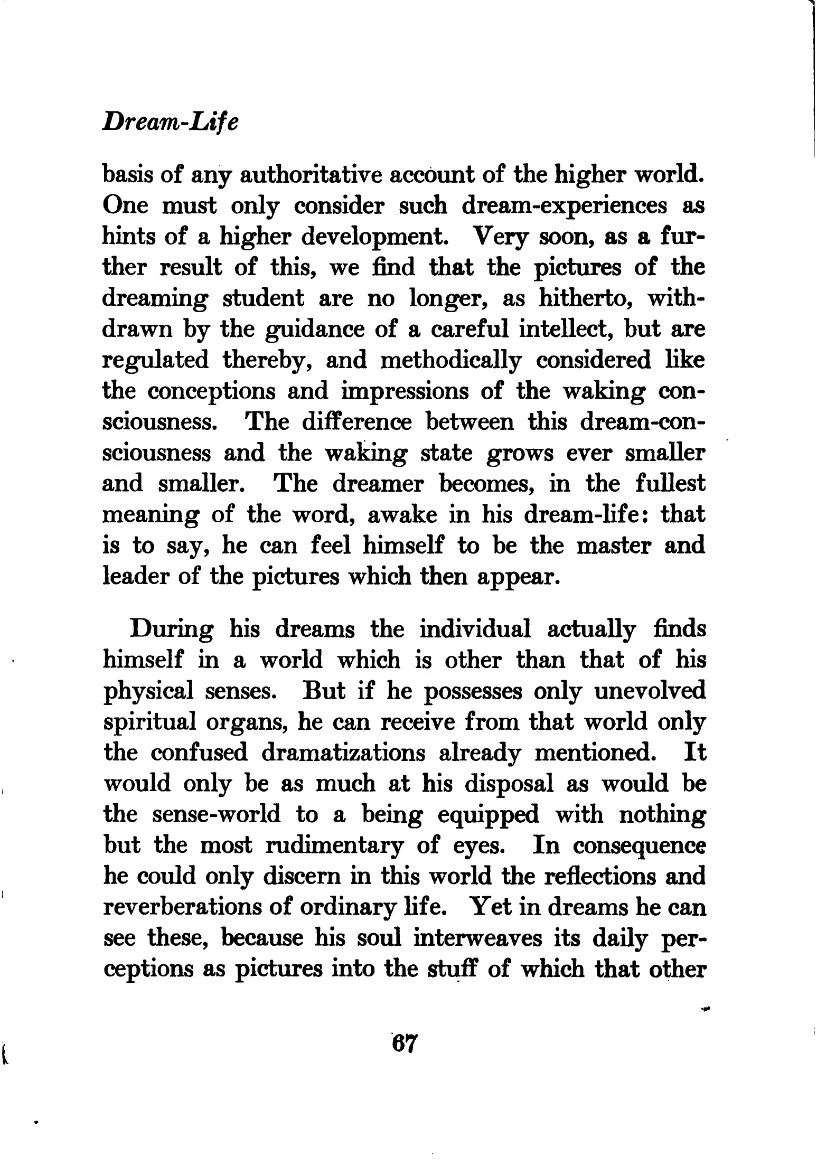
Source facsimile: Initiation and Its Results (1909), printed p. 67, Reader page 65.
Rudolf Steiner, Initiation and Its Results, Clifford Bax translation, First American Edition, 1909. Public-domain historical page from the checksum-verified Library PDF. · Image source ↗ · Public Domain
See references (7)
- Initiation and Its Results, printed p. 67, Reader page 65
- Initiation and Its Results, printed p. 68, Reader page 66
- Initiation and Its Results, printed p. 69, Reader page 67
- Initiation and Its Results, printed p. 65, Reader page 63
- Initiation and Its Results, printed p. 66, Reader page 64
- Initiation and Its Results, printed p. 78, Reader page 76
- Initiation and Its Results, printed p. 70, Reader page 68
Knowledge of the Higher Worlds by Rudolf Steiner
Rudolf Steiner’s chapter on dream life begins with ordinary dreams that transform bodily or environmental impressions into pictures. He then describes a change toward more ordered dreams and a dreamer who can supervise mental activity consciously. The proposed development concerns a spiritual training, rather than every occurrence of recognizing a dream. [18][19][20]
The qualification about authority is explicit. Dreams may offer an initial indication of further development, but Steiner says they should not become the basis of an authoritative description of a higher world. He distinguishes the vividness and order of an experience from its standing as knowledge. [19]
The training is then assigned two tasks: taking stock of dream experiences as clearly as waking impressions, and carrying the same proposed observations into waking life. He expects a spiritual mode of attention to coexist with ordinary sensory experience. His later discussion repeats waking carryover as a condition of the knowledge claimed. [21][22][23]
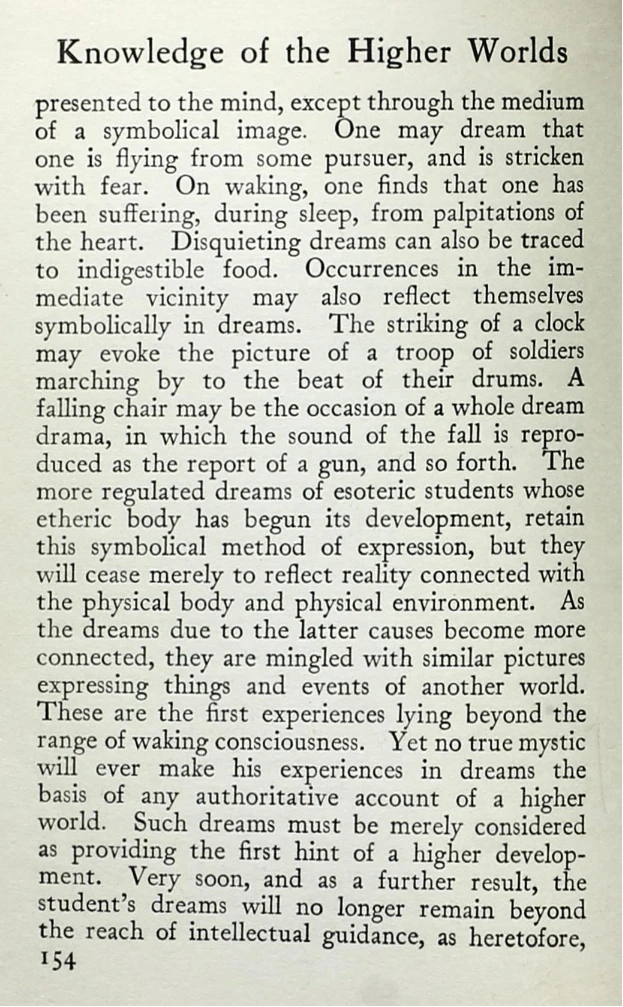
Source facsimile: Knowledge of the Higher Worlds, Reader page 158. Steiner warns against making dreams the basis of an authoritative account of higher worlds.
Rudolf Steiner, G. Metaxa translation, edited by Harry Collison. Historical public-domain source facsimile from the exact checksum-verified Library edition. Repository date 1932; the inspected title page is undated. · Image source ↗ · Public Domain
See references (6)
- Knowledge of the Higher Worlds and Its Attainment, Reader page 157
- Knowledge of the Higher Worlds and Its Attainment, Reader page 158
- Knowledge of the Higher Worlds and Its Attainment, Reader page 159
- Knowledge of the Higher Worlds and Its Attainment, Reader page 160
- Knowledge of the Higher Worlds and Its Attainment, Reader page 161
- Knowledge of the Higher Worlds and Its Attainment, Reader page 169
The Divine Comedy by Dante Alighieri
In Purgatory IX of Dante Alighieri’s Divine Comedy, a golden-feathered eagle carries the pilgrim into fire. He experiences the burning so vividly that he wakes. The scene gives him a powerful dream and lets its meaning emerge afterwards. [15][14]
Dante wakes frightened in another place. Virgil explains that Lucia carried him up the mountain while he slept. The waking account changes what the reader makes of the dream. [14]
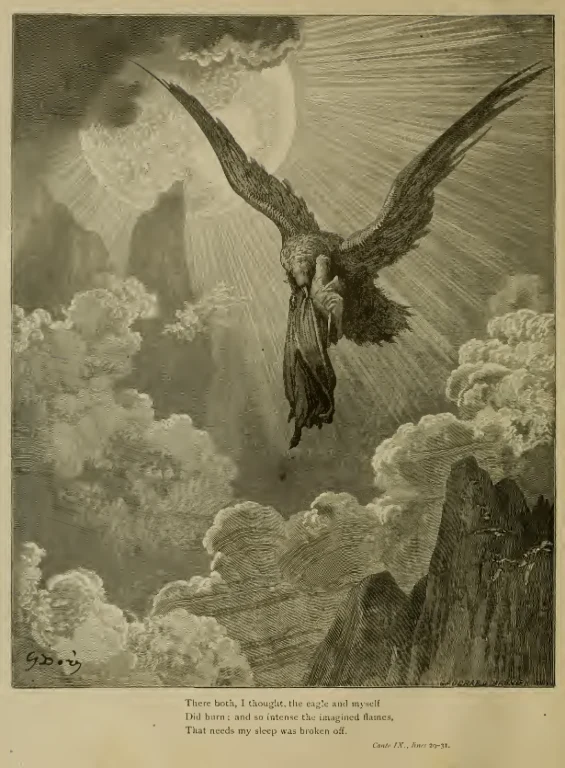
Gustave Doré, Purgatorio IX. The eagle lifts the sleeping Dante in his dream.
Gustave Doré (design), historical engraving in the Lumitheca Library edition of Dante’s Purgatory and Paradise. Public Domain. · Image source ↗ · Public Domain
Awareness, control and interpretation
The sleep experiments test awareness during a dream through a reported experience and a timed signal. Steiner places conscious direction of dream images in a larger theory of spiritual perception. The signal addresses the first question, while his claims concern the second. [3][4][8][17][19][20][23][1][2]
Steiner’s continuity of consciousness goes further still. It describes awareness he believes can continue through dreamless sleep, beyond the question of recognising a dream while it happens. [10][11][12][13]
Dante gives the dream a meaning the pilgrim discovers after waking. His reaction shows how much a dream can feel like an event without the dreamer identifying it as a dream at the time. [14][6][7][3][5]
See references (17)
- Benjamin Baird, Sergio A. Mota-Rolim and Martin Dresler, The cognitive neuroscience of lucid dreaming (2019), author manuscript pp. 2–4
- Karen R. Konkoly and colleagues, Real-time dialogue between experimenters and dreamers during REM sleep (2021), Summary and In Brief
- Initiation and Its Results, printed p. 67, Reader page 65
- Initiation and Its Results, printed p. 68, Reader page 66
- Initiation and Its Results, printed p. 69, Reader page 67
- Initiation and Its Results, printed p. 65, Reader page 63
- Initiation and Its Results, printed p. 66, Reader page 64
- Initiation and Its Results, printed p. 78, Reader page 76
- Initiation and Its Results, printed p. 77, Reader page 75
- Initiation and Its Results, printed p. 79, Reader page 77
- Initiation and Its Results, printed p. 87, Reader page 85
- Initiation and Its Results, printed p. 88, Reader page 86
- Purgatory and Paradise, Reader page 57
- Rudolf Steiner Archive: GA 10 publication and translation history
- Knowledge of the Higher Worlds and Its Attainment, Reader page 158
- Knowledge of the Higher Worlds and Its Attainment, Reader page 159
- Knowledge of the Higher Worlds and Its Attainment, Reader page 169
Read further in the library

Initiation and Its Results
Reading note
The separately titled account draws on exact passages in the consulted Library edition.

Purgatory and Paradise: The Vision of Dante
Reading note
Separately attributed comparison with exact previously researched Library passages.

Knowledge of the Higher Worlds and Its Attainment
Reading note
The separately titled account draws on exact passages in the consulted Library edition.
Sources
See references (23)
- Benjamin Baird, Sergio A. Mota-Rolim and Martin Dresler, The cognitive neuroscience of lucid dreaming (2019), author manuscript pp. 2–4 ↗Benjamin Baird, Sergio A. Mota-Rolim and Martin Dresler. Neuroscience & Biobehavioral Reviews 100 (2019), 305–323. DOI 10.1016/j.neubiorev.2019.03.008. Consulted the author manuscript abstract and opening discussion of definition and eye-signal verification.Return to text ↑
- Karen R. Konkoly and colleagues, Real-time dialogue between experimenters and dreamers during REM sleep (2021), Summary and In Brief ↗Karen R. Konkoly and colleagues. Current Biology 31 (2021), 1417–1427.e6. DOI 10.1016/j.cub.2021.01.026. Primary experiment; consulted Summary, In Brief and opening discussion.Return to text ↑
- Initiation and Its Results, printed p. 67, Reader page 65Rudolf Steiner, Initiation and Its Results: A Sequel to The Way of Initiation, translated by Clifford Bax. First American Edition, 1909. Macoy Publishing and Masonic Supply Co., New York; Max Gysi, London. Claims of clairvoyant perception and subtle organs remain attributed. References identify the exact consulted Library edition.Read this page in Initiation and Its Results ↗Return to text ↑
- Initiation and Its Results, printed p. 68, Reader page 66Rudolf Steiner, Initiation and Its Results: A Sequel to The Way of Initiation, translated by Clifford Bax. First American Edition, 1909. Macoy Publishing and Masonic Supply Co., New York; Max Gysi, London. Claims of clairvoyant perception and subtle organs remain attributed. References identify the exact consulted Library edition.Read this page in Initiation and Its Results ↗Return to text ↑
- Initiation and Its Results, printed p. 69, Reader page 67Rudolf Steiner, Initiation and Its Results: A Sequel to The Way of Initiation, translated by Clifford Bax. First American Edition, 1909. Macoy Publishing and Masonic Supply Co., New York; Max Gysi, London. Claims of clairvoyant perception and subtle organs remain attributed. References identify the exact consulted Library edition.Read this page in Initiation and Its Results ↗Return to text ↑
- Initiation and Its Results, printed p. 65, Reader page 63Rudolf Steiner, Initiation and Its Results: A Sequel to The Way of Initiation, translated by Clifford Bax. First American Edition, 1909. Macoy Publishing and Masonic Supply Co., New York; Max Gysi, London. Claims of clairvoyant perception and subtle organs remain attributed. References identify the exact consulted Library edition.Read this page in Initiation and Its Results ↗Return to text ↑
- Initiation and Its Results, printed p. 66, Reader page 64Rudolf Steiner, Initiation and Its Results: A Sequel to The Way of Initiation, translated by Clifford Bax. First American Edition, 1909. Macoy Publishing and Masonic Supply Co., New York; Max Gysi, London. Claims of clairvoyant perception and subtle organs remain attributed. References identify the exact consulted Library edition.Read this page in Initiation and Its Results ↗Return to text ↑
- Initiation and Its Results, printed p. 78, Reader page 76Rudolf Steiner, Initiation and Its Results: A Sequel to The Way of Initiation, translated by Clifford Bax. First American Edition, 1909. Macoy Publishing and Masonic Supply Co., New York; Max Gysi, London. Claims of clairvoyant perception and subtle organs remain attributed. References identify the exact consulted Library edition.Read this page in Initiation and Its Results ↗Return to text ↑
- Initiation and Its Results, printed p. 70, Reader page 68Rudolf Steiner, Initiation and Its Results: A Sequel to The Way of Initiation, translated by Clifford Bax. First American Edition, 1909. Macoy Publishing and Masonic Supply Co., New York; Max Gysi, London. Claims of clairvoyant perception and subtle organs remain attributed. References identify the exact consulted Library edition.Read this page in Initiation and Its Results ↗Return to text ↑
- Initiation and Its Results, printed p. 77, Reader page 75Rudolf Steiner, Initiation and Its Results: A Sequel to The Way of Initiation, translated by Clifford Bax. First American Edition, 1909. Macoy Publishing and Masonic Supply Co., New York; Max Gysi, London. Claims of clairvoyant perception and subtle organs remain attributed. References identify the exact consulted Library edition.Read this page in Initiation and Its Results ↗Return to text ↑
- Initiation and Its Results, printed p. 79, Reader page 77Rudolf Steiner, Initiation and Its Results: A Sequel to The Way of Initiation, translated by Clifford Bax. First American Edition, 1909. Macoy Publishing and Masonic Supply Co., New York; Max Gysi, London. Claims of clairvoyant perception and subtle organs remain attributed. References identify the exact consulted Library edition.Read this page in Initiation and Its Results ↗Return to text ↑
- Initiation and Its Results, printed p. 87, Reader page 85Rudolf Steiner, Initiation and Its Results: A Sequel to The Way of Initiation, translated by Clifford Bax. First American Edition, 1909. Macoy Publishing and Masonic Supply Co., New York; Max Gysi, London. Claims of clairvoyant perception and subtle organs remain attributed. References identify the exact consulted Library edition.Read this page in Initiation and Its Results ↗Return to text ↑
- Initiation and Its Results, printed p. 88, Reader page 86Rudolf Steiner, Initiation and Its Results: A Sequel to The Way of Initiation, translated by Clifford Bax. First American Edition, 1909. Macoy Publishing and Masonic Supply Co., New York; Max Gysi, London. Claims of clairvoyant perception and subtle organs remain attributed. References identify the exact consulted Library edition.Read this page in Initiation and Its Results ↗Return to text ↑
- Purgatory and Paradise, Reader page 57Dante Alighieri, The Divine Comedy, translated by Henry Francis Cary, designs by Gustave Doré. Inferno: undated New Edition, Thompson & Thomas, Chicago. Purgatory and Paradise: New Edition, Thompson & Thomas, Chicago, 1901. Canto arguments are editorial matter and are distinguished from the poem.Read this page in Purgatory and Paradise: The Vision of Dante ↗Return to text ↑
- Purgatory IX, the dream of the eagle, Reader page 56Dante Alighieri, Purgatory and Paradise: The Vision of Dante, translated by Henry Francis Cary, with illustrations designed by Gustave Doré. Exact retained Library edition.Read this page in Purgatory and Paradise: The Vision of Dante ↗Return to text ↑
- Doré’s engraving of the eagle dream, Reader page 54Dante Alighieri, Purgatory and Paradise: The Vision of Dante, translated by Henry Francis Cary, with illustrations designed by Gustave Doré. Exact retained Library edition.Read this page in Purgatory and Paradise: The Vision of Dante ↗
- Rudolf Steiner Archive: GA 10 publication and translation history ↗Steiner Online Library, Rudolf Steiner Archive, GA 10 bibliography. Used only for publication relationships, not independent confirmation of spiritual claims.Return to text ↑
- Knowledge of the Higher Worlds and Its Attainment, Reader page 157Rudolf Steiner, Knowledge of the Higher Worlds and Its Attainment, authorized English translation by G. Metaxa, edited by Harry Collison, Anthroposophic Press, New York City. Exact Library edition IMJ-0513-E001. No publication year is visible on the inspected title page; the repository assigns 1932. Claims of supersensible perception remain attributed to Steiner.Read this page in Knowledge of the Higher Worlds and Its Attainment ↗Return to text ↑
- Knowledge of the Higher Worlds and Its Attainment, Reader page 158Rudolf Steiner, Knowledge of the Higher Worlds and Its Attainment, authorized English translation by G. Metaxa, edited by Harry Collison, Anthroposophic Press, New York City. Exact Library edition IMJ-0513-E001. No publication year is visible on the inspected title page; the repository assigns 1932. Claims of supersensible perception remain attributed to Steiner.Read this page in Knowledge of the Higher Worlds and Its Attainment ↗Return to text ↑
- Knowledge of the Higher Worlds and Its Attainment, Reader page 159Rudolf Steiner, Knowledge of the Higher Worlds and Its Attainment, authorized English translation by G. Metaxa, edited by Harry Collison, Anthroposophic Press, New York City. Exact Library edition IMJ-0513-E001. No publication year is visible on the inspected title page; the repository assigns 1932. Claims of supersensible perception remain attributed to Steiner.Read this page in Knowledge of the Higher Worlds and Its Attainment ↗Return to text ↑
- Knowledge of the Higher Worlds and Its Attainment, Reader page 160Rudolf Steiner, Knowledge of the Higher Worlds and Its Attainment, authorized English translation by G. Metaxa, edited by Harry Collison, Anthroposophic Press, New York City. Exact Library edition IMJ-0513-E001. No publication year is visible on the inspected title page; the repository assigns 1932. Claims of supersensible perception remain attributed to Steiner.Read this page in Knowledge of the Higher Worlds and Its Attainment ↗Return to text ↑
- Knowledge of the Higher Worlds and Its Attainment, Reader page 161Rudolf Steiner, Knowledge of the Higher Worlds and Its Attainment, authorized English translation by G. Metaxa, edited by Harry Collison, Anthroposophic Press, New York City. Exact Library edition IMJ-0513-E001. No publication year is visible on the inspected title page; the repository assigns 1932. Claims of supersensible perception remain attributed to Steiner.Read this page in Knowledge of the Higher Worlds and Its Attainment ↗Return to text ↑
- Knowledge of the Higher Worlds and Its Attainment, Reader page 169Rudolf Steiner, Knowledge of the Higher Worlds and Its Attainment, authorized English translation by G. Metaxa, edited by Harry Collison, Anthroposophic Press, New York City. Exact Library edition IMJ-0513-E001. No publication year is visible on the inspected title page; the repository assigns 1932. Claims of supersensible perception remain attributed to Steiner.Read this page in Knowledge of the Higher Worlds and Its Attainment ↗Return to text ↑