Continuity of Consciousness
Continuity of consciousness is Steiner’s ideal of unbroken inward awareness during sleep. Read how he distinguishes it from occasional dream or sleep recall.
In this article
Understanding the concept
Continuity of consciousness means unbroken inward awareness across periods that normally feel like gaps. Rudolf Steiner uses the phrase for an ideal in which a person remains inwardly aware through sleep while the body continues to rest. [1][2]
Initiation and Its Results by Rudolf Steiner
In Initiation and Its Results, Steiner starts with separate episodes of awareness. He says they can become longer and the gaps smaller until, at the fullest stage, sleep life is experienced as a continuous whole. [3][1][2]
The relation between experiences matters to his explanation. Steiner discourages the student from forcing isolated perceptions into a theory through ordinary speculation. He expects new experiences to connect with earlier ones without that premature construction. [3][1]
A footnote distinguishes that ideal from earlier experiences. Awareness may first extend into previously disordered dreaming and later into what the student regarded as dreamless sleep. Steiner gives each of these changes a place before full continuity. [2]
The following chapter illustrates his belief in continuing soul activity with the story of a student whose watch had gained half an hour. The student wakes from a dream of six shots when the faulty watch says six, before the neighbour appointed to wake him knocks at the actual hour. Steiner interprets this as a relation maintained by the soul during sleep, while explicitly presenting the episode as an illustration rather than a proof. [4][5][6]
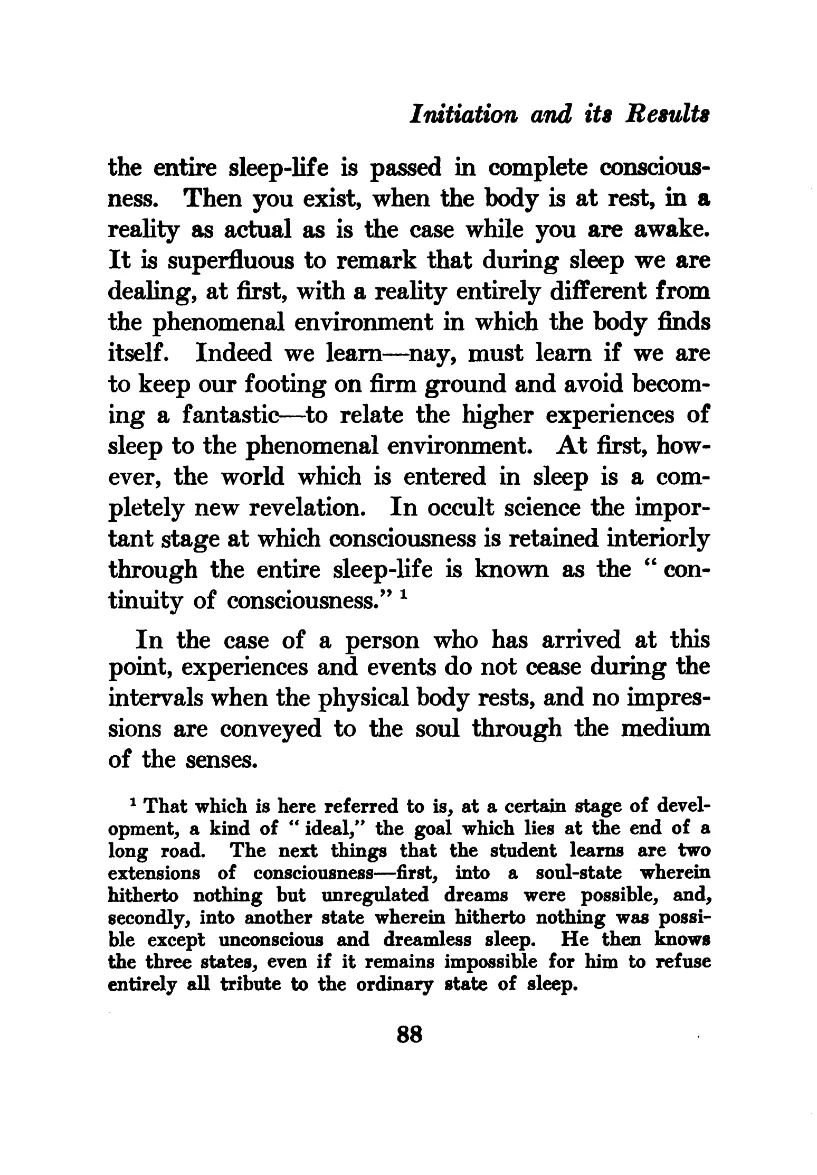
Initiation and Its Results (1909), printed p. 88, Library Reader page 86. Steiner describes separate experiences giving way to longer periods of awareness.
Rudolf Steiner, Initiation and Its Results, Clifford Bax translation, First American Edition, 1909. Public-domain historical page from the checksum-verified Library PDF. · Image source ↗ · Public Domain
See references (6)
- Initiation and Its Results, printed p. 87, Reader page 85
- Initiation and Its Results, printed p. 88, Reader page 86
- Initiation and Its Results, printed p. 86, Reader page 84
- Initiation and Its Results, printed p. 90, Reader page 88
- Initiation and Its Results, printed p. 91, Reader page 89
- Initiation and Its Results, printed p. 92, Reader page 90
Knowledge of the Higher Worlds by Rudolf Steiner
Rudolf Steiner names continuity of consciousness as a stage at which the interruption normally associated with sleep is said to give way to a continuing inward awareness. The body still rests. He presents this as a spiritual mode of experience connected with ordinary waking life. [12][13]
The chapter retains a difference between the ideal and earlier attainments. Extending awareness into disordered dreaming and then into previously unconscious dreamless sleep does not by itself establish complete continuity. The text places the latter toward the end of a long path. [12][13]
He also qualifies how the experiences become connected. The student should not manufacture a unity by speculation, but wait for further experiences to supply connections. In the book’s own explanation, a continuous spiritual life develops alongside the capacity to understand what has been experienced. [14][12]
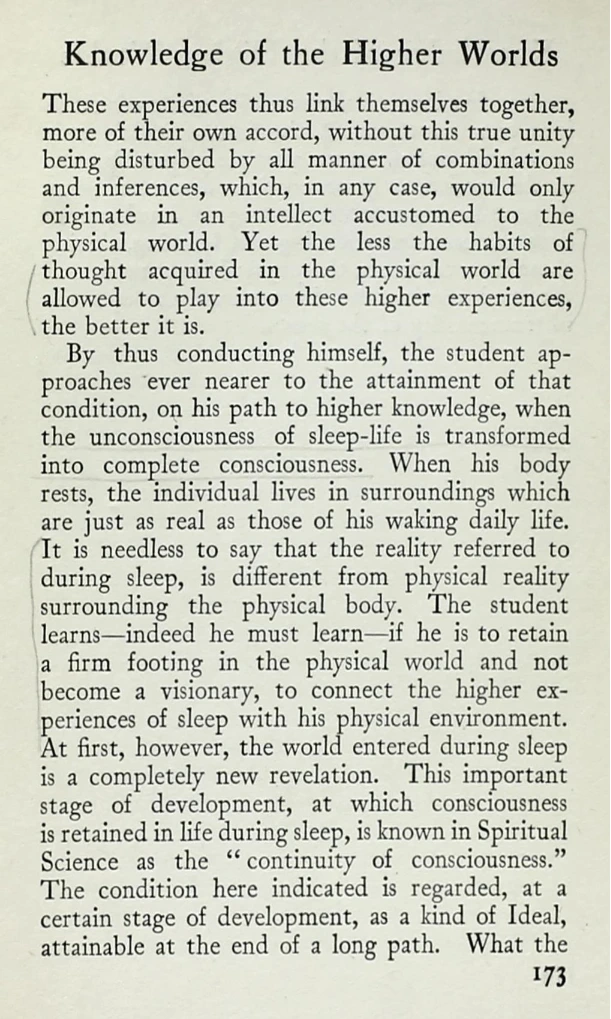
Source facsimile: Knowledge of the Higher Worlds, Reader page 177. Continuity concerns awareness while the physical body rests.
Rudolf Steiner, G. Metaxa translation, edited by Harry Collison. Historical public-domain source facsimile from the exact checksum-verified Library edition. Repository date 1932; the inspected title page is undated. · Image source ↗ · Public Domain
Gone West by J. S. M. Ward
J. S. M. Ward’s Gone West describes Carrie moving between a spirit meeting and ordinary waking life. Her astral and bodily memories do not fully communicate; a portion of an encounter is reported to return as a dream. The guide treats a change of state as a limit on access to experience. [7][8][9][10]
Bridging the gaps in recall
The Bax and Metaxa versions let the body sleep. The watch story illustrates Steiner’s belief that the soul can maintain a relation to what is happening outside. The larger ideal concerns how awareness could continue from one experience to the next. [2][4][5][6][11][12][13]
Ward’s Carrie recalls part of an encounter after returning to waking life. Her story depends on the break between the two states. Steiner imagines that breaks of that kind diminish as sleep life becomes more continuous. [7][8][9][10][1][2][4][5][6][12][13]
See references (12)
- Initiation and Its Results, printed p. 87, Reader page 85
- Initiation and Its Results, printed p. 88, Reader page 86
- Initiation and Its Results, printed p. 90, Reader page 88
- Initiation and Its Results, printed p. 91, Reader page 89
- Initiation and Its Results, printed p. 92, Reader page 90
- Gone West, printed p. 78, Reader page 91
- Gone West, printed p. 79, Reader page 92
- Gone West, printed p. 80, Reader page 93
- Gone West, printed p. 81, Reader page 94
- Rudolf Steiner Archive: GA 10 publication and translation history
- Knowledge of the Higher Worlds and Its Attainment, Reader page 177
- Knowledge of the Higher Worlds and Its Attainment, Reader page 178
Read further in the library
Initiation and Its Results
Reading note
The separately titled account draws on exact passages in the consulted Library edition.
Gone West
Reading note
Separately attributed comparison with exact previously researched Library passages.
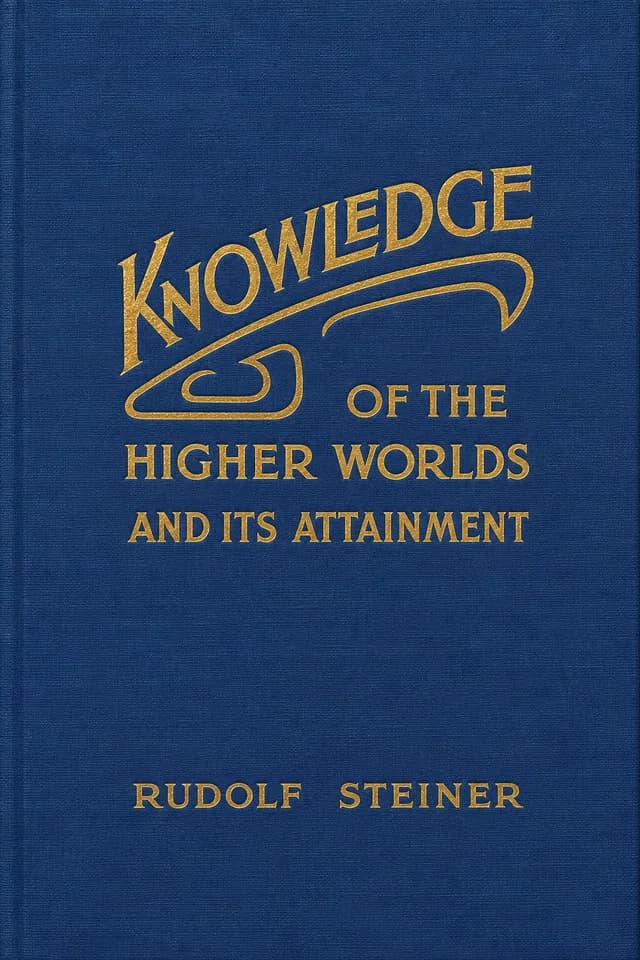
Knowledge of the Higher Worlds and Its Attainment
Reading note
The separately titled account draws on exact passages in the consulted Library edition.
Sources
See references (14)
- Initiation and Its Results, printed p. 87, Reader page 85Rudolf Steiner, Initiation and Its Results: A Sequel to The Way of Initiation, translated by Clifford Bax. First American Edition, 1909. Macoy Publishing and Masonic Supply Co., New York; Max Gysi, London. Claims of clairvoyant perception and subtle organs remain attributed. References identify the exact consulted Library edition.Read this page in Initiation and Its Results ↗Return to text ↑
- Initiation and Its Results, printed p. 88, Reader page 86Rudolf Steiner, Initiation and Its Results: A Sequel to The Way of Initiation, translated by Clifford Bax. First American Edition, 1909. Macoy Publishing and Masonic Supply Co., New York; Max Gysi, London. Claims of clairvoyant perception and subtle organs remain attributed. References identify the exact consulted Library edition.Read this page in Initiation and Its Results ↗Return to text ↑
- Initiation and Its Results, printed p. 86, Reader page 84Rudolf Steiner, Initiation and Its Results: A Sequel to The Way of Initiation, translated by Clifford Bax. First American Edition, 1909. Macoy Publishing and Masonic Supply Co., New York; Max Gysi, London. Claims of clairvoyant perception and subtle organs remain attributed. References identify the exact consulted Library edition.Read this page in Initiation and Its Results ↗Return to text ↑
- Initiation and Its Results, printed p. 90, Reader page 88Rudolf Steiner, Initiation and Its Results: A Sequel to The Way of Initiation, translated by Clifford Bax. First American Edition, 1909. Macoy Publishing and Masonic Supply Co., New York; Max Gysi, London. Claims of clairvoyant perception and subtle organs remain attributed. References identify the exact consulted Library edition.Read this page in Initiation and Its Results ↗Return to text ↑
- Initiation and Its Results, printed p. 91, Reader page 89Rudolf Steiner, Initiation and Its Results: A Sequel to The Way of Initiation, translated by Clifford Bax. First American Edition, 1909. Macoy Publishing and Masonic Supply Co., New York; Max Gysi, London. Claims of clairvoyant perception and subtle organs remain attributed. References identify the exact consulted Library edition.Read this page in Initiation and Its Results ↗Return to text ↑
- Initiation and Its Results, printed p. 92, Reader page 90Rudolf Steiner, Initiation and Its Results: A Sequel to The Way of Initiation, translated by Clifford Bax. First American Edition, 1909. Macoy Publishing and Masonic Supply Co., New York; Max Gysi, London. Claims of clairvoyant perception and subtle organs remain attributed. References identify the exact consulted Library edition.Read this page in Initiation and Its Results ↗Return to text ↑
- Gone West, printed p. 78, Reader page 91J. S. M. Ward, Gone West: Three Narratives of After-Death Experiences, third impression, William Rider & Son, London, 1920, as reproduced in Geoff Cutler’s December 2009 digital transcription. Ward’s introduction is distinct from the supplied 1974 foreword.Read this page in Gone West ↗Return to text ↑
- Gone West, printed p. 79, Reader page 92J. S. M. Ward, Gone West: Three Narratives of After-Death Experiences, third impression, William Rider & Son, London, 1920, as reproduced in Geoff Cutler’s December 2009 digital transcription. Ward’s introduction is distinct from the supplied 1974 foreword.Read this page in Gone West ↗Return to text ↑
- Gone West, printed p. 80, Reader page 93J. S. M. Ward, Gone West: Three Narratives of After-Death Experiences, third impression, William Rider & Son, London, 1920, as reproduced in Geoff Cutler’s December 2009 digital transcription. Ward’s introduction is distinct from the supplied 1974 foreword.Read this page in Gone West ↗Return to text ↑
- Gone West, printed p. 81, Reader page 94J. S. M. Ward, Gone West: Three Narratives of After-Death Experiences, third impression, William Rider & Son, London, 1920, as reproduced in Geoff Cutler’s December 2009 digital transcription. Ward’s introduction is distinct from the supplied 1974 foreword.Read this page in Gone West ↗Return to text ↑
- Rudolf Steiner Archive: GA 10 publication and translation history ↗Steiner Online Library, Rudolf Steiner Archive, GA 10 bibliography. Used only for publication relationships, not independent confirmation of spiritual claims.Return to text ↑
- Knowledge of the Higher Worlds and Its Attainment, Reader page 177Rudolf Steiner, Knowledge of the Higher Worlds and Its Attainment, authorized English translation by G. Metaxa, edited by Harry Collison, Anthroposophic Press, New York City. Exact Library edition IMJ-0513-E001. No publication year is visible on the inspected title page; the repository assigns 1932. Claims of supersensible perception remain attributed to Steiner.Read this page in Knowledge of the Higher Worlds and Its Attainment ↗Return to text ↑
- Knowledge of the Higher Worlds and Its Attainment, Reader page 178Rudolf Steiner, Knowledge of the Higher Worlds and Its Attainment, authorized English translation by G. Metaxa, edited by Harry Collison, Anthroposophic Press, New York City. Exact Library edition IMJ-0513-E001. No publication year is visible on the inspected title page; the repository assigns 1932. Claims of supersensible perception remain attributed to Steiner.Read this page in Knowledge of the Higher Worlds and Its Attainment ↗Return to text ↑
- Knowledge of the Higher Worlds and Its Attainment, Reader page 176Rudolf Steiner, Knowledge of the Higher Worlds and Its Attainment, authorized English translation by G. Metaxa, edited by Harry Collison, Anthroposophic Press, New York City. Exact Library edition IMJ-0513-E001. No publication year is visible on the inspected title page; the repository assigns 1932. Claims of supersensible perception remain attributed to Steiner.Read this page in Knowledge of the Higher Worlds and Its Attainment ↗Return to text ↑